
 E-Paper



Vice President Jagdeep Dhankhar stirs row with Article 142 'nuclear missile' for Judiciary remark. What is it?
Jagdeep Dhankhar condemned the Supreme Court's ruling that mandates a timeline for the President to give assent to state bills.

 Prefer HTon Google


Vice President Jagdeep Dhankhar on Thursday criticised the Supreme Court of India for a judgement setting a timeline for the President to sign the bills passed by the states. He was referring to the April 8 judgement in the state of Tamil Nadu versus the governor case, which was seen as a win for the states across India.
The above-mentioned judgement set up a timeline for the President to grant assent to the bills reserved for her consideration by the state Governors.
Questioning the judgement for setting a timeline for the President of India to sign bills passed by the states, Dhankhar called for accountability by the judiciary. He also described Article 142 of the Indian Constitution as, “nuclear missile against democratic forces available to the judiciary 24x7”.
What is Article 142?
Article 142 of the Indian constitution states that “The Supreme Court in the exercise of its jurisdiction may pass such decree or make such order as is necessary for doing complete justice in any cause or matter pending before it.”
This means that the article allows the top court discretionary powers to pass any order or give any judgment it thinks is necessary to ensure complete justice in any case before it. This is also known as the Supreme Court's "plenary power".
The article also allows the Supreme Court “all and every power” to make any order for the purpose of making a person appear in court, discovery or production of any documents in the court, or punish anyone for contempt of court.
What did Vice President Jagdeep Dhankhar say?
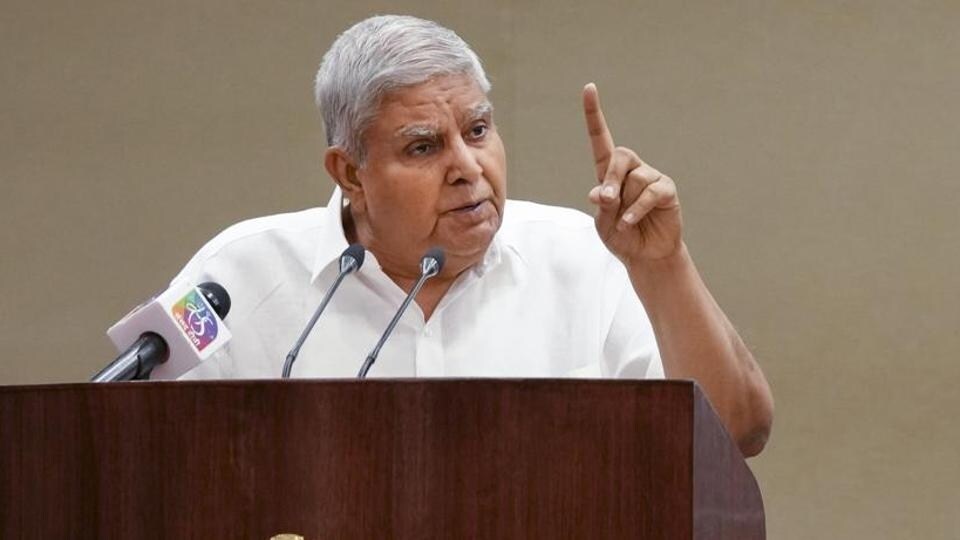
Vice President Jagdeep Dhankhar, while addressing the 6th batch of Rajya Sabha interns on Thursday, expressed concern over the Supreme Court acting like a “super Parliament”.
Calling for accountability for the judiciary, Dhankhar said, "So, we have judges who will legislate, who will perform executive functions, who will act as super Parliament and absolutely have no accountability because the law of the land does not apply to them.”
Referring to the April 8 judgement, Dhankar expressed discontent over a directive being issued to the President of India. He said, “There is a directive to the president by a recent judgment. Where are we heading? What is happening in the country? We have to be extremely sensitive. It is not a question of someone filing a review or not. We never bargained for democracy for this day. President being called upon to decide in a time-bound manner, and if not, becomes law.”
“We cannot have a situation where you direct the President of India and on what basis? The only right you have under the Constitution is to interpret the Constitution under Article 145(3),” he added.
One of the major concerns of Dhankhar was the overlapping of powers between the three pillars of democracy, which, he said, was not good. “Time has come when our three institutions -- legislature, judiciary and executive -- must blossom... Any incursion by one in the domain of the other poses a challenge, which is not good.”
Dhankhar also said that while the government is accountable to the Parliament and the people of India, if the Judiciary takes up executive powers, who will hold it accountable. “When the government is elected by people, the government is accountable to Parliament, the government is accountable to the people in election. There is a principle of accountability in operation. In Parliament, you can ask questions, critical questions, because the governance is by the executive. But if this executive governance is by judiciary, how do you ask questions?” he said.
Criticism to Jagdeep Dhankhar's remarks
Rajya Sabha member Kapil Sibal criticised Jagdeep Dhankhar for his remarks on the judiciary, calling them “non neutral” and “non constitutional”. On Friday, Sibal said, “If you give such statements it will look as if judiciary is being taught a lesson. It Is not neutral and not constitutional.”
He also said that he has never seen any Rajya Chairman making political statements of such nature. “"I respect him a lot but you said article 142 is nuclear missile material, how can you say this? Article 142 has given powers to the Supreme Court and it is given by the Constitution, it is not by the government it is the Constitution to do complete justice," he added.
Congress leader and MP Randeep Singh Surjewala also “respectfully” disagreed with Dhankhar’s statements and said that the Supreme Court ruling was necessary. In a post on X (formerly Twitter), Surjewala said, “The Supreme Court judgement putting Constitutional fetters on the power of Governors and President of India is timely, accurate, courageous and corrects the notion that ‘those holding high offices are above any fetters or imposition of checks and balances’ in exercise of their powers.”
“Judicial Independence is indeed a ‘nuclear missile’(to use Hon’ble VP’s words) to strike at injustice, arbitrariness, inequity, usurpation & assumption of power to subvert the Constitution and to defend the rights of people against arbitrary actions & decisions of those in power,” he added.
With PTI inputs.


