
 E-Paper


Follow the latest breaking news, major developments and agenda-setting stories from India and around the world with the newsdesk at Hindustan Times. Operating round the clock, the desk brings together experienced editors, reporters and correspondents to deliver fast, accurate and contextual reporting across subjects that influence public policy, governance, business, society and international affairs. The HT News Desk covers politics, elections, government policies, the economy, business and markets, science and technology, the environment, law and order, infrastructure, education, climate issues and geopolitics, while closely tracking developments across states, institutions and global capitals. The team also leads coverage of major breaking news events, policy announcements, court proceedings, natural disasters, public emergencies and significant international developments. Reports published by the newsdesk are based on information gathered from reporters on the ground, official statements, government agencies, court records, regulatory filings, recognised institutions and other authoritative sources. Stories undergo editorial scrutiny and verification processes to ensure accuracy, fairness and relevance, and are updated as events evolve and additional information becomes available. Whether covering a key political decision in New Delhi, an economic policy shift affecting millions, a landmark court ruling or a major global event, the HT News Desk aims to provide readers with reliable, fact-based journalism that delivers not only the latest developments but also the context and analysis needed to understand their wider implications.
West Bengal Police arrest man for selling cow urine as ‘cure for Covid-19’
Sheikh Mamud was produced before a court in Hooghly on Tuesday which remanded him to four-day judicial custody. BJP state unit president Dilip Ghosh, meanwhile, said that distributing cow urine is no crime.


The police in West Bengal’s Hooghly district have arrested a person for selling cow dung and cow urine, claiming that consuming these would help people get protection against coronavirus disease Covid-19.
The person, Sheikh Mamud, a man in his 50s, was booked under sections 295A (Deliberate and malicious acts, intended to outrage religious feelings) and 120B (punishment for criminal conspiracy) of the Indian Penal Code, along with provisions of the Drugs and Magic Remedies (Objectionable Advertisements) Act, 1954. All the sections are non-bailable.
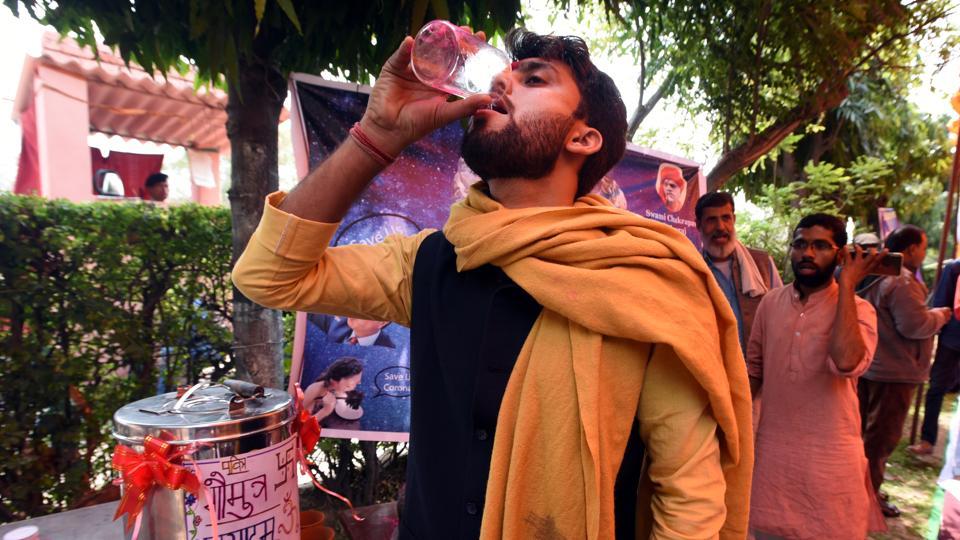
Following the police action, Mamud argued that he was inspired by Hindu Mahasabha’s event in New Delhi last week where supporters of the organisation consumed cow urine in public.
“The person has been arrested and we are investigating his motive,” said Humayun Kabir, commissioner of Chandannagar police commissionerate.
Mamud was produced before a court in Hooghly on Tuesday which remanded him to four-day judicial custody.
He was selling urine of Indian cow at Rs 500 per kg and that of Jersey cow at Rs 400 per kg at a roadside stall at Dankuni in Hooghly district, about 25 kilometres from Kolkata.
In a separate development, an FIR has been registered at Jorabagan police station on Tuesday against unknown persons for feeding cow urine to people. The case was registered in connection with a ‘gaumutra (cow urine) party’ organised by a local BJP leader, Narayan Chatterjee, who claimed on Monday that cow urine provided “100 per cent protection against novel coronavirus”.
A ‘home guard’ of the Kolkata Police, who lodged the complaint, said he was misled by the organisers, who passed of cow urine as “charanamrita” or ambrosia.
The police have registered the case under sections 269 (unlawfully or negligently spread the infection of any disease dangerous to life), 278 (making the atmosphere noxious to health) and 114 (abettor present when crime is committed) of the Indian Penal Code and started investigation.
Meanwhile, BJP’s state unit president Dilip Ghosh said that distributing cow urine was no crime. “Many of those who are opposing cow urine have consumed it secretly. I myself have consumed cow urine many times and will keep consuming it for its health benefits,” Ghosh, a Lok Sabha MP from Midnapore, said on Tuesday.


