
 E-Paper



What the election verdict means for 6 key leaders
An analysis of what the assembly election results imply for the top leaders in the Indian political landscape


Narendra Modi
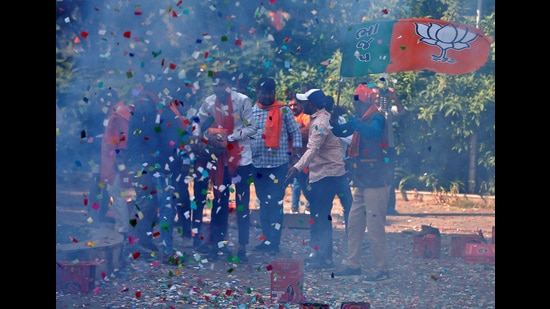
For 20 years, Narendra Modi has won Gujarat for the Bharatiya Janata Party. But in these elections, Modi not only beat his own record but also led the BJP to the second highest vote share and highest seat tally in Gujarat’s electoral history. Modi owned the campaign, addressing over 30 rallies and doing two roadshows. He made the elections about his personal prestige and the state’s identity, and single-handedly offset all the local weaknesses of the party state unit. He showed Gujarat that he remains deeply invested in the state that made him a leader; he showed to the rest of India that his national hegemony comes from his invincible local roots. If Gujarat 2012 catapulted Modi to the Centre, Gujarat 2022 allows Modi to walk into the final full year of his second term unchallenged and looming larger than ever in national imagination.
Also Read | Gujarat polls triumph testament to BJP’s efforts, all-round support: Modi
Amit Shah
In 1987, Amit Shah first met Narendra Modi and assisted him in managing local municipal elections in Gujarat for the BJP. Thirty-five years later, Shah brought his power as home minister, his stature as the BJP’s number 2, his identity as Gujarati leader with a pulse over the state’s Hindu sensibility, his skills as an election micromanager par excellence, and his role of as a member of Parliament from the state’s capital to shepherd the most successful BJP campaign in history. The win reinforces Shah’s reputation as an indispensable leader in the BJP’s electoral architecture and adds to his political capital, in terms of both handling Gujarat affairs and influencing policy at the Centre.
Rahul Gandhi
Rahul Gandhi abdicated his campaign responsibilities, and decided that an abstract ideological battle delinked from elections was the way to counter the BJP. Reality came back to bite him midway through the Bharat Jodo Yatra, as Gujarat’s voters meted out the most severe punishment for the Congress ever in its history in the state. The party not only failed to live up to the 2017 mandate and perform its role as an effective Opposition, but did not even campaigning effectively. The win in Himachal may bring the Congress some cheer, but the victory was largely a function of local factors, where Gandhi was irrelevant. Thursday appeared to suggest once again that the Nehru-Gandhi scion’s erratic politics leaves him ill-equipped to take on the BJP in 2024.
Arvind Kejriwal
In 10 years, Arvind Kejriwal has taken a party born out of a movement in Delhi to becoming the city’s governing outfit to running a full state government in Punjab to attaining the status of a national party. This is no mean achievement. Winning over 10% of the vote share in Gujarat, and helping making the campaign more competitive even if the outcome didn’t reflect the competitiveness, will add some heft to Kejriwal’s weight in the national political theatre -- but not as much as he would have liked (and definitely not as much as is needed for a party to become the epicentre of a united Opposition). The Gujarat results also show that AAP has a long way to go. Its ideological vacillation alienates voters; its Delhi model can be a talking point but doesn’t win it a critical mass of voters; and there are clear limits of the appeal of its leadership. How Kejriwal deals with the weaknesses, while building on the nascent electoral strength, will determine his and AAP’s future over the next decade.
Mallikarjun Kharge
The first set of elections held under his charge as Congress president will leave a weak Mallikarjun Kharge weaker in the party structure. Hobbled with an image problem, of being seen as propped up the Nehru-Gandhi family, Kharge displayed limited imagination in the Gujarat campaign. The Himachal win does indeed give Kharge a third state for the party to rule over, but his test now will be security the party flock, managing the inevitable tensions over leadership in the state, and sustaining the government for a full five years. Kharge’s next big test will be in his home state of Karnataka where the Congress has the ingredients for a victory. Whether he can actually translate this into a win will determine whether he can exercise any autonomy as party president or remain a mere figurehead.
JP Nadda
For the BJP president, Thursday was a bittersweet moment. While it was under his presidency that the party has won a historic verdict in Gujarat, in his home state, Nadda was unable to deliver a win. To be sure, the incumbent was at a disadvantage in a state that has shown a pattern of alternating between the two parties in the fray. But despite campaigning hard, Nadda was unable to overcome the disadvantages posed by a lacklustre CM and anti-incumbency. His inability to manage internal feuds will also be a source of disappointment. Yet, Nadda’s equations with Modi and Shah, and his amicable political style of functioning and networks across the ideological parivar hold him in good stead and will, in all likelihood, give him another term as the party president.


