
Sign in

Why did India axe Justin Trudeau's diplomats?

India had sought parity in the strength of Canada's diplomatic presence by bringing down the number of those stationed in the country from 62 to 21.

Updated on: Oct 21, 2023, 19:21:52 IST
Share
Share via
  • facebook
  • twitter
  • linkedin
  • whatsapp
Copy link
  • copy link

Canada has withdrawn 41 of its diplomats from India, a day before the deadline set by New Delhi, failing which they were liable to lose diplomatic immunity. The action comes after India had sought parity in the strength of the North American country's diplomatic presence by bringing down the number of those stationed in the country from 62 to 21.
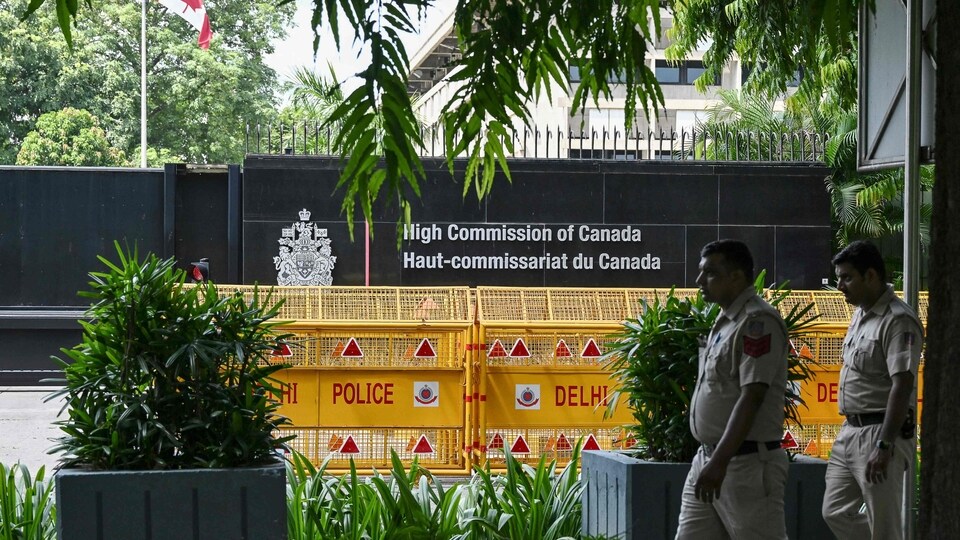
Security personnel stand guard in front of the High Commission of Canada in New Delhi. (AFP)

Canadian prime minister Justin Trudeau slammed the move, calling it a violation of the ‘Vienna Convention governing diplomacy” and said New Delhi’s actions will also impact “”millions of Canadians who trace their origins to the Indian subcontinent.”

Why did India axe Canadian diplomats?

India has 21 diplomats in consulates and embassies in Canada. On the other hand, Canada has three consulates in India. It has five trade offices and state government offices and none of them have been asked to be removed.

In its statement, the ministry of external affairs had said,"We have seen the Statement by the Government of Canada on October 19 regarding Canadian diplomatic presence in India. The state of our bilateral relations, the much higher number of Canadian diplomats in India, and their continued interference in our internal affairs warrant a parity in mutual diplomatic presence in New Delhi and Ottawa".

HT has learnt that some of the withdrawn diplomats were found to be involved in activities incompatible with the diplomatic status. Some diplomats were liasoning directly with political parties' leadership. It is alleged that Canada had roped in its diplomats with certain Indian politicians to gather political intelligence.

India had asked Pakistan for diplomatic parity way back in 1994 after its diplomats were found to be ‘exceeding their brief’.

What next for India?

India has been asking Canada to stop pro-Khalistani activities on its soil. New Delhi has no interesting in either breaking off the bilateral relationship or escalating the entire issue.

  • Shishir Gupta
    ABOUT THE AUTHOR
    Shishir Gupta

    Shishir Gupta is Executive Editor at Hindustan Times and one of India's top journalists covering national security, strategic affairs, foreign policy and geopolitics. Over the past three decades, he has extensively reported on India's military, diplomatic and security landscape, covering every major conflict and national security challenge, from the 1999 Kargil War and the 2020 East Ladakh standoff to Operation Sindoor in 2025. He has also covered major terror attacks, including the IC-814 hijacking, the 26/11 Mumbai attacks and the 2025 Pahalgam terror strike, along with numerous Pakistan-backed terrorist incidents in the Kashmir Valley and across India. He has reported on national and state elections for more than three decades. A recognised authority on strategic affairs, Gupta has covered India's nuclear programme since the Pokhran-II (Shakti series) tests in May 1998 and has written extensively on global nuclear issues, Indian diplomacy and the country's expanding global outreach. He has also reported widely on international conflicts and terrorism, with a special focus on the Indian subcontinent. Gupta has interviewed Prime Minister Narendra Modi more than four times, including Modi's first interview with the print media after becoming Prime Minister in May 2014. His other interviews include three with the Dalai Lama, as well as conversations with Benjamin Netanyahu, Amit Shah, Yogi Adityanath, S. Jaishankar, Nirmala Sitharaman and Piyush Goyal. He is the author of Indian Mujahideen: The Enemy Within (Hachette, 2011) and Himalayan Face-off: Chinese Assertion and Indian Riposte (Hachette, 2014). He was awarded the Chevening-Wolfson Joint Scholarship at Wolfson College, University of Cambridge, UK, in 1998 and participated in the International Visitor Leadership Program (IVLP) of the US State Department in 2006. He received the Ben Gurion Prize from Israel in 2011 and the K. Subrahmanyam Prize for Strategic Studies in 2015 from the Manohar Parrikar Institute for Defence Studies and Analyses (MP-IDSA). Since 2024, he has hosted Point Blank, Hindustan Times' weekly YouTube show on global geopolitics.Read More