
 E-Paper



Why Opposition leaders don’t think a pan-India alliance is best bet against BJP
With 20 months to go for the Lok Sabha elections, Opposition leaders think that parties should contest independently in regions where they are strong but be prepared for a post-poll alliance.

 Prefer HTon Google


New Delhi: With around 20 months to go for the Lok Sabha elections, the thinking right now among opposition parties is to contest independently in regions where they are strong without force-fitting a wide pan-India alliance, but be prepared and open for a post-poll alliance.
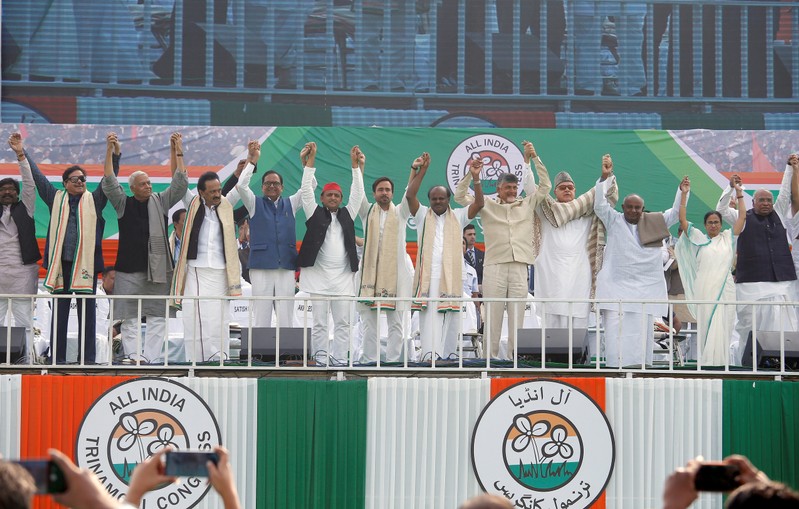
According to leaders of Opposition parties, barring states where there is already an alliance – Maharashtra, Bihar, Tamil Nadu and Jharkhand – the extent of the understanding between different players should be for the dominant one in the region to be supported by the others to ensure that the contest remains bipolar.
To be sure, this thinking could well be a result of the inability of Opposition parties to find common ground – especially on the issue of leadership – as well as the aspirations of their local units that often see them contesting against each other in assembly and panchayat elections.
“Prime Minister Narendra Modi’s BJP can be defeated in 2024. He is a PM who has failed to deliver multiple promises in 2022,” said Trinamool Congress (TMC) leader Derek O’Brien. “Our best chance is to take him on in individual states with strong leaders. In about five-six states, the contest is directly between the Congress and the BJP. In those areas, the Congress has to win matches.”
“There is a need for alliance in a few states where the opposition parties have pre-existing pacts. There is no need for any all-India pre-poll alliance. Modi versus a single face in pan-India will only help the BJP,” added the TMC leader. The statement is an implicit acknowledgement of Modi’s standing as the tallest and most popular political leader in the country today.
A senior Congress strategist who asked not to be named pointed out that the UPA government between 2004 and 2014 was a post-poll coalition. He added that preliminary talks between various parties and within the Congress too have started for the 2024 election and claimed that the overwhelming majority is in favour of a post-poll pact.
Defeating the BJP will be a Herculean task for the Opposition camp, which is bogged down by several problems including an exodus in some parties, in-fighting in others, and the sheer opportunity available for one party to grow at the expense of the other instead of taking on the BJP. In Gujarat, for instance, most analysts expect the Aam Aadmi Party (AAP) to gain at the expense of the Congress in the coming assembly elections. Opposition leaders also pointed to this year’s Goa elections, where three opposition parties – the Congress, Trinamool and AAP – fought individually against the incumbent BJP.
“We are very clear that there won’t be a pre-poll alliance in every state; only in states where we already have pacts with regional parties. We have discussed this issue internally and our leaders are clear about it. Depending on the result, the opposition parties will have to decide how to work together,” added the Congress strategist.
In Tamil Nadu, the Congress and the Left are in alliance with the Dravida Munnetra Kazhagam (DMK), while in Bihar, chief minister Nitish Kumar’s dramatic exit from the National Democratic Alliance (NDA) has strengthened the opposition coalition that consists of the Rashtriya Janata Dal (RJD), the Janata Dal-United (JDU), the Congress and Left parties. In Maharashtra, the Congress has its most trusted ally, the Nationalist Congress Party (NCP), and a section of the Shiv Sena. Jharkhand is ruled by a coalition of the Jharkhand Mukti Morcha (JMM), Congress and other parties.
CPI(M) leader Sitaram Yechury also favours a post-poll pact. He has underlined that in the past, coalitions have mostly come together after polls. The Left has usually provided outside support to the ruling combine in some of those instances, as it did to the UPA-I government before falling out with the Congress over the Indo-US nuclear deal.


