
Sign in

Yuan Wang 6 to monitor Indian missile or Chinese satellite launches?

Unlike its sister ship Yuan Wang 5, which docked at the Chinese leased port of Hambantota in Sri Lanka in August, the Shanghai based Yuan Wang 6 is not slated to enter into any Sri Lankan port but is presently out in open sea south of Lombok Straits.

Published on: Nov 5, 2022, 13:26:39 IST
Share
Share via
  • facebook
  • twitter
  • linkedin
  • whatsapp
Copy link
  • copy link

Although the Indian Navy is monitoring the movement of Chinese satellite and ballistic missile tracking ship Yuan Wang 6 as part of its maritime domain awareness, the vessel is not scheduled to enter into any sea port in Sri Lanka. The ship entered the Indian Ocean region on November 4 via Lombok Straits, which is some 3500 kilometres away from Port Blair.
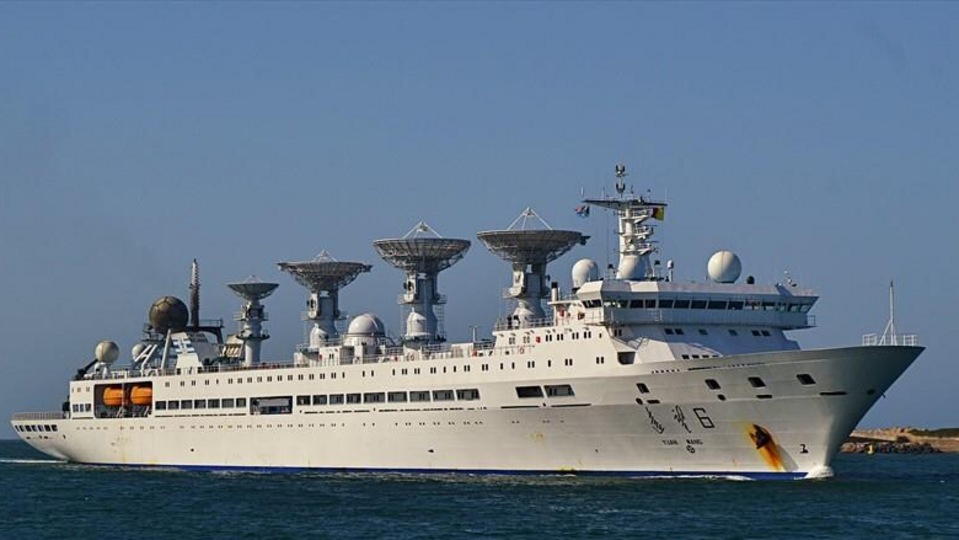
The Chinese satellite and ballistic missile tracking ship Yuan Wang 6 is at present south of Lombok Straits, which is over 3500 km away from Port Blair.

While media reports on the basis of twitter feed reported that the ship was out to monitor scheduled ballistic missile launches off the coast of A P J Kalam Island this month, the national security planners are not unduly worried as China has the capability to monitor Indian missile launches through satellite.

According to South Block officials, the strategic support ship was actually in the Indian Ocean to monitor Chinese satellite launches planned on November 12 and at the end of the month. Unlike its sister ship Yuan Wang 5, which docked at the Chinese leased port of Hambantota in Sri Lanka in August, the Yuan Wang 6 is not slated to enter into any Sri Lankan port but is out in open sea south of Lombok Straits.

Fact is that the Chinese strategic vessels are increasingly surveying the Indian Ocean Region as they explore alternative routes to Malacca Straits by doing ocean bed mapping. The Chinese vessels can enter the Indian Ocean Region only through Malacca, Sunda, Lombok, Ombai or Vetar straits, all of which are partly or fully controlled by Indonesia.

Beijing is not only exploring sea routes in the Indian Ocean to reach the Chinese base in Djibouti on the east coast of Africa far removed from India but also through the Arctic Circle to reach European ports like Hamburg, where Chinese company COSCO has bought over 24 per cent of equity.

India, on its part, has made it known to its neighbours particularly Sri Lanka about the risks of allowing Chinese military vessels to dock at their port for refuelling or rest and recreation purposes. It has also asked these countries not to use their tankers to refuel Chinese warships on the high seas as it would have an impact on bilateral ties with India.

  • Shishir Gupta
    ABOUT THE AUTHOR
    Shishir Gupta

    Shishir Gupta is Executive Editor at Hindustan Times and one of India's top journalists covering national security, strategic affairs, foreign policy and geopolitics. Over the past three decades, he has extensively reported on India's military, diplomatic and security landscape, covering every major conflict and national security challenge, from the 1999 Kargil War and the 2020 East Ladakh standoff to Operation Sindoor in 2025. He has also covered major terror attacks, including the IC-814 hijacking, the 26/11 Mumbai attacks and the 2025 Pahalgam terror strike, along with numerous Pakistan-backed terrorist incidents in the Kashmir Valley and across India. He has reported on national and state elections for more than three decades. A recognised authority on strategic affairs, Gupta has covered India's nuclear programme since the Pokhran-II (Shakti series) tests in May 1998 and has written extensively on global nuclear issues, Indian diplomacy and the country's expanding global outreach. He has also reported widely on international conflicts and terrorism, with a special focus on the Indian subcontinent. Gupta has interviewed Prime Minister Narendra Modi more than four times, including Modi's first interview with the print media after becoming Prime Minister in May 2014. His other interviews include three with the Dalai Lama, as well as conversations with Benjamin Netanyahu, Amit Shah, Yogi Adityanath, S. Jaishankar, Nirmala Sitharaman and Piyush Goyal. He is the author of Indian Mujahideen: The Enemy Within (Hachette, 2011) and Himalayan Face-off: Chinese Assertion and Indian Riposte (Hachette, 2014). He was awarded the Chevening-Wolfson Joint Scholarship at Wolfson College, University of Cambridge, UK, in 1998 and participated in the International Visitor Leadership Program (IVLP) of the US State Department in 2006. He received the Ben Gurion Prize from Israel in 2011 and the K. Subrahmanyam Prize for Strategic Studies in 2015 from the Manohar Parrikar Institute for Defence Studies and Analyses (MP-IDSA). Since 2024, he has hosted Point Blank, Hindustan Times' weekly YouTube show on global geopolitics.Read More

Get the latest India News, breaking headlines and real-time updates from across the country. Stay informed about politics, government policies, crime, weather and major national developments.