
 E-Paper



Aadhaar to be linked to all social sector schemes from April 2015
In order to extend the use of Aadhaar number to various social welfare schemes, government has asked the Unique Identification Authority and the National Population Register to complete the enrolment of the entire population by March.


To link unique identification or Aadhaar number with disbursement of welfare funds from the next financial year, the Prime Minister’s Office has asked the Unique Identification Authority of India (UIDAI) and National Population Register (NPR) to advance enrollment of all eligible residents from June to March 2015.
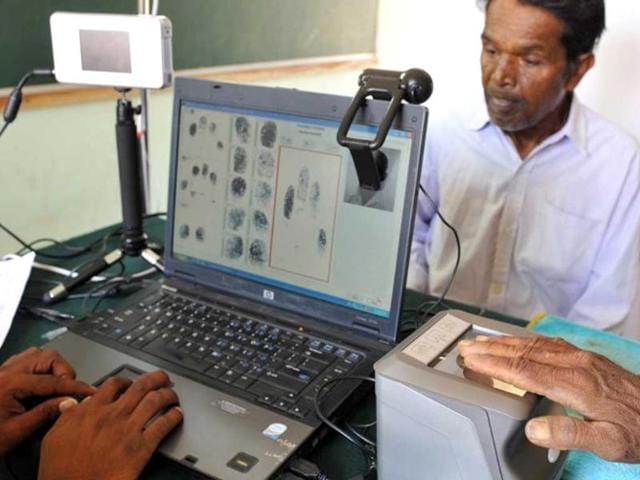
The move is part of the bigger government agenda to plug leakages in the social sector schemes aimed at better fiscal management. It is also aimed at incorporating the concept of Aadhaar based direct benefit transfer for all government expenditure worth Rs 3,00,000 crore every year from the next fiscal, which would bring paradigm shift in administering of the poorly managed government schemes.
A Planning Commission study in 2012 had shown that Aadhaar can save public money of Rs 50,000 crore in three years once all 1.2 crore eligible residents were enrolled with an annual rate of return of 52% in the investment. The study had said that Aadhaar would result in substantial benefits if it was integrated with government schemes such as Public Distribution System, Mahatma Gandhi National Rural Employment Guarantee Act and disbursement on fertilizer and cooking gas subsidies.
Fraud or duplication is not possible under the Aadhaar system where authentication of one’s number and demographic details are possible by a click of a mouse. “It is anytime, anywhere online authentication system that enables checking fraud in less than 10 seconds,” a UIDAI official said.
The government sources said the Prime Minister Narendra Modi’s decision was recently announced at a meeting of the PMO officials with UIDAI, NPR and other ministry officials. Directions were also issued to speed up seeding of Aadhaar number in the bank accounts of existing beneficiaries under different government schemes, sources said.
“Linking Aadhaar with schemes will help us in linking fund flow to the States and the Central ministries with their outcome based performance as outlined by the Prime Minister at a meeting with all secretaries of the government of India,” a senior government functionary said, adding that Aadhaar will make correct assessment possible.
The UIDAI has generated Aadhaar number for 700 million residents and have covered 90% population in nine states including Andhra Pradesh, Kerala, Delhi and Himachal Pradesh. About 16 states have an average coverage of more than 70%. In four states assigned to UIDAI recently --- Uttar Pradesh, Bihar, Uttarakhand and Chhattisgarh --- about 26% of the target population has been enrolled.
“We are enrolling over a million people every day and would be enhancing our capacity to enroll 1.5 million people a day shortly. We are confident to meet the new target set up by the Prime Minister’s Office,” said a senior UIDAI official.
The government has provided fresh impetus to Aadhaar by linking it to various schemes and making Aadhaar based attendance in government offices mandatory. The real impact of Aadhaar would be visible from the next financial year when the government plans to link it with all social sector schemes.


