
 E-Paper



Kashmir militants have pledged allegiance to us, says Islamic State
The head of a regional affiliate of the Islamic State has said militants in Kashmir have pledged allegiance to the group, providing it a “big opportunity” to expand its co-called caliphate to the area.

 Prefer HTon Google


The head of a regional affiliate of the Islamic State has said militants in Kashmir have pledged allegiance to the group, providing it a “big opportunity” to expand its co-called caliphate to the area.

Hafiz Saeed Khan – who was named the IS chief for Khurasan, the historic name for the area encompassing Afghanistan, Pakistan and parts of India, almost a year ago – made the claim during an interview to the group’s online magazine Dabiq.
Khan, who has reportedly survived two drone strikes, including one earlier this month, was responding to a question on whether the IS is “capable of expanding to Kashmir to fight the cow-worshipping Hindus” and jihadis from other groups such as the Lashkar-e-Taiba that are allied to Pakistan.
He accused Pakistan’s army and intelligence set-up of exploiting “various ‘Islamic’ organisations on the issue of Kashmir for their despicable personal interests” and contended there was no one to save the Kashmiri people “from the quagmire into which they were thrown”.
“Because of this, many of the people of Kashmir and the soldiers of the factions left and made hijrah to Wilāyat Khurāsān...Thus, there’s a big opportunity, with Allah’s permission, to establish the religion of Allah there and for the Islamic State to expand to it,” Khan said.
Read: IS announces expansion into AfPak, parts of India
Without giving details, Khan said the IS has made “specific arrangements” in Kashmir and “the Muslims will soon hear pleasant news about the Khilāfah’s expansion to those lands”.
He said “apostate factions and agents of...Pakistan” such as LeT “do not have control over any territory in the regions of Kashmir, because they proceed in accordance with the orders of the Pakistani intelligence”.
Khan made repeated derogatory references to the Pakistani Taliban, jihadi groups such as the LeT and the security establishment in Islamabad, which has for long been accused of using militants for a proxy war against India.
The Pakistani intelligence, he said, “direct the work” of groups like the LeT, “pushing them forward when they wish and pulling them back when they wish”.
“In reality, we’ve seen before how (Pakistan’s) army and intelligence, would exploit the various ‘Islamic’ organisations on the issue of Kashmir for their despicable personal interests. They also exploited the zeal of the people of Kashmir for the sake of their own interests, not out of any concern for the affairs of the Muslims, nor for the sake of establishing Allah’s law in the land,” Khan said.
He added that “when the...(preservation of their interests) required that they ceasefire, withdraw, and retreat, the intelligence agencies left the people of Kashmir in the middle of the road and in the worst of situations”.
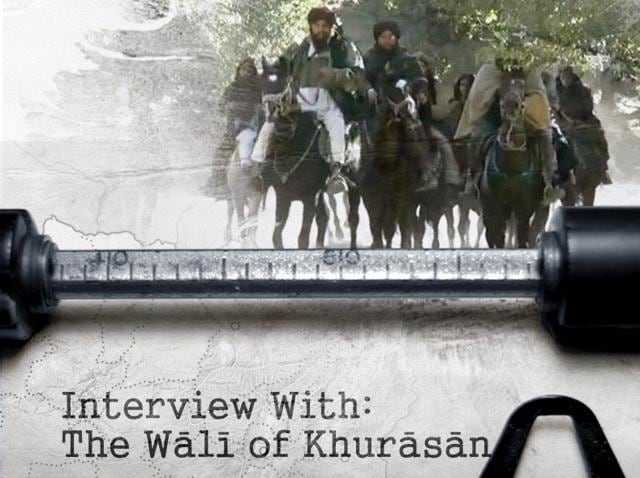
Khan said the IS had achieved control in the Khurasan region, “but not on the same level” as Iraq and Syria. He described Pakistan and Afghanistan as enemies of the “caliphate”.
He described Afghan Taliban chief Akhtar Mansoor as a person with “strong and deep ties with Pakistani intelligence” who lived with his associates “in the most important cities of Pakistan, such as Islamabad, Peshawar, and Quetta”.
Mansoor’s “advisory council contains members from the Pakistani intelligence”, he added. The Pakistani Taliban faction led by Mullah Fazlullah had pledged allegiance to Mansoor and was thus indirectly acting on the orders of the Pakistani intelligence, he said.
Khan also expressed his anger at the Pakistani media, claiming it acts as an agent of Jews and Christians and accuses IS fighters “of being agents of the Indian intelligence”.
The IS formed its affiliate for Khurasan months after Al Qaeda announced the formation of a new wing for the Indian subcontinent. Both Al Qaeda and IS have launched a push to gain a foothold among Pakistan’s numerous terror groups.



