
Rs 13 cr seized: Use of black money rampant in TN, Kerala ahead of polls
Use of black money rampant in Tamil Nadu, Kerala as EC finds itself bridled by law to act against suspects despite proof
During the 2011 assembly polls, the Election Commission had claimed before the Madras high court that a senior DMK leader was involved in distributing cash in police jeeps and ambulances and hence it needed to search his residence.
The DMK got a stay against the EC warrant, arguing that it will provide ammunition to the Opposition and thereby disturb the electoral level-playing field. And that was enough to tie the hands of the EC.
Five years later, not much has changed in the poll-bound states as the EC does not have sufficient powers to curb the use of black money in India’s electoral politics.
A similar incident cropped up recently in Assam, where state minister Rockybul Hussain is under the EC lens for unaccounted cash. But the poll watchdog is being accused by the Congress of acting at the “behest” of the BJP-led central government.
“We cannot debar a candidate from contesting even if we have credible evidence of black money being used by him or her,” says a senior EC official not wanting to be named. “Action can be taken only under the Income Tax Act, which is a long process and has no bearing on the person’s electoral prospects.”
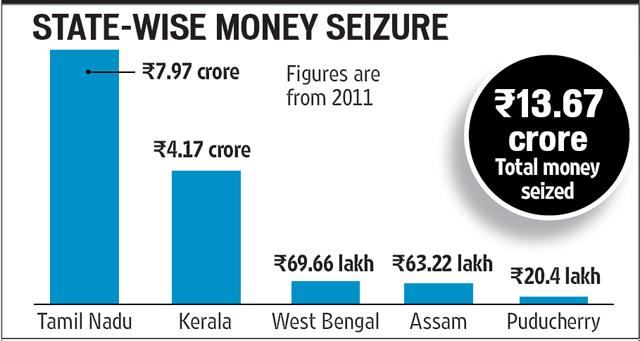
In the fortnight since the latest polls were announced, the EC has seized Rs 13.4 crore unaccounted cash with more than half of it coming from Tamil Nadu. Rs 4.7 crore has been seized in Kerala and smaller amounts from political activists in Assam, West Bengal and Puducherry.
In 2011, the EC had seized Rs 60 crore in Tamil Nadu alone, where several voters woke up to find a ` 500 note tucked in their morning newspaper. This was apart from the shirts, dhotis and electrical appliances that parties doled out to voters in Tamil Nadu and Kerala.
The EC had admitted in an affidavit before the Madras high court that the cash seized was just 10% of the black money used in the polls.
“We estimate that the use of black money would be much more than last time, especially in states where the contest is close,” says the EC functionary, adding that the Central Board of Direct Taxes (CBDT) and the Financial Intelligence Unit (FIU) — agencies under the Union finance ministry — have been asked to provide inputs to the EC appointed expenditure observers.
Former chief election commissioner TS Krisnamurthy says the use of black money in poll-bound states, especially Tamil Nadu, has been “unprecedented”. “More than what the EC is doing is needed,” he adds.
The impact of black money in polls can be gauged from reports of the Association for Democratic Reforms, which showed that richer the candidate, higher is the possibility of winning. An ADR report published recently said the average asset of the winning candidates has more than doubled in the last five years.
ABOUT THE AUTHORChetan ChauhanChetan Chauhan is the National Affairs Editor looking into all aspects of news and features from across India. A Chevening scholar with over three decades of experience in reporting and news management, Chetan has extensively covered all important aspects of the social sector, political economy, environment and climate change nationally and internationally. He did a journalism course at the Reuters Institute of Journalism in Oxford and Digital Media training at Nanyang Technological University in Singapore. He started as a reporter with The Statesman in 1996 and joined the Hindustan Times in 2000 in the metro bureau covering environment, crime and Delhi politics. He covered hot local news, from the Jessica Lal murder case to the rebellion of Delhi Congress MLAs against then Chief Minister Sheila Dikshit, to the replacement of toxic vehicle fuel with cleaner compressed natural gas (CNG) in the national capital. Some of his stories on air pollution became part of the Supreme Court’s landmark MC Mehta versus Government of India case in the National Capital Region (NCR), forcing the government to take corrective measures. As part of the national political bureau since 2004, he covered important central sectors such as environment, education, social justice, labour, rural development, water resources, renewable energy, agriculture, broadcasting and the Planning Commission for more than a decade producing several exclusive and investigative breaking stories. His specialisation is the environment, having covered at least a dozen United Nations global conferences on climate change, biodiversity and wildlife including climate summits in Paris, Copenhagen and Bali. He also covered India’s two five-year plans ---11th and 12th and reported on drafting and execution of right based laws such as Right to Education, Right to Information and rural job guarantee law, MG-NREGA, now being introduced in new format as VG-RAM-G Act. He has in-depth knowledge of social sector issues. He was one of the first to report on tigers vanishing from Sariska and Panna wildlife reserves in 2004 and 2008, respectively, leading to the setting up of the National Tiger Conservation Authority (NTCA) and the introduction of stringent penal provisions for poaching. He has written extensively on the rising human-animal conflict in India and the degradation of India’s biodiversity hotspots because of mining and other activities. Since 2004, Chetan has covered Parliament comprehensively and participated in training on the nuanced coverage of Parliament proceedings. He has travelled extensively across India to cover national and provincial elections since 1998, especially in the Hindi heartland states, considered India’s road to power. He writes a regular column for Hindustan Times, Ecostani, on important national politics, economy, Himalayan ecology and environmental issues. His other responsibilities include providing inputs for edits and edit page articles for the publication, apart from managing news flow from across India.Read More

E-Paper


