E-Paper



A little risk, a little scrabble: What it takes to be a board-game designer

 Prefer HTon Google


‘What kind of response can I call forth in people? What dilemmas do I want to leave them with? These are questions a good game designer asks,’ says Venkat Iyer.
The world of board-game design in India is populated by the self-taught.
Many keep their day jobs as product designers, architects, business analysts or HR consultants. Some hone their skill on virtual learning platforms such as Udemy. “You have to have spent hours playing and studying niche games too, in order to be able to do this,” says Venkat Iyer, co-founder of Luma World.
Anyone who is curious and analytical could potentially be a board-game designer, says Kiran Kulkarni. The co-founder of Tacit Games is an architect and industrial designer from Bengaluru who researched ludology and mathematical models in his spare time, and kept a log of possible ideas, before he launched his company in 2020, and then their first game, Hampi and the Sun Jewel, in 2021.
“You have to love the art of it all,” he says. “Then comes the skill to detail your initial concept, flesh out characters and rules, layer components, explore possible biases.”
A solid understanding of math and statistics helps build a sturdy foundation, says Sidhant Chand, who conceived and designed games such as Chai Garam for Mozaic and Lakshadweep for Luma World, and now runs his own company, Zenwood Games.
Chand, 30, grew up in Bhubaneswar, moved to Mumbai for a career as an HR consultant; designed games part-time during the pandemic, to indulge a passion; then quit his job and struck out on his own, in 2022.
He started small, releasing card games such as the travel-themed Parikrama and the battle-themed Fortify. He has now stepped things up, with plans for an elaborate crowdfunded board game called Tycoon: India (1981), due for launch in April.

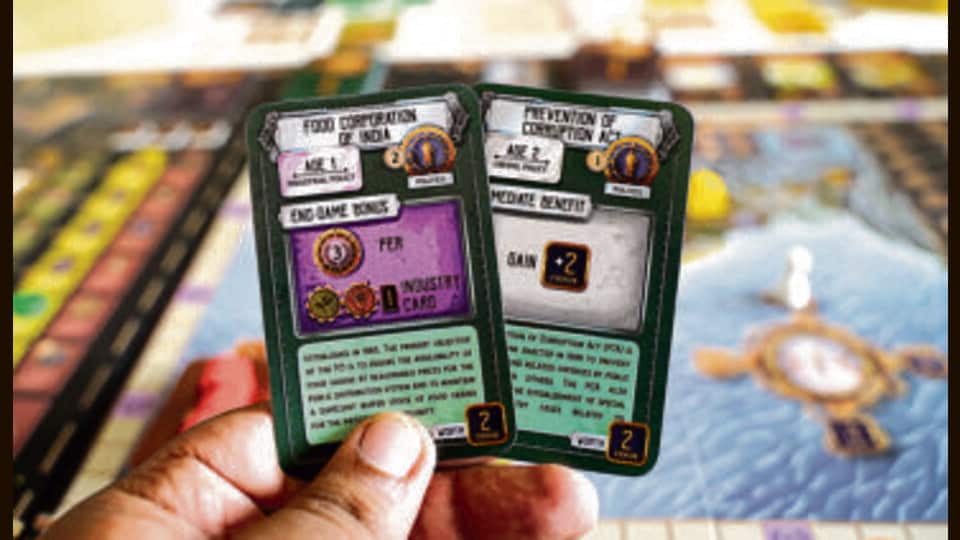
The one-to-four-player game, set in 1980s India plays out over seven rounds. Each player must pick industrial sectors from among a fixed set — minerals, fuels, agriculture, power, transport, finance — and then find ways to dominate in them, accumulate wealth, curry favour with the government, align with five-year policies, invest in national projects, influence government decisions, and gain the support of corporate boards.
The player with the most wealth, influence and favour at the end of the seventh round, is the tycoon.
The game is a good example of what a fruitful incubation period looks like in the industry. Chand has been playing versions of it since 2012. There was even a leaderboard in his college hostel corridor, he says laughing, as batchmates kept track of their wins.
By the time he was ready to build it for professional launch, his idea had been tested over and over, and refined by feedback. Its crowdfunding page on Kickstarter offers rich detail and videos of engaging gameplay, where it has generated immense interest. Tycoon met its $10,000 goal in 12 hours, and raised over $33,000 in a month. Another campaign, on the platform BackerKit, has raised $18,000 since November, and ends on January 15.
“The 1980s and ’90s were such a significant time,” says Chand. “I felt that it was a story that younger generations needed to know, while having fun with it. There is now talk of Atmanirbhar Bharat and India being a superpower, but how did we really get here? It was via the 1980s and ’90s, when there was politics and change, corporate greed, and a country full of people waiting for opportunities.”
That’s the kind of emotional connection that drives a board game, says Iyer of Luma World. “What kind of response can I call forth in people? What dilemmas do I want to leave them with? These are questions that a good game designer asks at every step,” he adds.
Another core skill: patience. Board-game design tends to be collaborative and long-winded. “If you’re too attached to your design, and don’t take in player feedback or criticism, you lose the plot.” A willingness to redraw the board, he says, is crucial.