
 E-Paper



Inside the '19th-century Ramgarh bungalow where Rabindranath Tagore wrote Nobel Prize-winning Gitanjali'

 Prefer HTon Google


Tucked away in the Kumaon hills is a quiet piece of literary history — The Writers’ Bungalow, where Nobel laureate 'Rabindranath Tagore stayed'. Take a tour.
Forget the crowded mall road and packed lakeside hotels of Nainital. If you want history with your mountain holiday, the hills of Kumaon have a secret worth booking. Also read | Magical night safaris, sunset boat rides, regal thalis: 2 unforgettable days of pure luxury in Mewar's private forest
More than a stay, a piece of literary history
On September 10, Neemrana Hotels shared an Instagram post that would stop every bibliophile mid-scroll: "Wake up in the 19th-century Writers’ Bungalow at Ramgarh, where Rabindranath Tagore stayed in the early 1900s while writing Gitanjali, the work that got him the Nobel Prize in Literature!"
It is not a metaphor. The same stone-and-wood bungalow where Tagore stayed, walked, and wrote some of the verses that would win India its first Nobel Prize in Literature in 1913 is a boutique homestay.
Located about 35 km from Nainital, Ramgarh has long been called the fruit bowl of Kumaon. In Tagore's time, it was pure isolation — pine forests, apple orchards, and snow peaks. That quiet is exactly what Neemrana has tried to preserve.
The property is a cluster of six heritage cottages, but the soul of it is The Writers’ Bungalow, built in 1860. Unlike restored heritage hotels, Neemrana has kept the bones intact — whitewashed brick, exposed beams, slate floors, wooden rafters, bay windows — and layered it with thoughtful design. The website gives a detailed look at The Writers’ Bungalow's two signature rooms.
The Bird suite: light, air and quiet
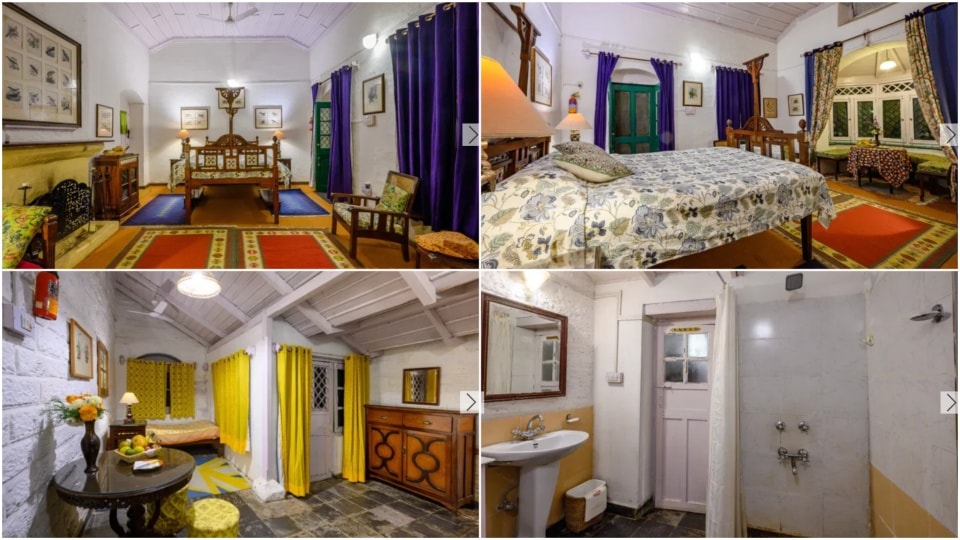
The Bird suite is tranquillity by design. Neemrana's own description says it best: “The sun rises over the high ranges and enters the Bird suite from its bay window.” Crisp white-painted brick walls create a rustic, textured backdrop. The ceiling has white-painted exposed beams with a simple fan, keeping the 19th-century volume intact. At the centre is a large wooden bed, dressed in yellow and green linen.
What gives the room its drama is colour. Deep purple curtains frame the tall windows and glass doors, cutting a rich contrast against the white walls and the intense green outside. Attached is a separate dining nook under a sloped, whitewashed wooden ceiling with exposed rafters. Dark flooring grounds the space, with a traditional wooden dining table, a vintage dark-wood cabinet.
The Butterfly room: colour, cosiness and character
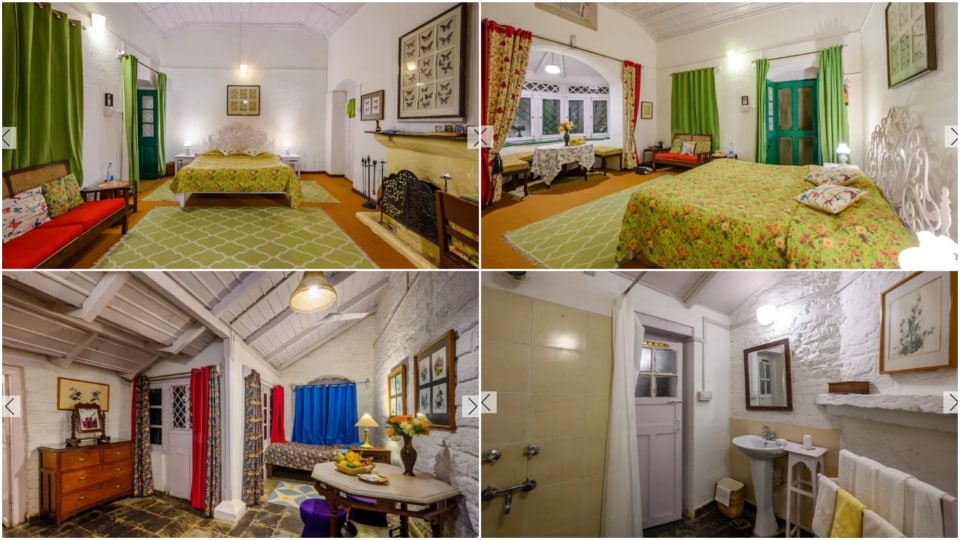
If Bird suite is meditative, the Butterfly room is joyful. It keeps the same heritage shell — white brick walls, wooden floors — but plays with a more eclectic, slightly bohemian palette. The room centres on a metal-frame four-poster bed facing the fireplace, its headboard detailed with delicate motifs.
The real charm is the bay window with built-in wooden benches — a perfect reading nook. The curtains feature a dense floral pattern in reds, ochres and yellows, layered with solid green drapes; combined with vintage side tables, and lamps, it feels warm, lived-in, and very Kumaoni-colonial.
Together, the two suites show how heritage preservation does not have to mean museum-like freezing of space. At The Writers' Bungalow, you are not just booking a room with a mountain view. You are staying in a place where one of the world's greatest poems was shaped by the light, the silence, and the same sunrise that still enters through that bay window today.
Note to readers: This report is based on user-generated content from social media. HT.com has not independently verified the claims and does not endorse them.
This article is for informational purposes only.


