
 E-Paper



Myth, fact and a bottle of rum: What was the life of the pirate really like?

 Prefer HTon Google


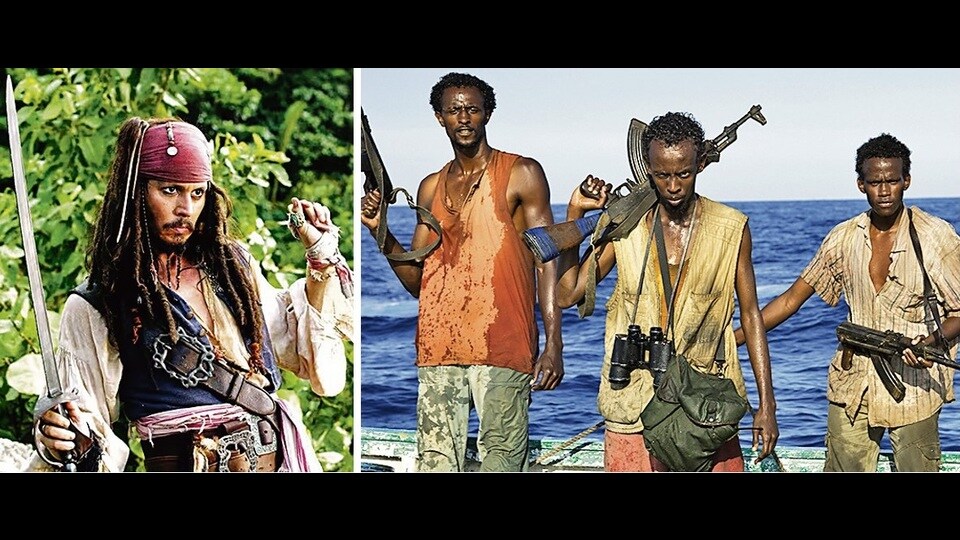
It’s been 20 years since the first Pirates of the Caribbean film. Ten since the more realistic Captain Phillips. What bits of those two takes are accurate?
Jack Sparrow and Abduwali Muse are essentially pirate fiction vs pirate fact.
This year marks two decades since Disney released its hugely successful Pirates of the Caribbean: The Curse of the Black Pearl, starring Johnny Depp. There have been four more films in the franchise so far. Sparrow is dastardly, superstitious, snarky. He often falters but always prevails; he is not to be trusted, but only in the most endearing way. His life is a rather enviable mix of drinking and carousing, swordfights and ready banter.
The real life of the pirate has generally been closer to that of Muse aka Skinny (played by Somali actor Barkhad Abdi), the chief antagonist in Captain Phillips (2013). This film, starring Tom Hanks, is based on the true story of the 2009 hijacking of an American cargo ship.
Skinny has sunken eyes and speaks haltingly. He and his crew are scrawny, grimy and impoverished. They’re former fishermen now part of a larger criminal organisation. Using what were once their fishing boats, they surround larger vessels and, through violence or the threat of it, loot goods or hold crews for ransom.
Was there ever a Jack Sparrow version of this life? How close was reality to either extreme? How did it all begin?
Mercenaries on the high seas
What historians call the Golden Age of Piracy (the mid-17th to early-18th centuries) was marked by brisk marine trade in luxury goods. Ships carrying silk, spices and slaves were often targeted.
Where did the pirates come from? Many had been soldiers-for-hire (which, incidentally, is where we get the term freelancer), acting as supplementary naval forces for empires seeking to establish a maritime presence. Some had operated during the War of the Spanish Succession (1701–1714), which began as a conflict over the successor to the Spanish throne but blew up into a larger battle for power in Europe.
Originally commissioned to raid enemy ships during this unrest, they found themselves unemployed when it ended, and began to conduct raids of their own. They focused on regions with the most marine traffic: the Caribbean and West African coasts, and the Indian Ocean. Major trading powers such as England enacted new laws to crack down on this activity, and carried out public trials and executions.
Some of the legends are true
As countries began to crack down on piracy, a new brand of mercenaries took to the seas, sent on royal commissions to apprehend these criminals. Some of those turned pirates too.
Captain Kidd (William Kidd), for instance, was a Scottish privateer commissioned in 1695 to apprehend brigands in the Indian Ocean. By 1697, he had begun attacking ships himself. He was arrested in 1699, tried, and hanged in public in 1701.
Pirate crews did tend to be a closely bonded ragtag bunch of people from across seas. When slave ships were raided, the raiding crew typically gave the fittest among them a chance to join the new dispensation. Marcus Rediker, historian and author of The Slave Ship: A Human History (2007), drawn from years of research into maritime archives, court records, diaries and first-hand accounts, found that almost a third of the crew across 15 vessels he researched were black, he told NPR in an interview.
There are a few women pirates in the historical record too. Anne Bonny was believed to be the companion of Jack Rackham aka Calico Jack; they sailed and looted together in the early 1700s. Mary Read is said to have disguised herself as a man to find work as a sailor and eventually joined the vessel captained by Calico Jack.
In the South China Sea, there are records of a woman captaining a pirate ship. Ching Shih sailed the seas during the Qing Dynasty, taking the wheel after the death of her husband Zheng Yi, in 1807.
They rarely sailed in galleons
Pirates preferred small, agile ships over large ones. They typically used Spanish sloops or schooners, which were faster and easier to manoeuvre in both deep and shallow waters. They intimidated and overthrew the crew of larger ships using brute force: pirate-ship crews were typically massive and well-armed. The main vessels were typically ringed with cannons; smaller boats would be used to surround a target vessel.
The flags are real
Pirate ships did fly the Jolly Roger. The black standard with the skull and crossbones in white became a symbol of terror. Other common flags included an all-black standard and an all-red one.
They didn’t chase gold or treasure
Ships carrying spices, textiles and timber were preferred, because these goods could be sold easily and at high prices. Pirates would not have had the time or resources to chase after storied treasure. When they did launch targeted expeditions, these were generally aimed at medicines, and equipment for repairs.
Records show, for instance, that in 1718, Blackbeard’s ship, the Queen Anne’s Revenge, and three small sloops, blockaded the port of Charleston in South Carolina for a week, looted ships and took crew members hostage. In ransom, he is said have demanded a chest of medical supplies.
Essential commodities have been a primary aim since the earliest recorded instances of piracy. These, incidentally, involved a rather amphibian model in which migrant tribes on the move by sea — such as the Vikings — halted at villages. Through violence or the threat of it, they then restocked their vessels with food and other essentials. Accounts of such attacks date to as recently as the Middle Ages (the period from the 8th to 11th centuries).
They did hold to a code of their own making
Captains were elected (with no institutional hierarchy in place, this lowered the risk of mutiny or unrest) and could be voted out on grounds such as cowardice or poor judgement.
A quartermaster, also elected, oversaw rations, distributed loot (generally equally between crew members) and addressed conflict, says Peter Leeson, an economist at George Mason University, in a 2007 paper titled An-arrgh-chy: The Law and Economics of Pirate Organization, published in the Journal of Political Economy.
Codes also specified how an injured crew member would be compensated, or what punishments would be meted out to crew members for crimes such as theft, desertion or smaller infractions such as violence against a shipmate.
Walking the plank is a literary myth
The reality of how pirates meted out punishment is, in fact, rather more gruesome. Sentences involved flogging with knotted whips, marooning, mutilation and keel-hauling (where a person was tied to a rope and thrown overboard, to be dragged to death or drowned).
The stories of prisoners being made to walk a narrow plank extending outwards from the ship, until they had fallen into the sea, can be traced to ones of the earliest novels about pirates written in English: Robert Louis Stevenson’s Treasure Island. The 1881 work became the template from which later works would draw their depictions. Long John Silver may seem familiar: he was opportunistic and greedy, handsome and charming, well-clad, well-fed, well-educated and rather witty.


