
 E-Paper



Kicking into beast mode: Rudraneil Sengupta on the sport that demands the most from its player

 Prefer HTon Google


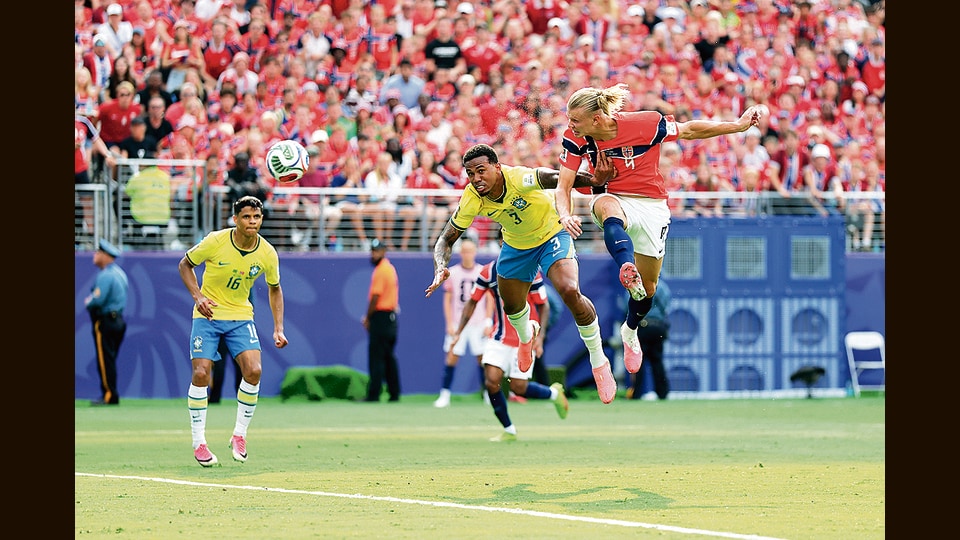
Each sport tests the body differently in ways obvious and unexpected. Go on and guess which one demands the most of an athlete
What sport demands the most all-round athleticism?
The body has a set of distinct capabilities—aerobic capacity, anaerobic conditioning, speed, strength, power, agility, mobility, and flexibility—and different sporting disciplines ask for varying degrees of mastery over each of these aspects.
Sports that run more on mental skills than physical ones, like chess, shooting, or archery, are exempt from this exercise, though the archer’s wrists, forearms and certain smaller back muscles are nothing to scoff at.
An obvious contender is football, where the Indian national team engaged in a rare and strange happening—playing Brazil in an international friendly—last night.
Strange because India, who have never qualified for the World Cup, is ranked 138th in the world, and Brazil, the record five-time world champions, are ranked sixth. This ridiculous mismatch is taking place because the All India Football Federation, which has dragged Indian football to the depths of misery, can afford to spend the kind of money on a single match that they can’t on a whole season of Indian league football.
India’s desperate lack of football development will show up not only in the skills and game-intelligence departments, but also on purely physical terms. Because football needs it all. The aerobic capability of running for 90 minutes, covering, on average, 10 km during a match. The anaerobic capability to do multiple flat-out sprints through the course of a match (anaerobic refers to the alternate energy pathway used by the body when the activity is too fast to rely on oxygen, like sprinting, or any kind of rapid movements like those needed in combat sports).
Speed is essential for football, and because it’s a contact sport, strength is necessary too. In a sport that needs jumping, sprinting, braking, and constant change of direction, power, mobility, agility and flexibility all play equally important roles. A footballer may be the most complete athlete in the world.
Hockey players, because the sport is so similar to football, come pretty close, but they play on a smaller field and don’t really need to jump, so football remains ahead on the athleticism front.
Combat sports athletes are clearly not to be messed with. To last a 3-minute round of boxing or wrestling, they need to acquire the aerobic capacity of a marathon runner and the anaerobic conditioning of a 100-metre sprinter. Power and strength are, of course, their main currency. To top that, wrestlers also need to be as agile, mobile, and flexible as gymnasts.
Gymnasts represent the pinnacle of agility, flexibility and power, but they don’t really need to do much in terms of lung power. Marathoners are the opposite.
Neeraj Chopra has made us all knowledgeable about what it takes to throw the javelin; throwing sports need a surprisingly diverse set of physical attributes. It’s not enough to be a hulk, though strength is the chief requirement. You need plenty of mobility and flexibility to put your body into the ideal throwing position. Again, aerobic conditioning is not particularly important, but it gets enhanced anyway when training for strength and power.
Perhaps the most commonly misunderstood sport is weightlifting, where, seemingly, it’s all about strength and power. Not so. The two Olympic lifts, Clean & Jerk and Snatch, also require superb agility and mobility. That amount of weight does not travel from the ground to the overhead position on the basis of strength alone, but the ability to push all the muscles, ligaments and tendons to their full capacity in a coordinated fashion.
Just watch a lifter like Mirabai Chanu, or any Olympic lifter really, in training, and it becomes apparent just how flexible and agile they are. It’s no wonder that every single physical sport—football, boxing, wrestling, javelin, etc—uses the two Olympic lifts as part of their training.
(Email Rudraneil Sengupta on rudraneil@gmail.com. The views expressed are personal)


