
 E-Paper



Step inside designer Amit Aggarwal's moody, minimal 4,800-square-foot residence in Delhi that overlooks Humayun's Tomb

 Prefer HTon Google


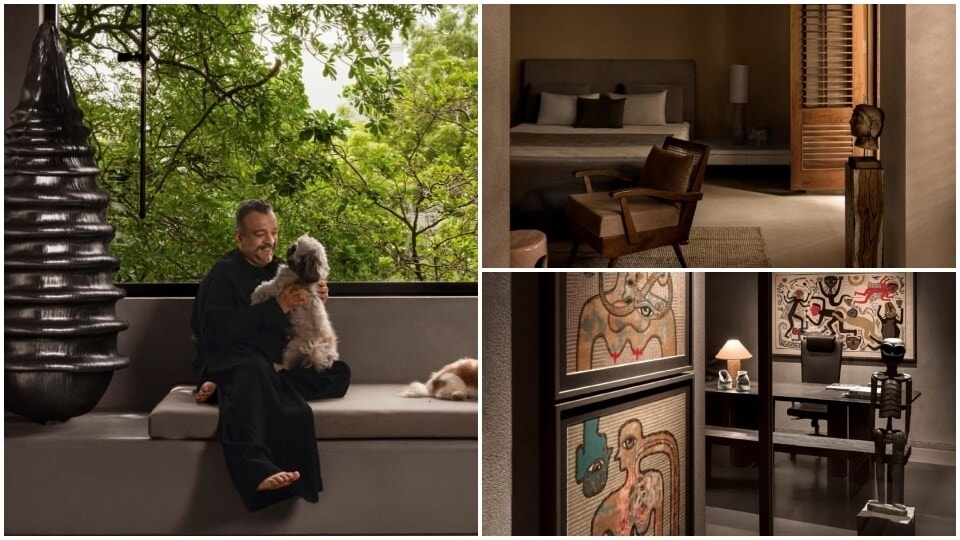
Overlooking Humayun’s Tomb, Amit Aggarwal’s 4,800-square-foot Delhi residence blends soft brutalism with light-filled, minimalist interiors.
As flamboyant, structural, and colourful as Amit Aggarwal's creations are on the ramp, his Delhi residence is, by contrast, quite minimal. But there is also an elegance to it that can only be expected of the designer. In a post shared on October 14 by Architectural Digest India, the designer showcased his gorgeous residence in Delhi. Let's take a look inside.
A tour of Amit Aggarwal's home
Overlooking the iconic Humayun's Tomb in Delhi and set in an ASI-protected building, Amit Aggarwal's home spans 4,800 square feet, per AD India. The residence is a light-filled homage to soft brutalism, where, as soon as one enters—featuring a concrete-grey façade—they are transported into a minimal space, where simple design language becomes larger than life.
There are double-height ceilings that tie the ground floor to the house's two levels, a black metal stringer running along the staircase, massive windows that illuminate every corner of the house, a courtyard that seamlessly becomes part of the living room, a skeletal light fixture, and a concrete bench. The three levels are themed from dawn through dusk to night—a manifestation of the designer and his partner's profound inner worlds colliding.
The living and dining area
The living room is a moody space with bespoke furnishings in dark-coloured wood, offset by the softer, rounder edges of the arched doorways and an off-white palette. A teakwood bench custom-made for the designer by a Mumbai-based artist using the yakisugi technique (a traditional Japanese architectural technique dating back to the 18th-century Edo period, meaning ‘burned cedar board’) becomes the highlight of the space. The centre table has the same wooden base with a concrete top.
According to AD India, the dining space is on the ground floor and features furniture made of the same wood as the living room furniture. The highlight in the space is a light fixture made out of a wooden log that the designer has had for 20 years, picked up from a warehouse in Saidulajab that stocked Balinese curios.
About the home
According to AD India, the designer revealed that his house is protected by the Archaeological Survey of India (ASI), which meant changes couldn't be made to its exterior. He added, "It has great bones. It needed a lot of structural work from the outside and the inside, which, in the given parameters of the ASI governance, is what we managed to do.”


