At the end of every Olympics, the obvious talking point is how India performed. Did we improve our medal count? Is this the best haul ever (still a pretty low bar for a country this size)? Did we finally win a medal in hockey or athletics?
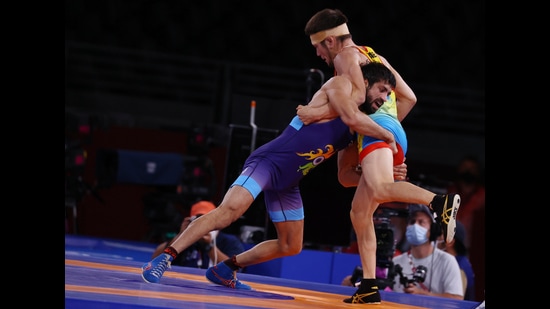
Wrestlers Ravi Kumar Dahiya of India and Nurislam Sanayev of Kazakhstan at the Tokyo Olympics. Delhi and Haryana have taken some steps to promote the sport, with the result that all India’s medallists are from these two states. Dahiya, who won silver, is from Haryana. The sport itself is popular across India, but no other state has worked to nurture it. (REUTERS)
The answers this time are: yes, yes, yes and yes. With 7 medals, we have improved on our best-ever Olympic medals tally (6, at the 2012 London Games). We finally have our first Olympic athletics medal too, and it’s a gold, courtesy Neeraj Chopra’s incredible arm.
And yet, the emphatic wins don’t reflect the true state of sports in the country. Instead, the celebrations, awards and adulation (all deserved) that we are about to witness will, once again, distract from the truth: India’s sports administrators may step up when the results are good, but they are largely missing through the entire process that makes those results possible.
Process before result is a truth so simple that the fact that they don’t get it can only be attributed to wilful, cynical indifference.
What is process? First, encouraging and developing a proper base by building spaces where a sport can be practised, hiring trainers to spot and mould young talent, and then allowing access to that infrastructure to the largest number of people possible, especially children. Without this, any medal that an Indian wins will remain an oddity, any success will continue to feel like a one-off. How many people in India have access to javelins or throwing coaches, for example?
There are some sports in India that are on the verge of a breakthrough in this regard. The narrative around the Indian shooting contingent, largely a bunch of young shooters (many of them teenagers) who were at their first Olympics, has centred entirely on their failure to win a medal. This is understandable, given the hype surrounding them in the lead-up to the Games. But shooting is, in fact, one of the few sports in which we have made great leaps in terms of building a base. This change has largely been led by the first generation of our shooters who did well on the international stage and had struggled to find everything they needed — guns, pellets, jackets, shoes, ranges. Many have since opened their own training schools and the change this has wrought can be seen in the waves of teenage shooters coming through the system now.
Wrestling is trying, but it needs a lot more. This sport has the advantage of deep cultural ties in the country. Still, it was only in 2008, after Sushil Kumar won India’s first Olympic wrestling medal in 56 years, that governments in Delhi and Haryana distributed Olympic mats to the numerous wrestling schools in both states. This small change had a major impact. Traditional Indian wrestling schools did their training in earthen pits, and the difference in the two surfaces was the difference between winning and losing.
Since 2008, India has won wrestling medals at every Olympics, including Tokyo. But though wrestling is popular across India, none of the other states has done anything to nurture talent in it. The result: Just about every one of India’s Olympic wrestlers still comes from Delhi or Haryana, and all of India’s medallists are from these two states.
In hockey, which was once the sport of choice in India, all the basics were in place and almost all were allowed to crumble from neglect. Now that there is renewed interest in the sport because of the men’s hockey team’s bronze (India’s first hockey medal in 41 years) and because of the women’s team’s improbable run to the bronze medal playoff, it’s time to take a deep look at how that once-great culture can be revived so that it flourishes again, in schools and colleges, local clubs, cities, towns and remote areas.
The first step is a simple one: astroturfs and protective gear.

 E-Paper