
 E-Paper



Tribal woman revives vanishing traditional Gujjar Jammu and Kashmir apparel

 Prefer HTon Google


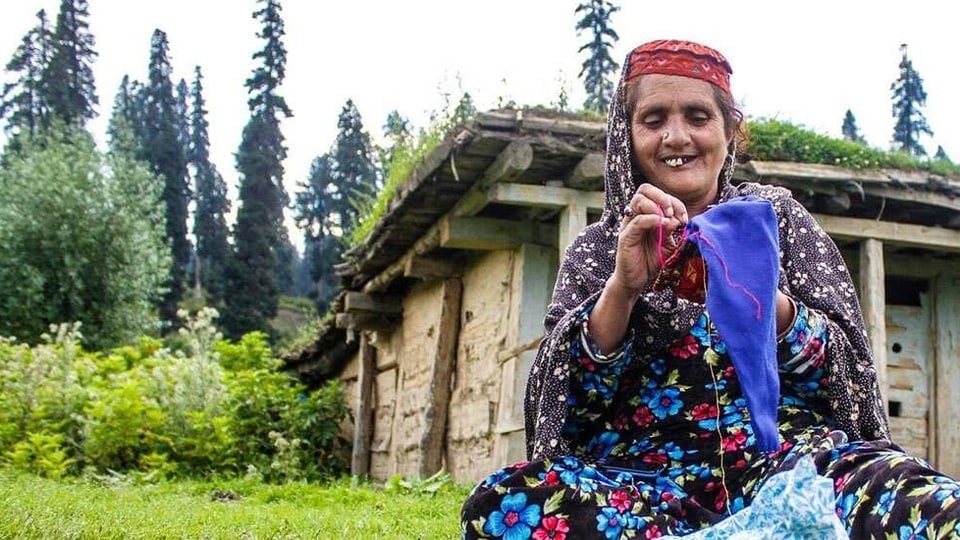
A Kashmiri tribal woman is preserving dying culture by sewing, designing, and embroidering traditional Gujjar Jammu and Kashmir clothing.
A tribal lady in Kashmir is restoring a dying culture by stitching, creating, and embroidering traditional Gujjar Jammu and Kashmir apparel. Gujjars and Bakerwals make up a sizable portion of Jammu and Kashmir's multi-ethnic population, with their own culture of clothes, food, and way of life. Gujjar culture, particularly of wearing apparel, has been diminishing in recent decades, as the new generation of youth has become enamored with modern clothing.
Worried about the vanishing attires, Shahida Khanum, a graduate of a remote area of the Bandipora district of north Kashmir has taken on it upon herself to revive the attire culture among the young Gujjar population. Khanum has opened up a centre in Aragam village of the district where she is stitching the traditional Gujjar attires. (Also read: India's map is woven into a Kani shawl by artisans in Jammu and Kashmir )
"Our traditional attires are vanishing because the young population does not know how these attires are stitched, designed or made. So year by year, the culture was vanishing and there was no one to revive and preserve it," Khanum said.
"I will preserve our culture and promote it among the Gujjar population," she said. Traditional Gujjar attires worn by women include a knitted cap (lashka in Gojri), long gown (kameez), shawl while men shalwar kameez, waistcoat, angoo and pagheri (headgear). Khanum said that no young Gujjar knows how to stitch and make these clothes.
"I took the help of some elder women of our tribe who told me how to design, stitch and knit caps and attires. I have started making these products at the centre and simultaneously training these girls," she said.
More than fifty girls are being trained by Khanum at the centre where the trainees learn stitching, designing, embroidering dresses, and knitting caps for Gujjar men and women. The traditional caps worn by the tribal women are completely different from common skullcaps.
Khanum says the cap, known as laska, by Gujjars is stitched from a piece of cloth, and then embroidered with colourful threads. She said that Gujjar women wear these caps and cover their head by wearing a scarf over it, but now this tradition was vanishing as no young gujjar women wears caps. Traditionally, knitting caps and stitching attires were common in every Gujjar family, but their young generation could not transform this skill into themselves.
"As young Gujjar women didn't learn to knit these beautiful caps, so they didn't wear them also. This was this tradition and culture was vanishing, so were attired like colourful gowns," she said. In the centre which is set up in a big hall, girls in rows are being trained by Khanum in stitching, designing and knitting attires.
"We will get trained in reviving our cultural attires and also earn our livelihood," Tahira, a student at the centre said. In this path-breaking idea of preserving culture and training girls for livelihood, Khanum says she is yet to be assisted by the government for financial help through its different schemes.
"I took a loan from a bank to buy some machines and other necessary equipment to open this centre. I approached social welfare and tribal Affairs department for financial assistance, but am yet to get any support," she said. However, in Jammu and Kashmir Khadi and Village Industries Board (KVIB), Khanum now sees hope for financial aid to expand her centre and train more tribal women.
"KVIB is all in support of women like Shahida Khanum who has become a ray of hope for tribal girls in Jammu and Kashmir. We have a number of schemes by which we can financially assist women like Khanum," Hina Shafi Bhat, the Chairperson of KVIB, said.


