Two Indians win top honours at Millennium Pitching Contest
Sachin Kochrekar and Shruti Jain, both currently at the University of Turku in Finland, have won at the inaugural edition of the award, for innovative solutions to the big challenges of our time.
Sachin Kochrekar’s plans to save the earth have just won him €10,000 (about ₹8.88 lakh), and praise for India. The Goa-born scientist is a doctoral candidate at Finland’s University of Turku and has been researching ways to convert carbon dioxide into fuel using renewable energy. His innovationwon first place at the Millennium Pitching Contest, a new initiative by Technology Academy Finland that aims to solve the biggest challenges of our time.
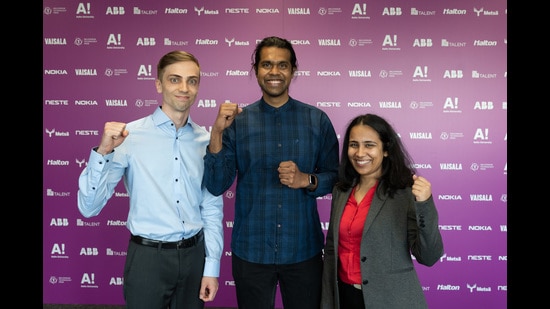
Sachin Kochrekar (centre), winner of the Millennium Pitching Contest, with Shruti Jain, who won second place, and Samu-Pekka Ojanen, who placed third. (Image courtesy Millennium Technology Prize 2020)
Kochrekar’s pitch is ingenious — mimicking nature’s own photosynthetic process to absorb carbon dioxide, but turning it into fuel instead of oxygen. The electrochemical reaction would use emissions from existing fossil-fuel engines and turn those emissions back into fuels that can power automobiles. His innovation hopes to repurpose CO2, which causes global warming, using it to close the carbon cycle and fight climate change.
“The work has high environmental impact,” says Yrjö Neuvo, chair of the contest’s jury and professor emeritus at Finland’s Aalto University, in a post on the Millennium Prize website.
India had another reason to rejoice at the awards. Shruti Jain, a biotechnology researcher at the University of Turku, won second place for her work on a nanoparticle-based blood test for early detection of cancer. The text examines the sugars that coat human cells — the ones on cancer cells appear different and have previously been hard to detect. Jain’s method uses specific chemicals and nanoparticles to attract those specific sugars, creating a better way to track the cells.
“The idea was very innovative. It has potentially high societal value. The impact will depend on how easily the innovation can be adopted,” Neuvo says. Jain’s prize is €5,000 (about ₹4.43 lakh).
The contest is part of a slew of initiatives introduced by Technology Academy Finland, which also organises the Millennium Technology Prize, a €1 million ( ₹8.86 crore) award, the biggest and most prestigious in the technology field. Winners for 2020 were announced in May – Cambridge professors Shankar Balasubramanian and David Klenerman, for inventing Next Generation Sequencing for DNA. Their process is a faster, cheaper, more effective way to read DNA and conduct DNA tests. NGS has become a global standard in cancer detection and medical research.
Rachel Lopez is a a writer and editor with the Hindustan Times. She has worked with the Times Group, Time Out and Vogue and has a special interest in city history, culture, etymology and internet and society.Read More

 E-Paper