
 E-Paper



Fit and Fine by Kamal Singh CSCS: Exercise and immunity–yay or nay!

 Prefer HTon Google



How much exercise do you need for it to be an effective way to improve your fitness and health that includes having a strong immune system
The pandemic made us aware of a need for having a robust immune system. Exercise, working out and fitness have been touted as an effective way to improve fitness and health which includes a strong immune system which can ward off the bacteria and viruses floating around. But the question is how much exercise is good for improving your health? Is there an upper limit or does the body acclimate to more and more exercise?
Moderate exercise
The WHO tells us that moderate intensity exercise is hugely beneficial in improving all the markers for health – it lowers stress, decreases blood pressure, improves glucose sensitivity (helps in blood sugar control), improves sleep and sleep disorders, supports weight loss and bone health and last but not the least does wonders for your mental health. You can bet that immune system too will work at its optimum with moderate exercise.
The American Heart Association (AHA) says during moderate exercise, you should be breathing harder than if you were inactive, yet still be able to speak. The Talk Test is a good way to monitor whether you are working out at a moderate intensity. If we want to get more technical, then moderate intensity exercise raises the heart rate to 50-60% of the maximum heart rate. The standard advice is to get 30 minutes of moderate pace exercise 5 times a week. Here’s how to calculate the maximum heart rate and the moderate intensity zone.
•220- age = Maximum heart rate. So if 30 years old, MHR = 190 beats per minute.
•50-60% moderate intensity zone, MHR x .50-.60. From the above example,
190 x .50 = 95 beats per minute and 190 x .60 = 114 beats per minute.
•Moderate intensity zone for a 30 year old = 95 – 114 beats per minute.
Moderate pace aerobic exercise includes the following :
1.Walking 3.2 km in 30 minutes.
2.Running 2.4 km in 15 minutes.
3.Cycling 8 km in 30 minutes.
4.Skipping rope for 15 minutes.
5.Walking stairs for 15 minutes.
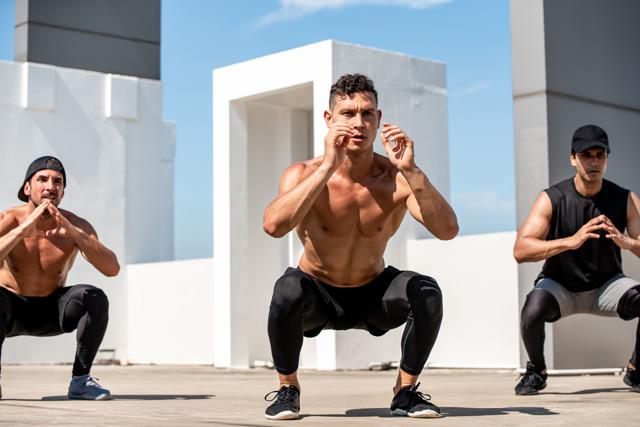
Incorporating few sets of strength training twice a week – push ups, squats, lunges, planks and crunches would make for an ideal workout regime for people looking to optimise their health through exercise.
Higher intensity exercise
Most of the fitness enthusiasts would be looking at the above information and saying, hey that is just my warm up! I am well aware of how many today are hard core fitness fiends but here we are discussing exercising for health and not performance! Also we do know that intensive exercise tends to suppress the immune system for days afterwards. In fact hard training athletes are particularly prone to greater number of Upper Respiratory Tract Infections i.e. colds through the year than the non-athlete population. The chances of an athlete catching a cold go up as a competition approaches and during the post competition phase. Thus good coaches and administrators try to isolate their athletes during this time.
Thus if you are a hard training gym goer or runner, then you should pay proper attention to rest and recovery. Your nutrition, sleep and supplementation should be optimised so that your body can recover and do not fall prey to any bacteria and viruses.
If you are looking to compete in an athletic event – half marathon or full marathon race, the International Olympic Committee has a set of recommendations for creating a training plan so as to minimise chances of suppressing your immune system and falling ill.*
Exercise and stay healthy
It is very clear that exercising and staying active has a positive impact on our health and fitness. To sum up, you need to:
•Exercise at a moderate intensity level for 150 minutes a week.
•Use the Talk Test to judge whether the intensity is moderate or too high. You should be able to talk while walking/running, then the intensity is moderate.
•Add a few sets of strength training to the aerobic exercise and you are golden.
•If you are pushing hard in your workouts, then you need to make sure that your nutrition, sleep and supplementation are on point.
Now lace up those shoes.
Kamal Singh is a Certified Strength and Conditioning Specialist who has been coaching for 15 years
From HT Brunch, December 12, 2021
Follow us on twitter.com/HTBrunch
Connect with us on facebook.com/hindustantimesbrunch


