
 E-Paper





Debapriya Bhattacharya is a Content Producer at Hindustan Times. He started his career in 2022, working in newsrooms in beats like education, US news, trending stories, and entertainment. In his new role in the lifestyle desk, he seeks to deliver a balanced blend of research-driven reporting and creative storytelling from health and recipes to art and culture. Science, philosophy, food and pop culture are what pump his veins and help bring heart to his stories. Debapriya tries to see out subjects that will allow him and readers to explore new frontiers and improve the quality of life for all. The explorations can be both external and internal, as thoughts seek to be as chaotic as the greater universe. As a citizen of the world, Debapriya has been fascinated by the lives of people across the globe throughout time. His curiosity leads him to explore new linguistic and cultural landscapes to broaden his horizons and deepen his understanding of global narratives. Beyond the newsroom, Debapriya loves to participate in debate and theatre, spaces that he considers to be holy grounds for nuance and self-expression. A graduate from Ashutosh College, University of Calcutta, Debapriya completed his Master's degree from the same university in 2022. An ambiverted bibliophile, he loves his solitude as much as he adores stimulating conversations. And despite his reverence for tech, libraries continue to be his favourite place for research.
Prepare gajar halwa without grating carrots with chef Kunal Kapur’s easy-to-make recipe


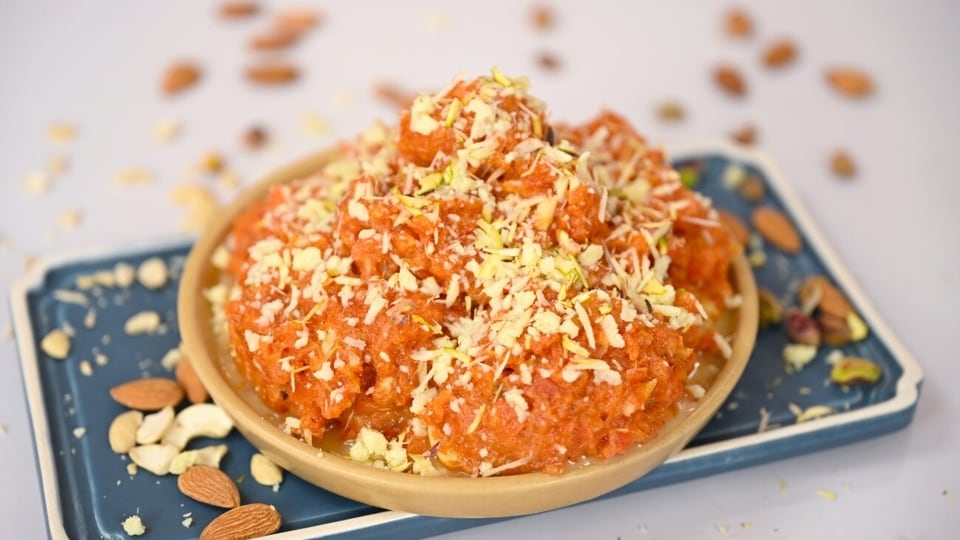
Chef Kunal Kapur simplifies preparing gajar halwa at home with his easy recipe that does not need carrots to be grated and is ready in less than half an hour.
A bowl of gajar halwa is one of the most comforting winter desserts imaginable, but preparing it takes significant effort, which includes, among other things, grating carrots. However, celebrity chef and MasterChef India judge Kunal Kapur has a simple fix for the trouble: his easy gajar halwa recipe.
Also Read | Chef Sanjeev Kapoor shares Chinese bread pakoda recipe: A delicious twist on a classic snack
It takes just about 25 minutes to prepare the recipe, which serves four. The detailed steps to make the dish are presented as follows.
Ingredients
- Carrots – 1.25 kg
- Ghee – 3 tbsp
- Full-fat milk – 1 cup/ 250 ml
- Sugar – 1 cup/ 200 g
- Cardamom powder – 1 tsp
- Assorted nuts, chopped – handful
- Khoya, grated – 150 g
Also Read | Doctor shares healthy and delicious breakfast cookie recipe loaded with protein and fibre: See preparation
Method of preparation
- First, cut the peeled carrots into large chunks. If the carrots have a thick yellow centre, remove it to prevent strands from forming in the halwa.
- In a pressure cooker, add ghee, carrots, milk, and sugar. Pressure cook on high heat until the first whistle. Then, lower the heat and wait for the second whistle before turning off the flame. Let it sit in its own steam for 10 minutes, and then remove the lid.
- Turn the flame back on and cook until the milk is fully reduced. If there are any large chunks remaining, mash them with a ladle. Finally, mix in cardamom powder and chopped nuts. Garnish with khoya, and the easy gajar halwa is ready to serve.
More about Kunal Kapur
Kunal Kapur is a celebrity chef and restaurateur who is also one of the hosts of MasterChef India. Born in September 1979 in New Delhi, he pursued higher education in hotel management. However, his training in culinary skills began at home with his father and grandfather. He began his career with the Taj Group of Hotels and has since won numerous awards as a chef. He has also opened his own establishments across the country and abroad.
Note to readers: This report is based on user-generated content from social media. HT.com has not independently verified the claims and does not endorse them.
This article is for informational purposes only.
ABOUT THE AUTHOR

Catch your daily dose of Fashion, Taylor Swift, Health, Festivals, Travel, Relationship, Recipe and all the other Latest Lifestyle News on Hindustan Times Website and APPs.


