
 E-Paper



Mexico's tourist train project threatens fragile cenote ecosystem and tourist attractions

 Prefer HTon Google


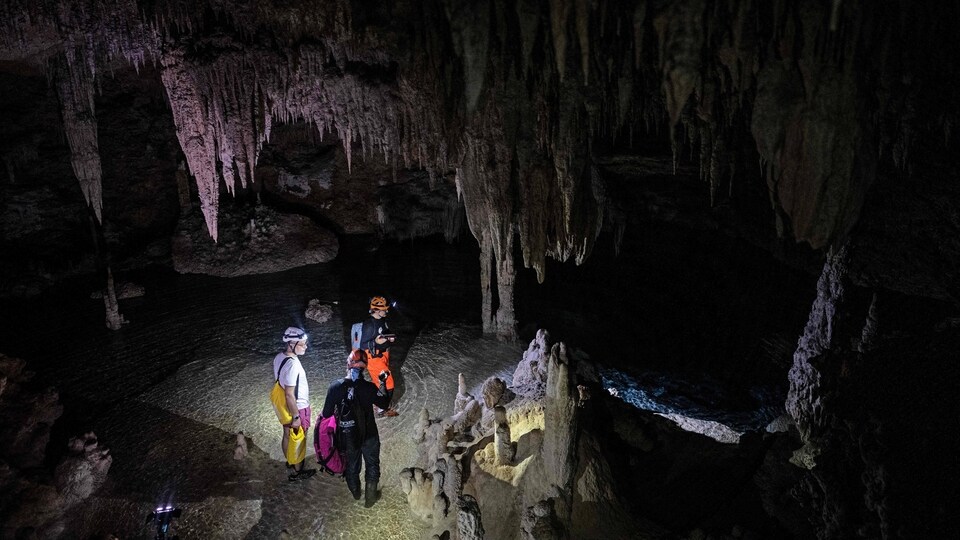
Mexico's tourist train project is sparking controversy as environmentalists condemn its detrimental impact on the region's fragile ecosystems.
In a cave in Mexico's Riviera Maya, where nature has sculpted a subterranean landscape of stunning beauty, thick steel columns supporting a controversial new tourist railway intrude into a delicate ecosystem. The Yucatan Peninsula boasts an estimated 2,400 of these caverns and sinkholes, which are known as cenotes and are a major attraction for tourists who swim and snorkel in the crystal clear waters that fill some of them.
Campaigners warn that the unique geological system is under threat from the Maya Train, one of outgoing President Andres Manuel Lopez Obrador's flagship infrastructure projects. "It's our worst nightmare. We've seen a large drill entering and breaking the ceiling of the cave" as well as its ancient stalactites, biologist and speleologist Roberto Rojo told AFP, surveying the damage.
In March, Rojo's group Selvame del Tren (Save Me From the Train) filmed a huge drill piercing a hole into a cavern for one of the pillars supporting a railway viaduct. Rojo calculates that the Maya Train, which partially opened in December, will need up to 17,000 columns along its 1,500-kilometer (930-mile) loop around southeastern Mexico. Work on the project has continued despite a court-ordered suspension pending environmental studies.
The original plan was to build part of the railway -- which the government says will bring prosperity to one of the country's poorest regions -- next to a major highway. But according to environmentalists, the government moved the section into the jungle to avoid a conflict with hoteliers who feared traffic delays during construction. They accuse Lopez Obrador of rushing to finish the railway before he leaves office in October.
‘Ecocide’
Activists have branded the construction work “ecocide.” They say the project lacks the proper environmental impact studies, has razed 8.7 million trees and has irreversibly damaged the underground ecosystem. Lopez Obrador calls the members of Salvame del Tren "pseudo-environmentalists" and accuses them of profiting from the "alleged defense of nature."
The construction work, deemed of "national security" importance, is protected by the National Guard. Reaching one of the affected cenotes is no easy task. It involves driving several kilometers from the resort city of Playa del Carmen, then continuing the journey -- almost impossible without a guide -- on foot, using a machete to cut through the undergrowth.
Once inside the cave, a helmet with a flashlight is essential. The cavern is adorned by thousands of stalactites and stalagmites, some ancient and several meters high, others newly formed and measuring just a few centimeters.
Clean-up promised
Despite Lopez Obrador's assurances, concrete has leaked out of the steel columns and contaminated the cenote water, according to environmentalists. Worryingly, the well is a source of water for human consumption and eventually reaches the offshore Mesoamerican Reef -- the second largest in the world, Rojo said. "Plants, animals and ourselves depend on this, which is one of the last healthy aquifers we have in Mexico," he said.
Lopez Obrador said three weeks ago that there has only been one accidental concrete spillage and that it was being remedied. But inside the affected cenote, a clean-up has not yet happened. Other columns show signs of leaks and rust. Drills continue to bore holes into the fragile ground. The newspaper El Universal reported Friday that the environmental protection agency PROFEPA had documented five spillages linked to the railway construction.
‘A balance’
The government says that for the five completed sections of the train, nine protected natural areas have been created, totaling 1.34 million hectares (3.3 million acres). Most of it corresponds to the Bajos del Norte National Park, an underwater reserve in the Gulf of Mexico.
The government also created a protected area in the southeastern state of Campeche that it says will be the second-largest rainforest reserve in the world, after the Brazilian Amazon. In Playa del Carmen, tourists blissfully unaware of the environmental fears arrived recently at a modern Maya Train station that had been inaugurated two months ago.
About a hundred people were waiting for the train, which has a capacity of 2,210 passengers, according to the defense ministry, which manages the project. Environmental damage is part of the project's "yin and yang," said Jaime Vazquez, a tour operator arriving at the station. "On the one hand there is an effect, of course, but on the other hand you benefit humans. So it's a balance," the 40-year-old said.


