
 E-Paper



BJP’s Amit Shah the strategist now emerges as leader of masses
On May 5, en route to Chandigarh, Bharatiya Janata Party president Amit Shah told this writer that he expected his party to win around 23 seats in West Bengal and 63 seats in Uttar Pradesh.

 Prefer HTon Google


On May 5, en route to Chandigarh, Bharatiya Janata Party president Amit Shah told this writer that he expected his party to win around 23 seats in West Bengal and 63 seats in Uttar Pradesh. He added that some in his own party thought he was off his mind to predict these numbers.
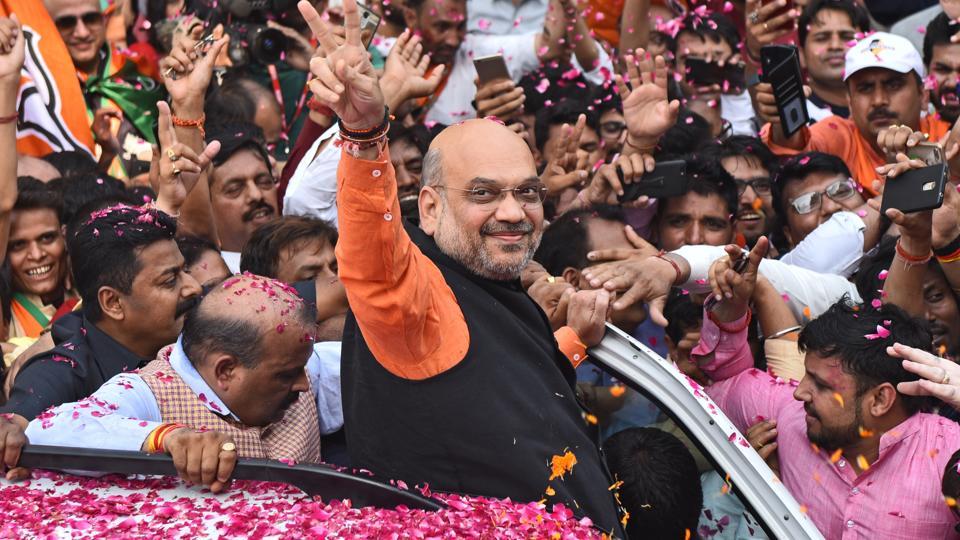
On May 23, it emerged that the BJP was set to becoming the first majority government in 48 years to return with a majority by improving its seat tally in West Bengal and retaining its hold on Uttar Pradesh. In the first state it was up against the Trinamool Congress. In the second, its opposition was the alliance of the Samajwadi Party, Bahujan Samaj Party, and the Rashtriya Lok Dal.
If the BJP owes part of its success to the Narendra Modi effect that, as some analysts said, ensured that as far as many voters were concerned he was the party’s candidate in their constituencies, then it owes another part to Shah’s organisational abilities which ensured that it almost held on to its seats in Uttar Pradesh, where, along with an ally which won two seats, it won 73 seats in 2014 and that it offset the marginal dip in seats with a strong performance in West Bengal, where it won two seats in 2014.
The party’s performance in West Bengal can be credited to a strategy that was put in place in 2014, soon after Modi took over as PM and Shah as party president. Both knew that they had to win over eastern India to balance losses from north and west of India in 2019.
The October 2, 2014 Burdwan blasts exposed the TMC’s poor record in internal security and provided Shah with an opportunity which he utilized to the optimum. Talking to Hindustan Times around the time of the party’s Burdwan rally on January 20, 2015, he said that time for BJP had come in the state.
Also read | ‘All losers are not losers’, says Mamata as BJP makes deep cuts in Bengal
Just as Shah discovered Himanta Biswa Sarma as leader of the BJP in North-East, he pushed strongman Kailash Vijayvargia and suave Sidharth Nath Singh as BJP faces in West Bengal. After Singh became a minister in the UP government, Shah brought in Sarma from Assam and another team from Gujarat.
The intellectual face of the BJP in the state was led by Rajya Sabha MP Swapan Dasgupta and Anirban Ganguly, but Shah knew that he had to take on the state’s mercurial chief minister Mamata Banerjee on the ground. As Banerjee responded to this, she only seems to have succeeded in alienating large sections of rural and urban Bengal. The next target for Shah is the 2021 state assembly elections.
Even as Shah focused on eastern India, his principal focus remained on UP, which he knew was critical to the BJP’s victory. For anyone who spent time in the Lal Bahadur Shastri airport in Varanasi, this was quite evident – a Club one Falcon Charter jet used by Shah would go up and down the runway at all hours.
Today, the BSP-SP alliance has been cut to size
Shah biggest strengths are his political astuteness combined with huge reserves of energy. For instance, after the BJP’s roadshow on May 14 at 6.30pm in Kolkata that was marred by violence, he addressed a meeting of the city’s intellectuals at Rajarhat at 8.30pm, gave several interviews, boarded a charter to Varanasi at midnight, held meetings with Railway Minister Piyush Goyal at Amethi House in Kashi, and then returned to Delhi by 6 am. He held a press conference on the Kolkata violence at 10 am and then went back to Uttar Pradesh. Through the campaign, he has addressed, on average, five rallies a day.
The 2019 elections also mark Shah’s electoral debut at the national level.
A political fighter to the core, Shah requested the BJP election committee to allow him to fight from Amethi against Congress President Rahul Gandhi . However, former party president and home minister Rajnath Singh prevailed on him to fight from safer confines of Gandhinagar as he wanted the party to consolidate its position in its best seats.
Shah wanted his nominating diling in Gandhinagar to be a quiet affair, but it was ally Shiromani Akali Dal’s chief Prakash Singh Badal who insisted it be made a showcase of the National Democratic Alliance’s strength.
When Shah demurred, Badal senior called up Prime Minister Modi and got home minister Rajnath Singh and finance minister Arun Jaitley to attend the road show. Badal insisted on speaking first in the rally and spoke of the ascendency of Shah as a leader in the BJP pantheon. The run-away victory in the 2019 elections has just under scored that point. If 2014 marked the arrival of Amit Shah the consummate election planner, then 2019 has marked the arrival of Shah as a mass leader at the national level.
Also read | ‘Will take everyone along, even opponents’: PM Modi after big win


