
 E-Paper



Lok Sabha Elections 2019: Where even nationalism is a caste in poll arena in UP
GROUND REALITY: This emotional issue is sometimes overshadowed by local ones. Till they are asked, people don’t even mention it, more so in the Yadav belt where their tilt towards the alliance is more pronounced

 Prefer HTon Google


“We struggle every day to feed our families, we don’t have money or jobs. What should we do, dance and celebrate the surgical strike?” a group of 50 people, belonging to different age groups, ask in unison as they quickly assemble to vent their anger.
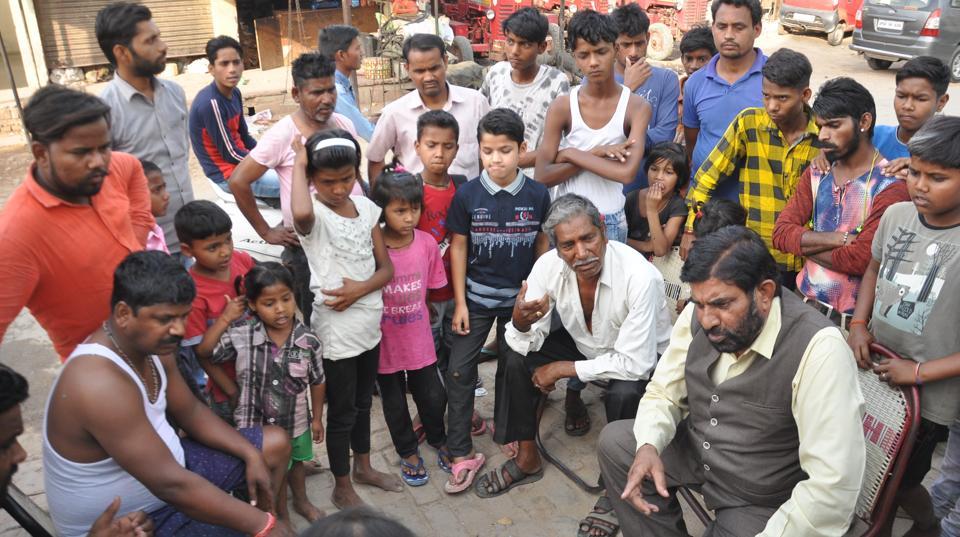
These men, mostly Balmikis and Jatavs , do not stop here. Instead, they have many unanswered questions.
“If we actually killed our terrorists in hundreds, why their dead bodies were not shown on TV channels? They were beaming return of our national hero (Wing Commander) Abhinandan. We salute him. But you tell us: A two-wheeler rider without a helmet cannot escape fine on barely a 500-metre stretch of road. How come a vehicle loaded with explosives reached the high security zone (referring to Pulwama attack)?” they ask.
They hold a serious grievance against the government for neglecting soldiers.
“What commitment are you talking about? The family of Kaushal Kumar Rawat, who died while defending the country sometime back, built his memorial in their agriculture field as the government failed to keep its word,” they say.
Balmikis had largely voted (to the Bharatiya Janata Party) in the 2014 general elections for change but they are indecisive today. Their grudge, the state government’s decision to move ‘safai karmacharis’ from permanent jobs to contract, has overshadowed their national sentiments.
Less than a kilometre away, the mood is different. A group of men are busy playing cards near the market place. Ask them about the mood of voters in this election and they all respond promptly: “It’s kamal, kamal and kamal (lotus-BJP’s symbol).”
More questions evoke similar answers. “Prime Minister Narendra Modi has done what Congress could not do in decades. He has given a befitting reply to Pakistan, whose leadership would now think twice before causing disturbance in our country. We are in safe hands,” they say.
Majority of these people are ‘Banias’ or ‘Brahmins’.
According to them, local and state level issues are bound to get eclipsed by the major issue of national security. However, Laxman Rathore (backward), who has a furniture shop here, has an interesting reply, “My vote is for the country though my wife does not want me to support BJP.”
A labourer working there, however, prefers silence and does not ditto his employer’s line of thought. When coaxed further, he quips, “My answer is in my silence.”
Over 10-km long stretch from Kehrai to Devri, dominated by Dalits with a sprinkle of upper caste population, reflects the common public sentiment across the countryside in western to central UP when it comes to the key issue of nationalism that the BJP high command has been accused of exploiting in the ongoing polls.
It is a part of Agra Lok Sabha constituency, which has three dominant caste groups -- Bania, Dalits and Muslims.
The emotional issue has, however, failed to bind the polity in favour of any party or leader as the election is clearly caste-driven, unlike 2014 when it was swept by a Modi wave.
Yes, nationalism too gets a caste hue in the state’s political domain, packed with two national parties – the BJP and Congress and two regional, but stronger forces -- the SP and the BSP - and some smaller parties like Mahan Dal, Apna Dal and Pragatisheel Samajwadi Party-Lohia (PSPL) of Shivpal Singh Yadav.
In fact, caste has always played an important role in the state’s electoral history. However, it became the fulcrum of every election after the exit of Congress, which represented rainbow coalition of Brahmin, Dalits and Muslims, from the seat of power.
The implementation of Mandal Commission report by late Prime Minister VP Singh that granted 27 per cent quota to OBCs, coupled with the rise of SP and BSP in the early ‘90s, intensified caste politics.
The BJP, which till then was seen as an upper caste party also projected a backward face, Kalyan Singh who led the Ram temple movement in the state. Simultaneously, BJP along with the RSS tried to make inroads among non-Yadav backwards and non-Jatav dalits.
As you travel about 500 km from Agra, Hathras, Aligarh, Firozabad, Mainpuri, Etawah, Kanpur and Unnao to Lucknow, the response of the people on the issue of nationalism clearly comment on their preference -- they are either pro-Modi or pro-caste.
The issue of nationalism, which has kicked off an unprecedented euphoria, is sometimes overshadowed by local issues. Till they are asked, they don’t even mention it, more so in the Yadav belt where their tilt towards the alliance is more pronounced. Even in Mohanlalganj area near Lucknow, the members of backward castes rarely talk about nationalism till the subject is broached.
A group of women is morosely sitting in a by-lane named Mandir Wali Gali of Devri Road, which is packed with shoppers. It’s a weekly ‘bazaar’ day and there is not an inch of space to move on the road.
The women virtually give a blank look when asked about the country’s security. Their only concern is water that has entered their homes because of poor drainage system.
An old lady, Sondai, follows me to some distance and asked, “I will vote for you, please get this water-logging problem resolved.”
However, young Sonu, who has been putting up a shop for several years at the bazaar, is confident that people will vote for the country’s security.
“How can we be safe if the country is not?’ he says.
But Kavlesh disagrees as he is struggling for a job. “I voted for Modi in 2014 and till date I have not found a job. Now they are talking about nationalism. This will not help us find one (job). Our vote is for Behenji (referring to Mayawati), whether she wins or loses.”
The scene is no different at the Aligarh Muslim University (AMU). Here the division is more on communal lines but the focus is on jobs and higher education although the students are reticent in their replies.
Karimullah, a student, feels the BJP has been using nationalism as a poll issue. “If you recall, Uri attack was in public domain before the UP elections,” he says.
According to him, despite the hype, the issue of nationalism will not influence voters’ choice as people are sceptic about the entire episode. He says BJP mentions nationalism 187 times in their manifesto but not employment.
Other students say nationalism has been redefined by the BJP. It’s going to drive emotions of the nation as it has been marketed as anti-Pakistan and anti-India.
In Nagla Lohia village of Fatehpur Sikri, which is a part of Fatehabad assembly segment, the people’s vote here is for nationalism.
The scene is no different in Firozabad’s Nishad (backward) belt. They supported BJP in 2014 and will support it in 2019 as well. Then it was vote for Modi, now it is for the country’s security.
In Sofipura village of Firozabad, an old man says, “BJP has fielded a weak candidate. The message is to defeat the cycle (symbol of Samajwadi Party) and support the PSP-L candidate Shivpal Singh Yadav.”
Nationalism takes a back seat when real politics starts.
Dalit activist Satish Prakash from Meerut sums up the mood across the state: “If you read Indian history, you will find that Dalits have never betrayed the country. But as it is an awakened community, they stay away from political frauds and are not swept by such emotional slogans. Nationalism can never be a poll issue as it is something permanent. It can’t be seasonal. BJP is committing a blunder.”
But then many from the upper caste are enamoured by the surgical strikes that built a macho image for the Prime Minister.
Such is the caste divide that one does not have to ask someone’s caste. Their response reveals it.


