
 E-Paper



Being in power and targeting the ally: Political opportunism or practical solution?
Why isn’t the Sena quitting the government if it doesn’t want to stand with the ruling party while being in power?


There are certain norms in politics. If there are two parties in alliance or multiple parties are in a coalition while running a government, the partners don’t oppose the policies of the government publicly. It is assumed that the decisions taken by the government are a collective responsibility of all the partners in power. It is not a rule but a basic protocol and often political parties follow it. There are several examples when they don’t. In Maharashtra itself, we saw the Nationalist Congress Party (NCP) doing it while it shared power with the Congress between 1999 and 2014. Now, it is the Shiv Sena which is training the guns on the BJP, its partner in power from Delhi to Mumbai.
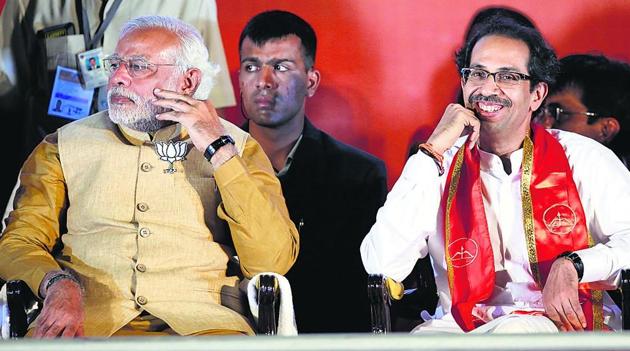
The art of enjoying perks of power and at the same time criticizing the ruling partner is again in focus as the Sena decided not to stand by its ally BJP as a no-trust motion was moved against the Modi government in Lok Sabha.
Sena leadership decided to boycott the proceedings when the motion was debated and voted in the Lok Sabha. Now, in an interview to Sena mouthpiece Saamana on Monday, Sena chief Uddhav Thackeray sought to explain his stand – he didn’t want to vote against the BJP because they were partners in power. He did not want to side with the Telugu Desam Party and the Opposition and would choose when to act against the BJP.
This leads to a rhetorical question: why isn’t the Sena quitting the government if it doesn’t want to stand with the ruling party while being in power?
Sena’s reply is that they will speak against the government whenever they think the latter is taking decisions that are not in the interest of the people.
Looking for logic in that explanation? Well, politics and logic may not go hand in hand in such cases. It is more about political calculations or opportunities.
But then, can the Sena alone be blamed for this?
The Shiv Sena-BJP alliance government that was in power in 1995-99 had also seen some bickering. Ironically, it was the BJP that had targeted the Sena, which was the major partner in the alliance. BJP leaders had publically targeted decisions such as forming a company to handle slum rehabilitation projects in Mumbai and the move to allot Maharashtra Housing and Area Development Authority’s (Mhada) plots at prime places in Mumbai to certain individuals. The related departments were with the Sena ministers then. Often, the BJP ministers used to privately speak against the decisions taken by the government. Many of them were then unhappy with chief minister Manohar Joshi who hailed from the Sena.
The Congress-NCP alliance that wrested power from the saffron combine in 1999 continued this tradition. The NCP took it to a new level. The two parties were together in power for 15 years but they were constantly at loggerheads during most of this period. NCP leaders often used to criticize the government publicly. The bickering between the two parties reached such a level that it used to affect the functioning of the government.
The Shiv Sena has just taken a cue from the NCP and customized it for itself.
The key question here is why do the parties do so? It is done to retain its support base or to occupy some opposition space. Sometimes, it is also done to avoid a split. The party leaders are not happy with the deal they get but also fear that some of their legislators would defect to the ruling party the moment they walk out of the government. In a nutshell, it is their compulsion to stay in power but at the same time they want to keep appealing to a certain support base or a group.
There have been arguments that the voters do not approve of such opportunistic politics, which is debatable. The Congress and NCP bickering went on for 15 years while they were in power but they were re-elected in 2004 and 2009. The NCP managed to hold on to its voter base till it lost ground during the Modi wave in 2014. The Sena managed to win municipal elections, including Mumbai civic body, while it continued to target the BJP. Most recently, it gave a tough fight to the BJP while contesting the Palghar Lok Sabha byelection. We will have to wait till the next Lok Sabha or Assembly elections to see if Uddhav Thackeray’s gamble works or not.

Stay updated with all the Breaking News and Latest News from Mumbai. Click here for comprehensive coverage of top Cities including Bengaluru, Delhi, Hyderabad, and more across India along with Stay informed on the latest happenings in World News.


