
 E-Paper



BMC commences coral translocation at Haji Ali and Worli for Mumbai coastal road project
The Brihanmumbai Municipal Corporation (BMC) began the process of shifting corals along the coastal road project route on Thursday, and it will take seven days to

 Prefer HTon Google


The Brihanmumbai Municipal Corporation (BMC) began the process of shifting corals along the coastal road project route on Thursday, and it will take seven days to complete the process.
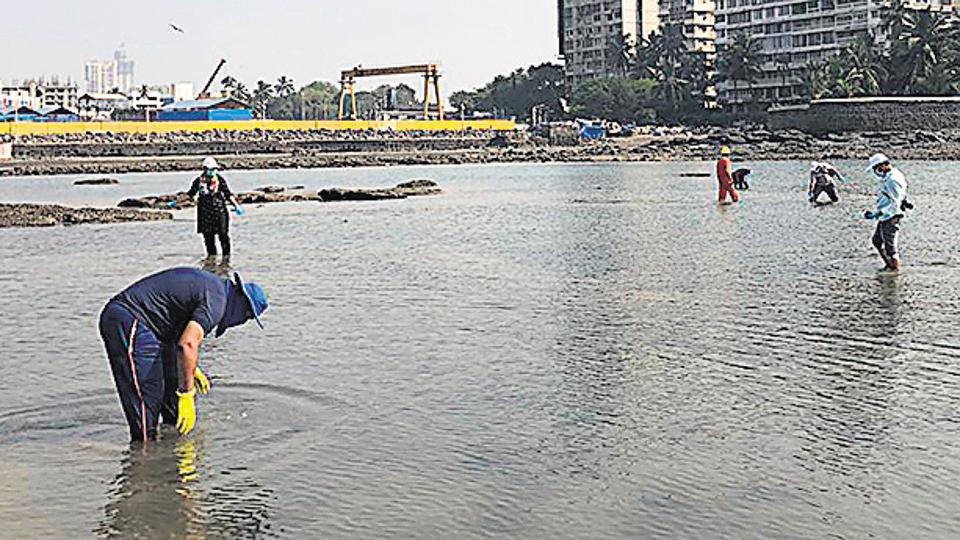
The state mangrove cell, which is monitoring the translocation, explained how the process will be carried out by the Goa-based National Institute of Oceanography (NIO).
Protected under Schedule I of the Wildlife Protection Act (WPA), 1972, corals are marine species sporadically spread across rocky intertidal regions along the Mumbai coast. BMC plans to shift two species of corals – 18 colonies across almost three feet at Worli, and another species across 1.1 foot at Haji Ali. BMC received WPA clearance from the Centre and forest department in October for the translocation.
“We began surveying both coral areas on Thursday with NIO and the mangrove cell. From Friday, major works will commence,” said a senior BMC official, requesting anonymity.
DR Patil, divisional forest officer (mangrove cell) said that the corals will be shifted to two different sites by NIO. “For Haji Ali, large boulders [on which coral colonies are] will be removed from the base and shifted at an identified location at Navy Nagar. Each coral colony will be tagged. Initially, all boulders will be removed and kept at Haji Ali in the water itself. Once all colonies are collected, the boulders will be shifted together.”
The mangrove cell has appointed range forest officer Suresh Warak and marine biologist Harshal Karve to monitor the translocation.
At Worli, sparse coral colonies have been identified across isolated rocks. “These rocks will be cut out and relocated to a site in Worli itself [outside the project area]. A base using cement and other materials will be made on which the cut rocks will be placed,” said Patil, adding that each coral colony will be tagged. “This will help us understand how many corals have been shifted and monitor them post translocation.”
Environmentalists said the entire translocation process had been plagued by lack of transparency. “It seems that this translocation is being carried out as a fait accompli, and there is no information available about the experience or the track record of the people carrying out this operation. I do hope the corals survive the translocation,” said Debi Goenka, executive trustee, Conservation Action Trust.
CONDITIONS TO TRANSLOCATE CORALS
While issuing the final nod to translocate two coral patches the Union environment ministry listed six conditions that BMC must comply with:
i) The entire translocation operation must be carried out in the presence of the forest department, and an expert from the Wildlife Institute of India, Dehradun or any marine expert from a national institute
ii) Ensure adequate protection to the corals during the entire process and also at the translocated site
iii) No damage is caused to other wildlife and utmost care exercised during translocation
iv) Submit a completion report post translocation to MoEFCC and periodic reports on the status of corals after translocation to new site
v) Ensure no diversion of protected areas or eco-sensitive zones are involved, and the process is not in contravention to any judicial awards
vi) In case of any mishap during translocation that endangers or may endanger the safety of the scheduled species, MoEFCC may review or revoke permissions given.
(Source: MoEFCC permission document)


