
 E-Paper



Cope, of good hope: Mumbai’s infra check
Mumbaiites have been shown this dream of seamless travel by multiple governments in the past. Almost 15 years ago, the Congress-Nationalist Congress Party (NCP) regime had promised a 146-km Metro network by 2021.


Days before the dates for the Maharashtra Assembly elections were announced, chief minister Devendra Fadnavis had said the government’s plan was to integrate the whole of Mumbai Metropolitan Region (MMR) via Metro, so anyone travelling from one place to another in MMR reaches his destination within 60 minutes. “We are creating a green transportation system which will carry one crore commuters by 2024. Mumbai will boast of the country’s largest Metro network and will also be the first city where integrated ticketing services project will be implemented,” Fadnavis had said, as he shared the dais with Prime Minister Narendra Modi in Mumbai.
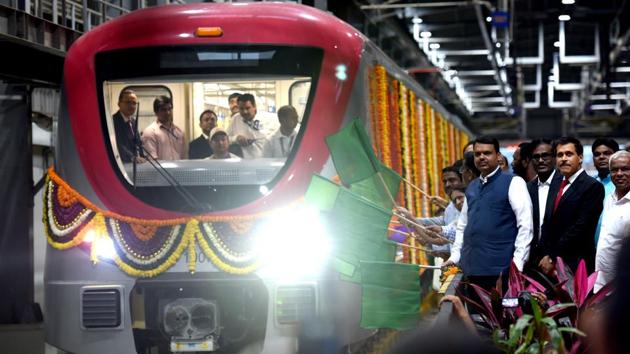
Mumbaiites have been shown this dream of seamless travel by multiple governments in the past. Almost 15 years ago, the Congress-Nationalist Congress Party (NCP) regime had promised a 146-km Metro network by 2021. However, so far, there is only one Metro network connecting three suburbs in Mumbai – Versova, Andheri and Ghatkopar. Connectivity to the urban areas around Mumbai is poor and dependent on the overburdened suburban railway. Mumbai has also earned the tag of the most traffic congested city in the world. While the Fadnavis government, in the past five years, has won credit for clearing many projects that were stuck for decades, Mumbai is still far away from the dream of a seamless, comfortable travel to work.
THE GRAND PLANS
The state is looking at implementing 13 Metro lines in and around Mumbai, of which six lines are under construction – Metro 2A (Dahisar-DN Nagar), Metro 2B (DN Nagar-Mandale), Metro 3 (Colaba-Bandra-Seepz), Metro 4 (Wadala-Thane-Kasarwadavali), Metro 6 (Swami Samarth Nagar-Vikhroli) and Metro 7 (Dahisar E-Andheri E). PM Modi recently did the bhoomipujan for three more lines – Metro 10 (Gaimukh-Shivaji Nagar), Metro 11 (Wadala-General Post office), Metro 12 (Kalyan-Taloja) and the detailed project report for three more lines are currently underway. These include Metro 8 (Airport Metro from Chhatrapati Shivaji International Airport to the proposed Navi Mumbai Airport, Metro 13 (Shivaji Chowk to Virar) and Metro 14 (Kanjurmarg to Badlapur).
The Mumbai Metropolitan Region Development Authority (MMRDA), which is executing the Metro projects, recently revealed its brand vision document of 337.10 km of Metro network in the MMR. Of these, lines 2A and 7 are expected to be operational from December 2020 and the underground Metro 3 will start operations from 2021.
Pankaj Kapoor, founder and managing director at realty consultancy Liases Foras, said, “Between 2004 and 2013, Mumbai almost received a step-motherly treatment, with no infrastructure development, except Metro 1 and monorail, which also took years to complete. In comparison, Delhi developed at a rapid pace.”
Before the Lok Sabha elections, Fadnavis and Modi spoke about the BJP’s focus on Mumbai’s infrastructure and took potshots at the slow pace of work under the previous government in almost every speech.
Surendra Jondhale, a political analyst, said the BJP’s large focus is on urban voters for whom infrastructure development is a huge point. “Most of the areas in the MMR are now semi-urban, which give priority to urban development. So the BJP’s focus is on urban infrastructure and development,” Jondhale said.
CRUMBLING INFRA
Along with the six Metro lines, the state government has also undertaken the work of executing the 22-km Mumbai Trans Harbour Link (MTHL), a sea bridge connecting Mumbai to Navi Mumbai, the Navi Mumbai International Airport (NMIA), the coastal road from Nariman Point to Kandivli, the Versova-Bandra sea link and the eastern waterfront development, which together account for ₹1.22-lakh-crore of investment. The Central government is also planning an ambitious bullet train from Mumbai to Ahmedabad, which will take the overall cost to ₹2 lakh crore.
However, behind the talks of investment in crores are Mumbai’s potholed roads, crumbling buildings, old bridges, over-crowded streets, trains and buses and water-logging every monsoon, where the BJP government has failed to show any improvement.
AV Shenoy, a transport expert from Mumbai Vikas Samiti, said the government never really looked at quick fixes to save a crumbling Mumbai. “It was all about announcing big-ticket projects. However, low-cost projects such as implementing a bus rapid transport system or creating a pedestrian cell to make Mumbai a walkable city would have helped improve the quality of life,” Shenoy said.
Jondhale also said the tussle between the Shiv Sena, which rules the Brihanmumbai Municipal Corporation (BMC), and the BJP in the past five years also resulted in the decay on-ground. “There is always a conflict when Mumbai drowns during the monsoon. The Sena will claim the MMRDA maintains some roads and shy away from the civic body’s main responsibilities,” Jondhale said.
The BMC’s comprehensive mobility plan of 2016 suggested dedicated bus lanes along the western express highway and the eastern express highway, but it was never implemented. The corporation’s development plan also said 51% of the city’s trips are on foot, however, there is no agency that looks specifically at pedestrian issues in the city.
Atul Shah, BJP spokesperson, said the government is looking at every issue in detail. “Be it the railways or the corporation, all issues related to infrastructure are being looked into. We are also working towards making some lanes vehicle-free and pedestrian-friendly measures, but these projects take time to be implemented.”
STILL THE FINANCE CAPITAL?
A report released by Oxford Economics in 2016 ranked Mumbai 31 of the 50 top metropolitan economies in the world. The global advisory firm ranked Delhi National Capital Region at 30 and also predicted 2030 rankings where Delhi would be at rank 11 and Mumbai at 14. The Global Metro Monitor 2018, released by the Washington-based Brookings, has only one Indian metropolitan region in the top-10 best-performing metro economies in the world – Delhi NCR. Many experts believe that Mumbai’s high cost of land and skilled labour are not attracting business making the financial capital lose its sheen.
Abhay Pethe, economics professor at the Mumbai School of Economics and Public Policy, said, “The primary reason is unaffordable realty prices which are pushing everyone out of Mumbai. It is also because of high congestion and poor quality of life that Mumbai offers, which make businesses choose cities like Delhi, Pune, Hyderabad and even Bengaluru.”
Mumbai also lost out on its long-pending dream of setting up an international finance centre (IFSC) in the Bandra-Kurla Complex to Gujarat. In 2015, Fadnavis had made the promise of creating an IFSC in Mumbai on the lines of Dubai, New York and London to make Mumbai an international finance hub. However, the Central government clearly delineated its stand by stating that unless the IFSC in Gujarat is put to optimum use, a second IFSC will not be developed.
Kapoor said that Mumbai would have been ideal for an IFSC given that the finance fabric exists in Mumbai. “Mumbai represents the banking and finance sector, so the city should have hosted an IFSC. If the MTHL had developed earlier, maybe Navi Mumbai could have been looked at.”
Professor Pethe, however, said the state government just leveraged on the age-old parlance of Mumbai being the finance destination without creating the right policy framework to house the IFSC.
Fadnavis, however, had said in the legislative council that although the central government has proposed the IFSC in Gujarat, the Maharashtra government was determined to set up another such centre at Bandra-Kurla Complex on its own.


Stay updated with all the Breaking News and Latest News from Mumbai. Click here for comprehensive coverage of top Cities including Bengaluru, Delhi, Hyderabad, and more across India along with Stay informed on the latest happenings in World News.


