
 E-Paper



Ageing Noida on lookout for elixir of well-being
Increasing pollution and reducing green cover are also a major concern and if natural resources are not managed properly, their decline will affect the health and well-being of residents.

 Prefer HTon Google


Although a planned city, 43-year-old Noida is already facing infrastructure issues and paucity of resources that’s eating away at its sheen. April 17 is celebrated as the Foundation Day of the city.
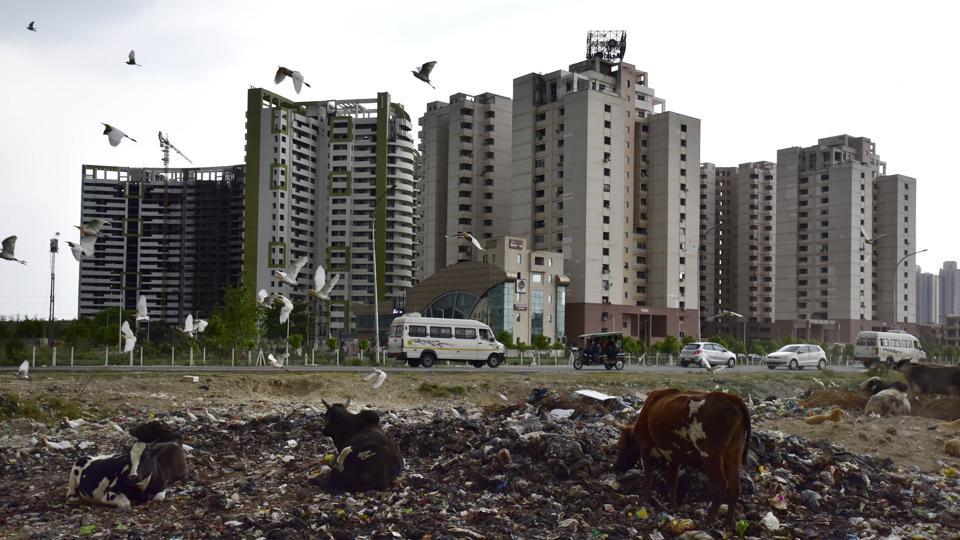
Established in 1976, in the middle of the national emergency, Noida was conceived as an industrial hub. It remained a cluster of 243 villages till it was notified as a township on December 24, 2000. Since then, Noida has grown as a residential area with several high-rise apartments and commercial buildings.
The population density also expanded exponentially over the years. However, despite the increasing pressure on the city’s resources, better and sustainable management of these resources has been a concern for residents and planners. Residents say the city has aged faster than its 43 years, with landfill already full, traffic at its peak and drains overflowing.
“There has been development in the city but at a cost. Even after the authorities realised that the population will grow exponentially, necessary planning was not done to accommodate it. There is no clarity on waste management, door-to-door collection or how will we prevent the landfill site from filling up. Traffic congestion in the city keeps increasing by the day,” AN Dhawan, secretary general of Federation of Apartment Owners’ Associations (FONRWA), said.
Dhawan has been living in Sector 52 for 21 years and has been raising residents’ concerns for years. He added that despite meeting officials and promises made by politicians, issues such as solid waste management, forming civic by-laws, encroachment by vendors and stray dog menace, among others, remain unresolved.
“All these issues can be managed, but the authority tends to sit on them till they become acute,” Dhawan said.
Increasing pollution and reducing green cover are also a major concern and if natural resources are not managed properly, their decline will affect the health and well-being of residents.
“Okhla Bird Sanctuary is a huge resource that was naturally available in the city, and has been deliberately destroyed over the past few years. It was a lush green space that invited thousands of birds and I would have visited the park several times till 2009. However, when the DND Flyway was constructed and then in 2011, after the Dalit Prerna Sthal came up at the expense of 9,000 trees, the park was destroyed and birds stopped coming,” Anand Arya, environmental expert and a resident of Noida for 29 years, said.
Residents also complain that lack of coordination between departments has increased problems. Law and order concerns have also increased, but the augmentation of the police force has not been done accordingly.
“There is a limit to expansion and the authorities need to focus on improving infrastructure. Noida is already stretched beyond capacity. Safety concerns have increased, especially for women,” Harisuman Bisht, popular Hindi/Urdu author and a resident of Noida since the early 1990s, said.
He, however, said, “I can still say that Noida is a better place to live in than many other developed cities. All we need here is better management and regular maintenance of infrastructure.”
Experts say planners need to utilise existing resources sustainably so that Noida remains livable. To prevent the city from ageing faster, better maintenance would be the right step.
According to experts, the interaction of Noida was initially planned to be only with Delhi. However, there has been interactions with Greater Noida, Gurugram and several parts of western Uttar Pradesh, apart from a huge increase in intracity commute as well. This has led to congestion and persistent traffic issues.
“It has been observed that in any city, if congestion index increases, it leads to reduced accessibility and a decline in investment. Therefore, it is essential for Noida to start working on reducing congestion by improving public transit network and last mile connectivity. This does not just mean having a Metro, but also smaller transport networks like a city bus service. Noida’s charm used to be its accessibility and connectivity, and this needs to be revived,” Sewa Ram, professor, transport planning, School of Planning and Architecture (SPA), New Delhi, said.
He explained that a similar boom happened in Gurugram when NH-8 (now NH-48) was planned. The road took development up to Manesar and Bhiwadi. However, with increasing travel woes, there was a sudden lull in the area.
“Noida was initially planned as a low density town, but catering to the increasing population, around 2007, the NCR planning board insisted that the density of Noida be increased from 80 persons per hectare to 150. By then, most of the older sectors were already developed and the densification was shifted to newer sectors,” Rajpal Kaushik, former chief town planner of Noida, said.
“There are very good plans in place but the problem is with implementation. The city’s roads, water supply, sewage and drainage network and all other infrastructure has to be updated timely and authorities keep trying to make efforts towards it,” Kaushik said.


