
 E-Paper



Chandrayaan opens new vistas for India
The mission’s success propels India to the threshold of multilateral space missions, exploration of outer space and use of celestial resources in the future

 Prefer HTon Google


As Vikram touched down on the surface of the Moon smoothly and safely on Wednesday evening, India became the fourth nation to soft-land an uncrewed craft on the lunar surface, and notably, the first to soft-land on the south pole of the Moon.
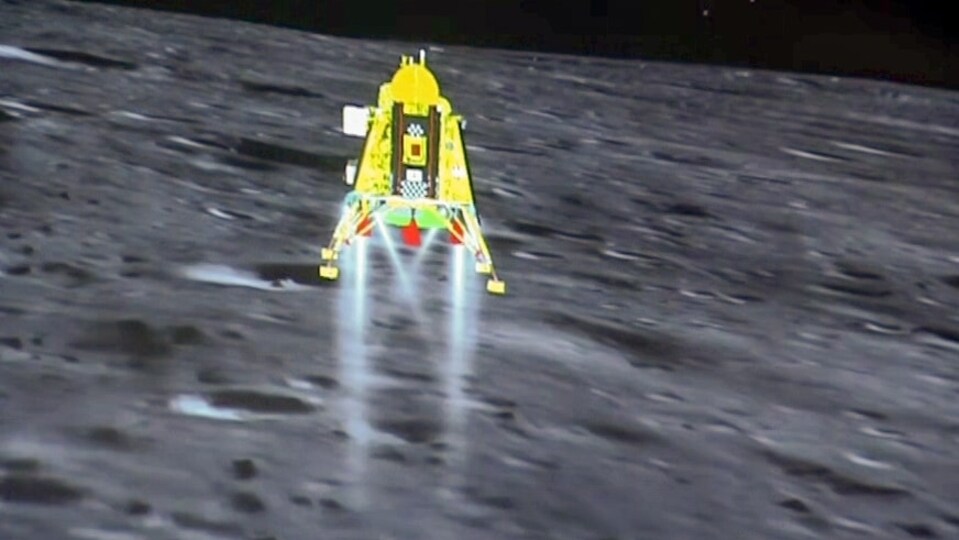
Every Indian rejoiced with pride while the whole world watched with awe our rising acumen in the arena of outer space under the leadership of Prime Minister (PM) Narendra Modi, a space buff himself. The technological feats were executed brilliantly by the Indian Space Research Organisation (Isro) along with a host of partners from industry, start-ups, and academia.
Space missions are exciting, but exacting too. They are complex pieces of technology and must operate for long, in the harsh and somewhat uncharted environment of outer space. India hurtled into space in 1962 with modest efforts in space science and rapidly grew on the bedrock of the indomitable vision of Dr Vikram Sarabhai and an exemplary organisational edifice crafted by professor Satish Dhawan. Risk management and failure recovery are part of the practice in rocket science.
The hallmark of India in the global space sector is the focus on its helpfulness for humankind through a constellation of Earth-oriented satellites (for communication, navigation, remote sensing) and an effective institutional tie up with all stakeholders along with concomitant self-reliance in space technology and launch capability. Their impact on stakeholders — in the government, industry and the public at large — is quite high. By the turn of this century, scientific and space exploration missions were here to stay, inspiring young minds, and propelling national pride. India has been expanding its limits in this tough domain and exploring new possibilities, armed with space sector reforms of 2020, and the Indian Space Policy 2023 enunciated recently.
Chandrayaan-1 (2008) and the Mars Orbiter Mission (2014) underscored India’s ability for precise navigation into deep space and for the tricky capture of the orbit of these celestial bodies, after a long journey (400,000 kilometres to the Moon, and 660 million kilometres to Mars). The Moon Impact Probe of Chandrayaan-1 established a smooth separation from the mother craft in lunar environs, for an intended free fall to the lunar surface and crashing on it.
In contrast, a soft landing on the lunar surface is quite intricate and technologically challenging, as we saw in the last lap of the Chandrayaan-3 mission. Here, an orbiting Vikram lander, while at around 30 kilometres above the Moon and at a velocity of 1.68 km/sec (i.e., about 6,050 km per hour), slammed the brakes on itself (using a set of rockets onboard) to the touchdown velocity of about 0.6 metres per second within 20 minutes and concurrently steered itself to the designated area on the lunar surface with the help of a set of sensors, algorithms and software aboard. At the same time, the suitable site of the landing (without boulders, ridges, and craters) was also ascertained while on the descent.
The success accentuated the intrinsic resilience of the Indian space fraternity to learn and adapt from past failures (the crash landing of Chandrayaan-2), institutional synergy and team excellence. This was achieved by the selfless service of a few thousand men and women at all levels with varied specialisations, working together 24x7 with a singular focus — the success of the mission and ensuring the rise in Isro’s stature and national pride. Vikram carries a suite of scientific instruments built by Indian scientists to study lunar seismic activity, plasma environment and thermal properties (near-surface), spectral signatures of the Earth from the lunar orbit, as well as elemental composition in and around the landing site (by the Pragyan Rover) during its life within a lunar day (i.e. 14 days of Earth). Hopefully, these instruments will bring forth path-breaking scientific findings like that from Chandrayaan-1.
Significantly, Chandrayaan-1 provided the platform for international cooperation by accommodating scientific payloads developed by five other nations, particularly that from the National Aeronautics and Space Administration (Nasa) in the United States (US), which discovered the presence of water molecules in the lunar North Pole. The Vikram lander carries Nasa’s Laser Retroreflector Array, a lightweight structure with eight retroreflectors that can serve as a long-term geodetic station and a location- marker on the lunar surface.
Astrosat, India’s first dedicated multi-wavelength space telescope that was launched in 2015, has been a globally acclaimed mission for space astronomy. The forthcoming Aditya-L1 mission is aimed at observing and understanding the chromospheric and coronal dynamics of the Sun. India is now on the threshold of climbing the next step of the technology ladder to embrace multilateral joint space missions (robotic and human-in-loop) for the exploration of outer space and the use of celestial resources (from the Moon, Mars, comets and asteroids) for the scientific, economic, and social growth of the world.
Thanks to the futuristic vision and diplomatic prudence of PM Modi, India became a party to the 2020 Artemis Accords led by the US. This opens new vistas for India. The joint missions undertaken within the framework of existing technological and economic prowess as well as geopolitical aspirations of the emerging new world order, will drive several technological advancements and spin-offs for the future, along with scientific revelations.
K Radhakrishnan is former chairman, Isro. The views expressed are personal


