E-Paper



Climate and Us | The Parvati Valley forest fire is a sign of the times to come
There are immediate meteorological features that can be linked to this spike in temperatures in March and April, but officials have explained to me that such extremes may not have been possible without the climate crisis.

 Prefer HTon Google


I got a short message last Wednesday around 8 PM from glaciologist Anil Kulkarni saying: “Huge forest fire in Parbati Valley. May affect glacier melt.”
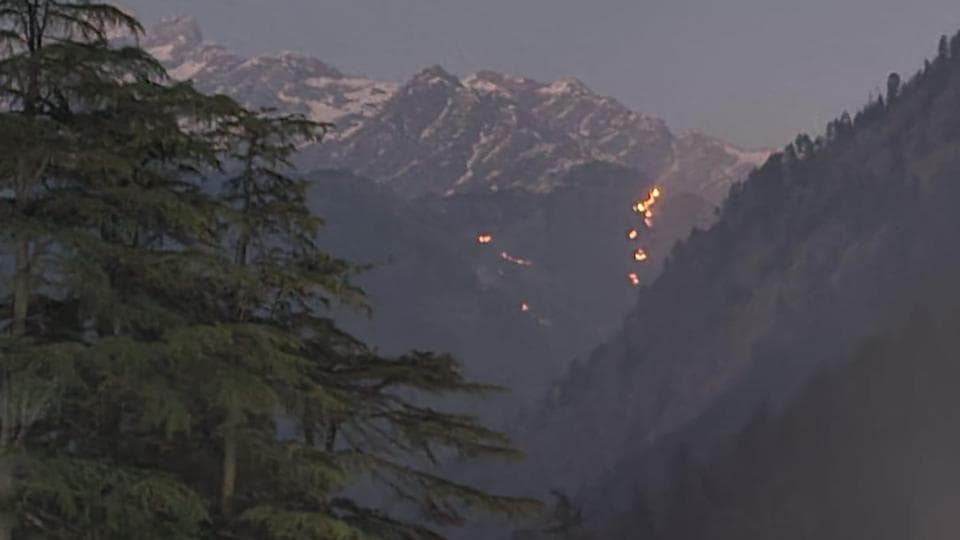
My first thoughts were: How can forest fires in the hills affect the glaciers that are so high up and far off? I replied that I would call him the next morning because I also felt it was possibly too late to follow up on the forest fire story for Thursday’s edition.
This was until he sent me some images of the fire. What I saw was heart-breaking. Fires gleamed around white snow-capped peaks giving a surreal picture of ice and fire in the same valley. I called him back immediately to get the details.
Professor Kulkarni of the Indian Institute of Science, who has done decades of work on Himalayan glaciers, said he had never seen anything like this in such high altitudes in the 40 years of his career. The heat and soot from the fire would affect the glaciers. Parvati Valley in Himachal Pradesh has 279 glaciers and 396 sq km of glaciated area, he said. I quickly filed my report but the image has stayed with me and many others who messaged me after reading about it.
Forest fires have been ravaging several parts of the country in March and April so far. Between March 15 and April 3, 98,286 fire points have been recorded by the Forest Survey of India based on satellite imagery. These fires leave devastating impacts on flora and fauna and people in the region by exposing them to extreme heat and noxious fumes.
During the 2019 Australian bush fires, images of injured animals moved many readers. A Koala with his back skin charred sitting as flames rose all around him is etched in my memory. It was an image that captured how the climate crisis, caused by humans, impacted animals by pushing them over the edge.
In most cases of forest fires, it’s a combination of someone, deliberately or by error, setting a fire that spreads rapidly due to conducive environmental conditions, experts have said. Both forest and meteorological officials that I spoke with said, in rare cases, fires begin on their own. Perhaps locals need to be roped in to keep a watch and prevent forest fires in vulnerable regions every summer.
The other side of the forest fire story is the unusually dry and hot spring over northwest and central India this year.
Wildfires, in many regions, have affected ecosystems and species, people and their built assets, economic activity, and health according to Intergovernmental Panel on Climate Change’s report titled Impacts, Adaptation and Vulnerability released on February 28.
The risk of severe climate impacts like forest fires increases with every additional increment of global warming.
In high-carbon ecosystems, such impacts are already being observed and are projected to increase with every additional increment of global warming, such as increased wildfires, mass mortality of trees, drying of peatlands, and thawing of permafrost, weakening natural land carbon sinks and so on, the IPCC has flagged in the report’s summary for policymakers.
Wildfires represented 3.5% of recorded disasters between 1998 and 2017, and though there is no clear data to show the increase in fatalities and losses, there is a net sharp rise in suppression costs according to a background paper by the United Nations (UN) Forum on Forests. “Ongoing climate change and other environmental issues linked to globalized human activities will make fire disasters more likely; definitive numbers, however, are impossible to provide given the complex feedback existing between fire, climate, and human footprint. Nonetheless, there is a general scientific agreement that many regions will experience more fire-conducive climate, leading to drier and warmer weather conditions,” the report said.
On Friday, India Meteorological Department, Pune, in its climate summary said this March had recorded the warmest day temperatures (maximum) in 121 years. Over northwest India, the average maximum temperature in March was the highest with a departure of 3.91 degrees Celsius above normal. The average minimum temperature — or night temperature — was the second-highest since 1901 with a departure of 2.53 degrees Celsius above normal. The mean daily temperature was the second highest with a departure of 3.22 degrees Celsius above normal. For the first time in 132 years, this March also recorded two systems of the intensity of depression and above forming over the north Indian Ocean.
Several immediate meteorological features can be linked to this spike in temperatures in March and April, but officials have explained to me on several occasions that such extremes may not have been possible without the climate crisis.
Today, IPCC will release its second report of this year and third report since last August spelling out what is a living reality for millions of people.
It will specify how globally nations have failed to curb emissions. Current national climate plans/nationally determined contributions (NDCs) will see us warm by about 2.7 degrees C this century, or possibly even higher according to the Emissions Gap Report 2021 by the UN Environment Programme and if CO2 emissions continue at current rates, we will exhaust the remaining 1.5 degrees C carbon budget in the early 2030s.
Today’s report will be significant because earlier two reports of the world’s most authoritative panel of climate experts — Climate Change 2021 - The Physical Science Basis, released in August last year and Climate Change 2022 - Impacts, Adaptation and Vulnerability, released last month — highlighted that at least half the world’s population lives in regions vulnerable to the climate crisis and that it has already resulted in several irreversible impacts.
The planet may have lost the opportunity to keep global warming under 1.5 degrees Celsius above pre-industrial levels, IPCC said in its August 2021 report. The 1.5 degrees global warming threshold is likely to be breached in the next 10 to 20 years in all emission scenarios, including when carbon dioxide emissions decline rapidly to net-zero around 2050.
The response to IPCC’s previous report has been lukewarm and now, the world’s attention is caught up in the security unrest in Ukraine and its severe fallout on energy and the economy.
From the climate crisis to air pollution, from questions of the development-environment tradeoffs to India’s voice in international negotiations on the environment, HT’s Jayashree Nandi brings her deep domain knowledge in a weekly column
The views expressed are personal