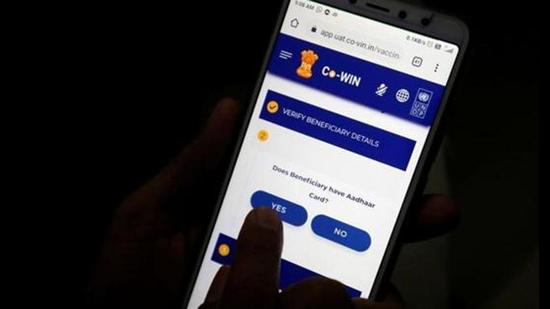
CoWIN’s inclusive and dynamic design can serve the world
CoWIN is now being envisaged as a digital vehicle for universal vaccination, blood donation, and may also be considered as a platform for organ donation in the future. The possibilities are endless
As we cross the historic milestone of a billion vaccine doses, imagine what might have happened if we didn’t have CoWIN.
The CoWIN platform has also been linguistically inclusive, offering services in 17 languages. With over 1.18 billion mobile connections, the mobile number was chosen as the registration gateway (REUTERS)
Could we have expected every citizen to remember the vaccine they took, and adhere to timelines, when the recommended interval between doses itself was changing? Wasn’t there a possibility of mix-up with two vaccines in a manual system? Didn’t it help to give people the option of choosing any centre for their second jab? Isn’t the value of digital certificates now evident, from international and domestic travels to keeping workplaces safe?
CoWIN not only enabled all of this, but it mastered scale and speed efficiently and transparently. It reduced the information asymmetry between people and the system, democratising the vaccination drive. From providing details such as the location of the nearest vaccine centres to almost obliterating the scope of any blackmarketing, CoWIN kept all stakeholders aligned and the system transparent.
From our experience, we know how scarce and valuable commodities become susceptible to leakage, rent-seeking, and other unfair practices. By tracing vaccines’ end-to-end, accountability was built into the system by design. In a culture obsessed with VIPs, CoWIN also proved to be a great leveller, by making sure that access to a life-saving resource is not determined by privilege, but by eligibility. The factors for eligibility always kept the most vulnerable at the forefront.
The system, while clear on the need for digitisation, was mindful of the digital divide. One set of people logged in and booked their appointments on the CoWIN portal. The other, larger subset of people, almost 70%, walked in without digital appointments, and was assisted with their registration and data digitisation at the Covid-19 vaccination centres. Over 240,000 Common Service Centres and a National Health Authority call centre also helped many more with registration for vaccinations in an assisted mode.
The CoWIN platform has also been linguistically inclusive, offering services in 17 languages. With over 1.18 billion mobile connections, the mobile number was chosen as the registration gateway. Aadhaar was recommended for identification due to its digitally robust authentication system and coverage of over 1.3 billion, and eight more options of identification were also offered for a truly inclusive approach. Even the architecture of CoWIN is inclusive and has been made open and interoperable.
CoWIN was also designed to be dynamic. Its constant improvisations are based on the rules framed by the government, and ground-up feedback. The portability feature allowed the freedom to individuals to choose when and where they wanted to take their first and second jab. People were also using different mobile numbers to register for their first dose and second dose. Initially, the platform didn’t have the system to de-duplicate. However, CoWIN evolved to subsequently allow them to merge and create a complete two-dose digital vaccination certificate.
As economic activities gathered pace, employers, public transport authorities, travel establishments, and others wanted to verify the vaccination status of people to ensure safety for all. Our recently launched Know-Your-Customer’s/Client’s-Vaccination-Status [KYC-VS] feature, allows for that to happen, with the beneficiary’s consent, with absolutely minimal data-sharing.
At a time when most countries were issuing manually signed hand-written certificates, even the first vaccination certificate issued in India was digitally signed and verifiable through CoWIN. When individuals needed their passport numbers to link with their vaccine certificates as per their convenience, a feature was added to allow them to do that as well.
Looking at the way CoWIN empowered our own vaccination drive, Prime Minister Narendra Modi suggested that this resource be shared with the world. CoWIN is India’s digital gift to the world. Following his direction, we hosted a global conclave on Co-WIN on July 5, 2021, where 141 countries participated. We are in the process of signing an MoU with one such attendee country and are in discussions with almost a dozen others.
CoWIN is now being envisaged as a digital vehicle for universal vaccination, blood donation, and may also be considered as a platform for organ donation in the future. The possibilities are endless, but the focus remains on serving the larger public good — today for India, and tomorrow for the world.

 E-Paper