
 E-Paper



Ecostani | In defence of ‘freebies’
Freebies undo historical injustices; bridge inequality gap; help fulfill constitutional promises; and are essential for socioeconomic welfare


Prime Minister (PM) Narendra Modi, at the inauguration of Bundelkhand Expressway in Uttar Pradesh, urged voters to reject attempts of political parties to lure voters through cash doles, which he termed as “revdi culture”, before elections, saying it could drain the economy.
His comments evoked strong reactions from political parties, especially the Aam Aadmi Party, whose convener and Delhi chief minister, Arvind Kejriwal, said giving quality service to people was not “revdi culture” and giving “benefits to a few corporates” was an example of this culture. Revdi means giving electoral freebies.
The PM’s comments on July 16 came a few weeks before the Supreme Court (SC) was expected to take up a Public Interest Litigation filed by a Bharatiya Janata Party (BJP) member, Ashwini Upadhayay, seeking a ban on freebies. On August 4, Chief Justice NV Ramana, who headed the three-member bench, expressed “Constitution limitation” in regulating freebies and wondered whether Parliament will bring a law to regulate freebies, on the suggestion of lawyer and Rajya Sabha MP, Kapil Sibal.
“Do you really think Parliament will regulate freebies? Which political party will debate this issue?,” Justice Ramana asked and then added that each political party wants freebies.
In the order, the SC decided to appoint an expert panel having members from the Finance Commission, Niti Aayog and Election Commission to suggest a formulation to regulate freebies. The court wondered if the Finance Commission can come out with guidelines for regulating or restricting freebies
Defining a “freebie”
There are different definitions of freebies, which covers a wide range of subsidies the government gives to people.
Most economists don’t consider subsidies given to people that deal with inherent societal inequality such as food and education as freebies, while doles such as giving washing machines, laptops to children, cheaper electricity and free water supply are considered freebies. There is no clear definition of what amounts to a freebie.
The Reserve Bank of India (RBI), in its recent economic risk analysis paper, dealt with the issue of freebies. “While there is no precise definition of freebies, it is necessary to distinguish them from public/merit goods, expenditure on which brings economic benefits, such as the public distribution system, employment guarantee schemes, states’ support for education and health,” the paper said.
The paper spelt out free electricity, free water, free public transportation, waiver of pending utility bills and farm loan waivers as freebies. The paper said these freebies potentially undermine credit culture, distort prices through cross-subsidisation eroding incentives for private investment, and disincentivise work at the current wage rate leading to a drop in labour force participation.
In the self-balancing act, the paper said some freebies may benefit the poor if properly targeted with minimal leakages. However, it was quick to add that the advantages must be evaluated against the large fiscal costs and inefficiencies they cause by distorting prices and misallocating resources, questioning the rationale continuation of several welfare schemes, which may fall under RBI’s freebie definition.
Fiscal argument
The RBI, on basis of the latest state budget figures, documents the expenditure on freebies range from 0.1% to 2.7% of the Gross State Domestic Product (GSDP), which is still less than the tax incentives provided to corporates through budgetary provisions.
The freebies exceeded 2% of the GSDP of Andhra Pradesh and Punjab, the two most financially vulnerable states, as per RBI estimates. Punjab for instance, spent 45.7% of its own tax revenue through subsidies and Andhra 30.3%. One should take into account that the state’s tax revenues, except excise, are not rising to keep pace with the rising expenditure, with the Centre also shrinking its share of funding to states through centrally Sponsored Schemes.
The RBI has also argued that because of freebies, the state’s debt to GSDP ratio was rising again, mostly on account of the power distribution debt burden, because of power subsidies to farmers to retail consumers. The states have been giving power subsidy to suppress the electricity prices in a bid to provide relief to the middle and poorer classes. Though in most states, the power subsidy is based on electricity consumed and not a blanket subsidy, as the paper seems to suggest.
The RBI said that states’ non-budget obligations have been rising in recent years and were around 4.5% of GDP in 2022. While the power sector accounts for almost 40% of these guarantees, other beneficiaries include sectors such as irrigation, infrastructure development, and food and water supply. The government had argued that power distribution subsidies were preventing the private sector from investing in these sectors to improve efficiency.
However, pro-subsidy economists argue that high electricity costs push people to spend less on food and look for non-environment friendly alternates such as biomass burning and therefore, targeted subsidy in the power sector is not bad.
Giving a reason to check rising freebies, the RBI said the Centre’s GST compensation payout has come to an end in June 2022, which will further reduce headroom available for social sector expenditure. And, in such a scenario, a multitude of social welfare schemes in the form of freebies will put a heavy burden on the exchequer and will also exert upward pressures on yields if they are financed through market borrowing.
“It will be important, therefore, for the state governments to reprioritise their expenditure to achieve optimum long-term welfare advantages by ensuring that the beneficiaries get empowered permanently and forego such benefits,” the paper argued. The RBI reiterated what different finance commissions have said earlier a sunset clause for each social sector scheme.
The economic good
What the RBI said in its paper may look economically prudent, but ending “freebies” may cause socio-economic disaster.
For instance, consider the farm sector. Cheaper electricity helps keep down the input cost for staple agriculture commodities rice and wheat, lessening inflation impact on them, when prices of all other inputs — fertilizer, pesticides and labour – have almost doubled in the past five years. As the government has reduced subsidies on fertilizers and pesticides, the farm sector is facing high input cost stress, leading to several state governments such as Telangana, Jharkhand and Odisha declaring crop sowing subvention schemes.
The argument that freebies can lead to Sri Lanka like the economic situation is not well-founded. Government budget data shows that the subsidy burden as the ratio of Gross Domestic Product (GDP) has fallen from 2.35% to 1.57% between 2017 and 2022 even though the country’s expenditure on providing subsidised rations to around 800 million people under the National Food Security Act (NFSA) during Covid has increased. However, off-budget borrowing by states has increased.
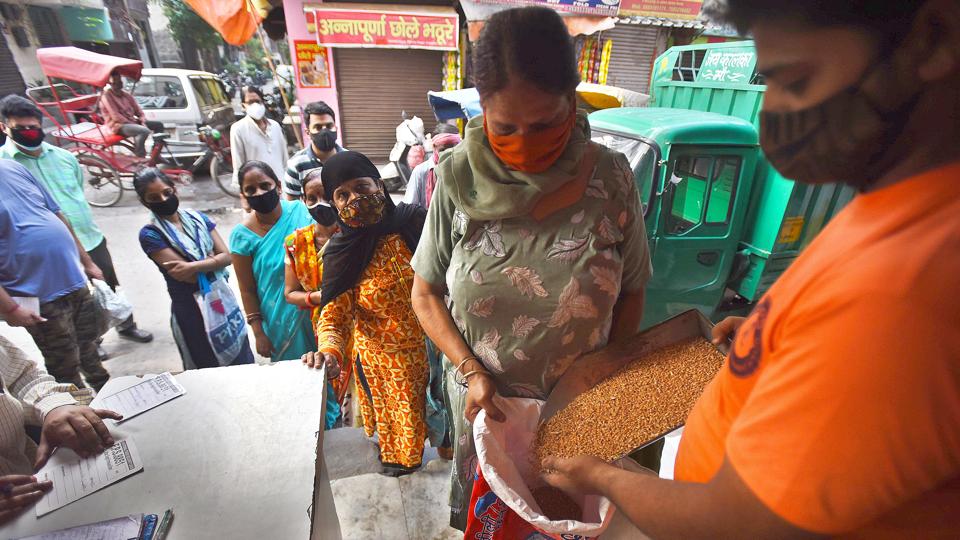
Numerous studies have been done on the benefits of nutrition because of food delivery through NFSA, mid-day meal scheme for schools and other nutrition-oriented subsidies. It is well-known that India fed its population during Covid inducted lockdown through Pradhan Mantri Garib Kalyan Anna Yojana (PMGKAY) when millions lost their work. As an aside, the ruling BJP termed the scheme as its achievement, even though it was introduced at the fag end of United Progressive Alliance government rule in 2013-14. PMGAY ensured that no one slept without food during Covid days and there have been demands of including non-ration card holders under the PMGKAY scheme to ensure every poor person gets its benefit.
It is also a well-acknowledged fact that the Public Distribution System (PDS) through which food is supplied under NFSA has brought down nutritional poverty levels across India. PDS allowed cheaper food available for the poor only because the government is able to produce food grains through the Minimum Support Price regime, which many consider a freebie to farmers.
Another social measure, Mahatma Gandhi Rural Employment Guarantee Scheme (MGNREGS) has repeatedly come under the scrutiny of economists saying that high expenditure was not resulting in any economic good. However, studies have shown that MGNREGS with PDS has helped the poor and marginalised sustain themselves during worst times including Covid and has provided an income cushion during natural calamities such as drought and floods. MGNREGS, through its watershed management programme, has helped in improving groundwater levels in several states. With the intervention of direct wage transfer to the bank or post office account of the beneficiary, the government has been able to plug leakages to a large extent.
The mid-day meals have ensured higher retention, especially of the girl child, in schools and have improved the classroom performance of students, even though learning levels in classrooms remain a concern. That is more because of the hiring of sub-standard teachers. The health cards and the free medical facility has improved health care indicators for the country.
So, in a way, the so-called freebies have enabled the poor access to basic entitlements of life guaranteed in the Constitution. Putting almost all public welfare measures under the freebie basket and scrapping it would increase the expenditure burden on the middle-class and the poor, who are already facing the burden of high inflation.
However, states should desist from distributing freebies that lead to no societal good such as money to all women as promised in Punjab, gold chains or promising modular kitchens as done during the last assembly elections in Kerala.
The debate
The Election Commission conveyed to the SC in April 2022 its inability to regulate freebies unless there is a specific law for it. It also pointed out that manifesto promises are already part of section VIII of the model code which seeks political parties to provide for the fiscal cost of the promise being made before the elections. The section was included in the MCC after consultation with political parties about a decade ago on the SC’s prodding.
Parties had resisted the EC’s move to regulate freebies in poll promises saying that it was outside the powers of the commission granted under Article 324 of the Constitution. Since manifestos became part of MCC, parties started coming out with vision documents and guarantees, instead of manifestos to escape EC scrutiny. As a result, the EC expressed its inability to regulate freebies after which the SC set up the panel.
The freebie debate is more about “elitism” in the society that believes that welfare measures for the poor are charity and have made the poor non-productive. An example of this is the RBI risk analysis paper quoted above seeking a sunset clause for all welfare schemes. Schemes have been modified in India as per the need of the hour and have been delivered on social security parameters. One should not forget the Constitution framers ensured that the deprived have first access to government resources and reservation was a step in this direction.
Political parties since Independence have offered welfare measures for the deprived. The SC, in 2016, said that it could not be termed a “bribe to voters”. The government gives tax rebates to corporates, which is considered an economic incentive and not a freebie. Similarly, measures that help the under-privileged come up the societal and economic ladder cannot be termed as a freebie, unless the inequality gap is fully bridged. Freebies that lead to societal upliftment should be considered as our way of undoing the historical injustice to marginalised through a deep-embedded caste and patriarchal mindset.
The views expressed are personal
 ABOUT THE AUTHORChetan Chauhan
Chetan Chauhan is the National Affairs Editor looking into all aspects of news and features from across India. A Chevening scholar with over three decades of experience in reporting and news management, Chetan has extensively covered all important aspects of the social sector, political economy, environment and climate change nationally and internationally. He did a journalism course at the Reuters Institute of Journalism in Oxford and Digital Media training at Nanyang Technological University in Singapore. He started as a reporter with The Statesman in 1996 and joined the Hindustan Times in 2000 in the metro bureau covering environment, crime and Delhi politics. He covered hot local news, from the Jessica Lal murder case to the rebellion of Delhi Congress MLAs against then Chief Minister Sheila Dikshit, to the replacement of toxic vehicle fuel with cleaner compressed natural gas (CNG) in the national capital. Some of his stories on air pollution became part of the Supreme Court’s landmark MC Mehta versus Government of India case in the National Capital Region (NCR), forcing the government to take corrective measures. As part of the national political bureau since 2004, he covered important central sectors such as environment, education, social justice, labour, rural development, water resources, renewable energy, agriculture, broadcasting and the Planning Commission for more than a decade producing several exclusive and investigative breaking stories. His specialisation is the environment, having covered at least a dozen United Nations global conferences on climate change, biodiversity and wildlife including climate summits in Paris, Copenhagen and Bali. He also covered India’s two five-year plans ---11th and 12th and reported on drafting and execution of right based laws such as Right to Education, Right to Information and rural job guarantee law, MG-NREGA, now being introduced in new format as VG-RAM-G Act. He has in-depth knowledge of social sector issues. He was one of the first to report on tigers vanishing from Sariska and Panna wildlife reserves in 2004 and 2008, respectively, leading to the setting up of the National Tiger Conservation Authority (NTCA) and the introduction of stringent penal provisions for poaching. He has written extensively on the rising human-animal conflict in India and the degradation of India’s biodiversity hotspots because of mining and other activities. Since 2004, Chetan has covered Parliament comprehensively and participated in training on the nuanced coverage of Parliament proceedings. He has travelled extensively across India to cover national and provincial elections since 1998, especially in the Hindi heartland states, considered India’s road to power. He writes a regular column for Hindustan Times, Ecostani, on important national politics, economy, Himalayan ecology and environmental issues. His other responsibilities include providing inputs for edits and edit page articles for the publication, apart from managing news flow from across India.Read More


