
 E-Paper



In Himachal, a deluge of missed warnings
Himachal Pradesh needs a policy and governance overhaul that prioritizes environmental sustainability and local communities

 Prefer HTon Google


As swollen rivers in Himachal Pradesh receded this week, and the state began accounting for the losses suffered, a meme began circulating. Barsaton mein pahad ghumne na aayen, kyunki pahad hi niche aa rahe hain – Don’t travel up the mountains in the monsoon because the mountains are coming down to visit you. Birthed by the alarming frequency and intensity of landslides and floods that have devastated the Himalayas monsoon after monsoon, the message was also a jibe at the frenetic tourism activity that has upended the local ecosystems. For a state saddled with fiscal debts, the struggle to generate revenues and employment has propelled extractive growth led by tourism and infrastructure development. In recent years, the Himalayas have become the site of multiple disasters that were attributed by various governments to erratic weather patterns spurred by the climate crisis. Yet, blaming excess rainfall or demonising flooding rivers cannot hide the development excesses and faulty planning that eroded the local capacity to weather climate vagaries.
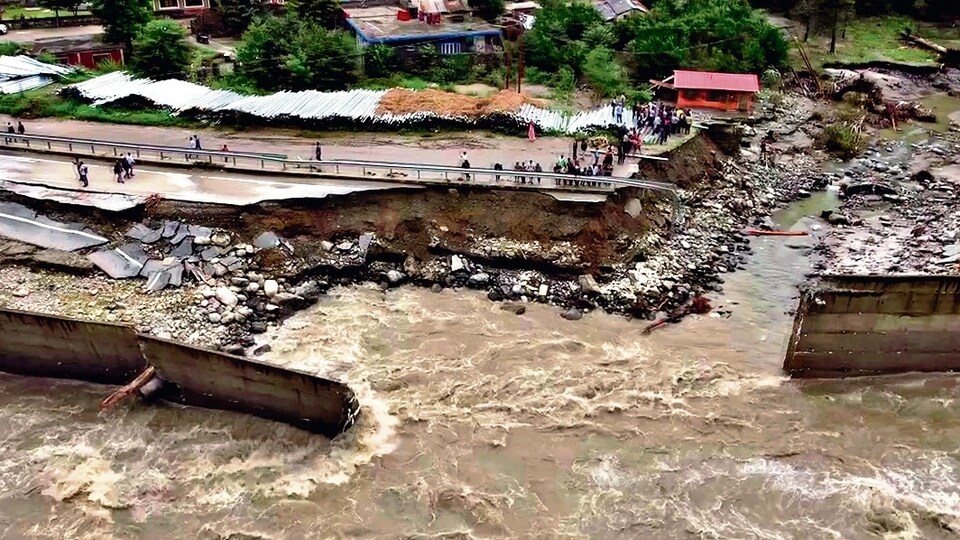
In the last two decades, Himachal Pradesh has seen a nearly 3,000% rise in the number of tourists – from around 520,000 in 2001 to 15 million last year. The hub of this commercial mass tourism is Kullu-Manali, and is fast spreading to the trans-Himalayan Lahaul-Spiti, which bore the brunt of the recent floods. The spike in the built-up area along the Beas floodplains, in contravention of all safeguards or regulations, created a situation where the surging river had nowhere to go and ultimately broke through the national highway and villages, sweeping away cars and buildings that stood in its way. The construction of a four-lane highway from Kiratpur via Ner Chowk (Mandi) to Manali contributed to the unprecedented concrete sprawl along the river, originating from Rohtang. The highway between Pandoh and Manali alone has five tunnels. The muck and debris generated from the surface and underground excavation were dumped in and around the streams and river beds, adding to the sediment load of the rivers and causing more damage downstream.
Six large hydropower dams on the Beas and its tributaries in this stretch alone have blocked and tunnelled the river. A total 350 small and large dams are planned on this river alone. During downpours, the sudden release of stored and diverted water adds to the problem. These mega infrastructure projects have destabilised slopes to trigger land and mudslides, which further add to the quantum of silt in rivers. Similarly, 15,000 hectares of forests have been cleared for development activities since 1980, state forest data shows.
Connectivity is critical for access to basic health, education and markets in rural Himachal. But instead of applying caution, a nexus of local contractors-politicians leveraged village road building with no environmental oversight to mow down trees. Both deforestation and related disasters have dispossessed local communities with marginal land holdings of their livelihoods.
In recent years, transmission lines and roads have been categorised as linear projects and granted a slew of exemptions on the ground that these are essential infrastructure and have a lower environmental impact because they are built in a straight line. The results have proven otherwise.
The frequent deluge in the mountains also has far-reaching effects downstream – as evident in Punjab and Delhi. Framing these events as climate or natural disasters without addressing the development-led causes are a mere attempt at absolving us of the questions of accountability and justice.
In an era where more extreme weather events are becoming the norm, our myopic policies are putting an unequal burden on the most vulnerable in our cities, villages and neighbourhoods to adapt to a changing world. Systemic policy and governance overhaul with circular economies and citizens at its core is a longstanding demand that the greed for profit has drowned out. Unlike models of untrammelled economic growth, nature follows a non-linear logic, which is why rivers refuse to toe the line.
Manshi Asher is an environmental justice researcher based in Himachal Pradesh. The views expressed are personal


