
 E-Paper



In Kashmir, new aspirations and a ray of hope
As a result of accountability and direct communication, students have lined up for scholarships. In the last financial year, 800,000 students benefited under various scholarship schemes. Until December 2020, 950,000 lakh applications for scholarships had been received.


Kashmir Valley’s chinar trees, after having been stripped bare by the bitter winter, have begun to grow fresh buds. By the end of the month, they will regain some of their former glory. Will Kashmir and Kashmiriyat undergo such a renewal?
Over the past week, I met several young people while in Kashmir with my family. Tausif Majid, from Tangmarg, Baramulla, considered a hotbed of terror, told me he is preparing for the entrance examination for a post-graduate degree in chartered accountancy. He eventually wanted to join the Indian Administrative Service. Somewhat surprised, I asked him why. He said over the last 10 years, many had passed this examination in Kashmir, and he hoped to do the same, through hard work, and bring name and fame to his family. I was elated, for it is the dreams of the young that make the world a better place.
Two days later in Pahalgam, I passed a signboard that said “Punjabi Vaishno Dhaba, pure vegetarian”. For vegetarians like us, this seemed like a godsend. We found the one empty table in the small, clean eatery. While the four of us were perusing the menu, a young woman came and asked in fluent English, “Sir, I hope you have chosen from the menu. Tell me, what can I offer you?” We did not expect such grace and courtesy towards outsiders in a town marred by violent terror.
After a delicious meal, I learnt her name was Gurupriya and she was from a family of Kashmiri Sikhs. Gurupriya told me, “This dhaba was opened by my father, now I have been running it for the last few years.” She wanted to expand the business further so that she could give everybody a taste of the good food and warmth of Kashmiri hospitality. Gurupriya said her uncle also ran a similar Punjabi restaurant nearby. Back in the car, I recalled that I had come to this region after 18 years. If I came back after another 18 years, perhaps I would find that the young woman had fulfilled her dream.
While wandering about the Valley, I noticed a number of new hotels, wide avenues and signs of fledgling businesses. While it is too early to say that normalcy has returned, these are positive signs that things are on the right track. Feelings of dissatisfaction and alienation will remain among some and this will be kept alive by radical elements for as long as they can.
While I was talking to Gurupriya on the afternoon of March 29, terrorists had attacked a member of the Block Development Council (BDC) and his security personnel, outside the municipal office at Sopore in Baramulla district. On April 1, as we were re-entering Srinagar, I learnt that a Bharatiya Janata Party (BJP) worker was attacked at Naogaum that day. According to the Institute for Conflict Management, in 2020, 321 people lost their lives in 140 terror incidents — these include 33 innocent Kashmiri civilians, 56 security personnel and 232 terrorists. This shows that the maximum damage is being inflicted on the terrorists. One reason for there being no major disturbance after the effective abrogation of Article 370 is the effective working of the security forces.
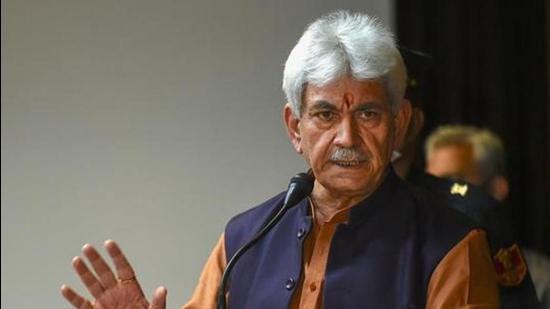
Lieutenant-Governor Manoj Sinha is aware that to establish peace in the Valley, ordinary Kashmiris must gain the upper hand. This is the reason why he personally meets people one day in the week. All senior officers are present at this meeting, and problems are dealt with immediately. He has set up complaint boxes in every panchayat, and, in order, to address people’s problems, he has begun a block day programme every Wednesday.
As a result of such accountability and direct communication, students have lined up for scholarships. In the last financial year, 800,000 students benefited under various scholarship schemes. Until December 2020, 950,000 lakh applications for scholarships had been received. This explains the confidence of young men such as Tausif at Tangmarg.
Mohammad Amin, a government employee, was delighted that the railway project connecting Srinagar to Jammu is being implemented at a rapid pace. He believes that when the train between Delhi and Srinagar becomes operational, young people will find an easier passage to higher education. He said that earlier too, a lot of money used to come from Delhi, but, for the first time, people were seeing that it was being put to better use. A young entrepreneur, who had returned to Srinagar after completing his Masters in Business Administration from London, was so impressed with the flourishing infrastructure that he decided to construct a hotel here. He spoke of feeling hopeful after years, despite all the naysayers.
Will Kashmir’s dreams, like those of its fabled chinars, blossom this time around? I, for one, am very hopeful.
Shashi Shekhar is editor-in-chief, Hindustan
The views expressed are personal


