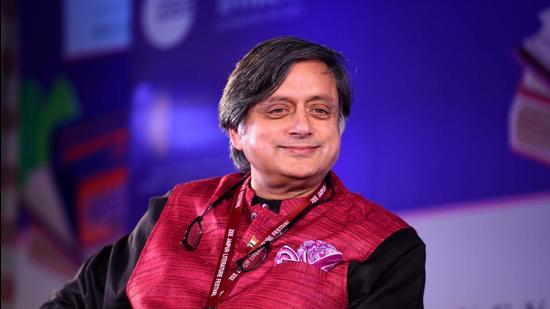
Shashi tharoor believes Ban ki-moon won the battle to become UN secretary-general because the US did not want a strong secretary-general. But would Shashi have been stronger? Alas, we’ll never know.
In a serendipitous coincidence, Shashi Tharoor and Ban Ki-moon have recently published books with accounts of their 2006 battle to become Secretary-General of the United Nations (UN) At the time, Shashi was UN under-secretary-general, Ban was South Korea’s foreign minister. This was the first time their respective countries fielded a candidate for this prestigious post. Ban won and Shashi lost but the story behind their competition has now been revealed.
Why did India put up Shashi? He was never likely to win. Nor – despite his inexplicable claim to the contrary – did this “capture the Indian imagination”. It was folie de grandeur. (Amal KS/HT PHOTO)
“It was rumoured that Shashi Tharoor did not enjoy the Indian government’s support”, Ban writes in Resolved. He also claims Shashi “overestimated the appeal of (his) UN service to world leaders”.
Initially, Shashi contradicts this. In an essay in Pride, Prejudice and Punditry, Shashi writes that Manmohan Singh approached him directly: “Would you be interested in contesting for the post of Secretary-General? Put bluntly like that, I could hardly say no.” Later, Shashi suggests the promotion of his candidature was weak and half-hearted. “If Indian diplomats ever mentioned it, they claimed, they did so with the air of officials merely doing their duty”. For both, the key was support from or, at least, not a veto by the five permanent Security Council members. Within this, Washington’s vote was critical. Bizarrely, both thought they had it.
Shashi writes, “both the prime minister and the NSA felt the US would be supportive … similar thoughts were expressed by the NSA about Russia and the UK”. His relations with the French, he adds, “were known to be good”. So “four permanent members were therefore assumed to be likely to favour us”.
Ban tells a different story. Even before his candidature was announced, Condoleezza Rice told him “you have my full confidence”. Russia’s Lavrov said, “he would not oppose my candidacy”. The doubt was the French. Douste-Blazy, their foreign minister, said France “had never supported any candidate who does not speak ‘the language of diplomacy’ (French)”. Ban did not. Shashi did.
It seems India did little to win US support which went to Ban. Shashi writes, “the only thing that might have made a difference was a high-level intervention with President Bush” and it had to be “very early in the process”. But “Manmohan Singh and M. K. Narayanan (NSA), though sincere and loyal … were … much more focussed on the Indo-US nuclear deal”. Shashi’s candidature was not a priority.
So why did India put up Shashi? He was never likely to win. Nor – despite his inexplicable claim to the contrary – did this “capture the Indian imagination”. It was folie de grandeur.
Ultimately, US support also swung the Chinese. Shashi writes the Chinese foreign minister told him his country “will not stand in your way”. But was that support or simply an assurance not to veto? On the other hand, the Chinese foreign minister gave Ban a statue of Pegasus with the words “Please keep this in your office when you are elected Secretary-General”.
When the voting began, the US ensured China delivered. Ban reveals that at a meeting of Security Council foreign ministers to agree on a candidate, Rice manoeuvred her Chinese counterpart into proposing his name.
That left the French. It seems Ban’s hints that Frenchmen would “head the UN Department of Peacekeeping and Operations” did the trick. Shashi makes no mention of similar “deals”. But was this because no major country took his candidature seriously?
Ban reveals how the voting went. There were four straw polls. Votes were cast to encourage or discourage or express no opinion. Ban’s positive votes increased from 12 to 14 whilst the only negative disappeared in the fourth. Shashi’s score steadily deteriorated. He started with 10 positive and 2 negative, which worsened to 10-3, before sliding to 8-3. After the fourth poll, Ban writes, “The others withdrew their candidacies, assuring my success”.
Shashi believes Ban won because the US did not want a strong secretary-general. I’m not sure if history will conclude the winner was weak, but this does raise the question: Would Shashi have been stronger? Alas, we’ll never know.
Karan Thapar is the author of Devil’s Advocate: The Untold Story

 E-Paper