Policies and People | India needs a climate crisis curriculum
Include the climate crisis as a separate subject. Or better still, integrate it with existing subjects. Also, recognise children as key agents of change in addressing the climate and environmental crisis, and make the curriculum more practical
Two years ago, a friend who taught at a primary school in Himachal Pradesh told me an interesting story. While teaching a primary class one day, he noticed a new, shiny poster on the classroom wall. It had a photo of a massive building with a glass façade, and a tagline that linked the building with cities, progress and development.
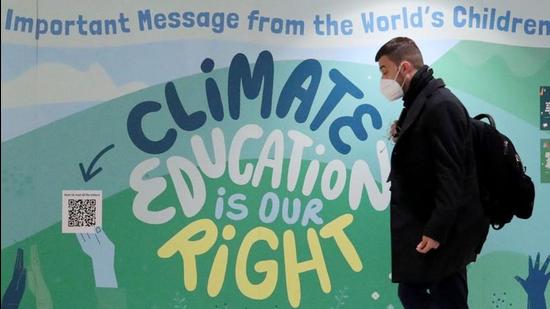
Unfortunately, climate education is still to enter most classrooms across the world (REUTERS)
“I found the poster incongruous. It sent out a wrong message to the students,” he said, reflectively. “Why do we want these young children of the Himalayas to think that such energy-guzzling buildings and carbon-intensive cities, which are exacerbating the climate crisis, is the right model of development?”
My friend was right. The entire messaging around development and progress is self-defeating, especially at a time when the impact of the climate crisis, which has been caused mainly by human activities, is visible across the world. What students need today is a robust climate education curriculum that sensitises them to sustainable development and their role in achieving it.
Unfortunately, climate education is still to enter most classrooms across the world. According to a recent Unesco report, only 53% of the national curricula in 100 countries surveyed incorporated the climate crisis. The priority given to related subjects, and the depth of knowledge, imparted, if present at all, were low, the report found. Across all regions, most related references in education policy and curriculum documents were framed around “environment” in contrast to being framed around ideas of “sustainability”, “climate change”, or “biodiversity”. Fewer than 40% of the teachers were confident about explaining the severity of the climate crisis to students, and less than 30% knew how to explain the effects of the global phenomenon in their locality.
The United Nations Intergovernmental Panel on Climate Change reports have argued that education can play a key role in innovation in environmentally sound technologies and infrastructure, sustainable livelihoods and behavioural and lifestyle choices.
India has no curriculum focused on the climate crisis. Students are just given a cursory understanding of concepts and definitions of pollution, global warming and the climate crisis. Many students too have realised the problem: Last month, a group of young environmental activists started an online petition, requesting the Delhi and central governments to include climate education in Delhi schools to sensitise youngsters about the impact of the global climate crisis.
“I think awareness isn’t enough. We need to sensitise children too from an early age. Record-breaking heat waves, changing rainfall patterns, dust storms and increasing air pollution scares me about my future and the future of generations to come. If, as children, we are not taught about the climate crisis, and what we can do to stop this cycle of permanent damage to our planet in even the smallest of ways, there is no way we will live to see a green planet again,” Aniket Gupta, who started the online petition, said in an earlier interview with HT.
I spoke to a few teachers, and almost everyone acknowledged that the existing curriculum and teaching methods do not address the scale of the problem. They are also concerned that students are not practising what they learn at home or in school. One teacher acknowledged the absence of a sense of urgency and focus on behavioural change. Other than becoming caring, sensitive and engaged citizens, climate education can also make them ready for the green jobs of the future, said another.
Here’s what can be done. One, include the climate crisis as a separate subject. Or better still, integrate it with existing subjects. Two, recognise children as key agents of change in addressing the climate and environmental crisis, including by establishing child-friendly mechanisms and platforms to facilitate children’s formal engagement in climate policymaking. Three, make the curriculum more practical and reflective, and equip teachers with the right tools and training in environmental pedagogy. Four, ensure that climate curriculum goes beyond classrooms to include field trips to examine the on-ground impact of the climate crisis.
There is momentum around the world to harness the power of education to combat and adapt to the climate crisis.

 E-Paper