Just Like That | Notes on a Presidential home, faith, and miracles
Of Droupadi Murmu being the latest occupant of the Presidential Estate, which is a world unto itself; and my belief that there is a divine energy that some chosen few become a conduit of.
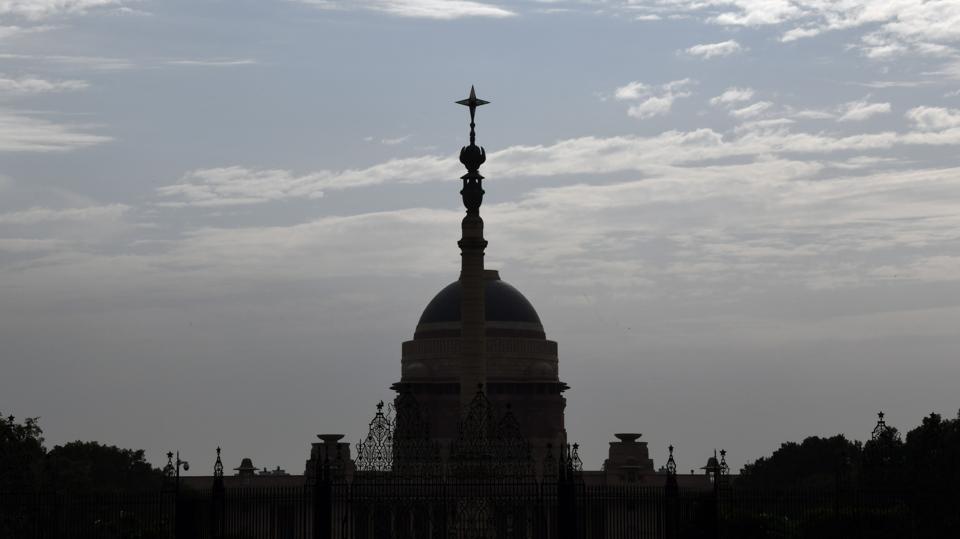
By now, President Droupadi Murmu would have settled down in her new residence, the Rashtrapati Bhavan (RB).
It took almost three decades for RB to be completed in 1931. (ANI)
In terms of area, it is the largest residence of any head of state in the world. The Bhavan has 340 rooms, and is situated in a Presidential Estate that is over 300 acres. Prior to 1912, when the construction began of the Viceroy’s House as a statement of imperial authority and power, this area was the home of some 300 families of the Raisina and Malcha villages. Their land was acquired and they were evacuated to make way for the construction.
It took almost three decades for RB to be completed in 1931. The architects were Edwin Lutyens, an incorrigible imperialist who looked down on everything Indian, and Herbert Baker. The chief engineer of the project was Sir Teja Singh Malik. Four contractors worked under his supervision.
One of them was Sir Sobha Singh, father of Khushwant Singh. The Moghul Garden was designed by William Mustoe. It is opened to the public when the garden is at its most beautiful, in February-March every year. One hopes that the government will not get into its head to change its name.
The Presidential Estate is a world unto itself, almost entirely self-contained. I have personal experience of this since I have worked in the RB Secretariat. In 1992, I went on deputation from the Ministry of External Affairs to join as Press Secretary to then President R Venkatraman.
The day I joined my new office, my personal assistant asked me for a passport size photograph to get my pass for RB. I told her that I would go to a photo studio and get the photograph taken. She looked very surprised, and said: “You will go to the market sir? But there is a photo studio in RB itself.”
The next day, I bought some formal suits and requested my office to send them to a particular dry-cleaner in Connaught Place, now called Rajiv Chowk. Again, my office expressed surprise. “Why would you send your suits to a dry-cleaner outside? There is a dry-cleaning unit on the premises, Sir’”
Almost anything one can need is available in-house. I stayed on, after President Venkatraman retired, to work with President Shankar Dayal Sharma. After a year’s stint with him, I left on a posting to our Embassy in Moscow.
Today, the RB has travelled far from being a symbol of remote colonial power. It stands at the apex of the democracy we embraced after Independence in 1947. The journey began when, on August 15 1947, Jawaharlal Nehru was sworn in as Prime Minister at 8:30 am in the magnificent Durbar Hall at RB by outgoing Viceroy Lord Mountbatten.
The latest occupant, President Droupadi Murmu, is the first tribal head of state, and has reached this highest office by dint of merit and hard work, symbolic of the best impulses of democratic empowerment. One wishes her the very best for her stay in her new home.
Of gurus and believers
India is replete with godmen and godwomen. Many of them have a huge following. Some among them are charlatans, and have been exposed as such. Others appear to be genuinely spiritually evolved. They provide succour and solace to their followers, and are also credited with performing miracles. It depends on whether you are a believer or not.
I neither fully believe nor completely disbelieve. One thing is certain — there is a divine energy that some chosen few become a conduit of.
When I joined the Indian Foreign Service, the two-year training capsule included four months in a district to understand the ground realities of India. I was allotted Anantapur in then united Andhra Pradesh. Puttaparthi, the headquarters of Sathya Sai Baba, fell in Anantapur district.
My mother thought this was divine providence for she was keen on a darshan. As Assistant Collector on training, I managed to get a private audience, along with my wife and mother. When we met him in a private room, there was also a foreigner, a lady, waiting to see him.
Sathya Sai Baba walked in, acknowledged our presence, and asked the lady: “Ma, what do you want?” The lady was so overawed by his presence that she could not answer. Baba then said: “You want a child?” When she nodded, he moved his palm in the air, and out came a fresh fig which he gave to her. “Eat”, he said, “your wish will be granted”.
As a skeptic, I was watching his hand, and the sleeves of his garment, very keenly to see if this was some kind of Gogia Pasha trick. It wasn’t. I don’t know, however, whether the promise he made to the lady fructified.
Pavan K Varma is an author, diplomat and former parliamentarian
Just Like That is a weekly column where Varma shares nuggets from the world of history, culture, literature, and personal reminiscences with HT Premium readers

 E-Paper