
 E-Paper



Kashmir crisis: It’s time for Mehbooba Mufti to prove her mettle
Rather than treating confronting Syed Ali Shah Geelani’s Jamaitis with her political capital, the chief minister is looking askance at the Modi government to break the logjam through diplomatic initiatives


Pakistani journalist Arif Jamal’s book Shadow War: The Untold story of Jihad in Kashmir confirms three major suspicions held by Indian intelligence since the civil unrest broke out in the Valley in early 1990s. The definitive work that traces Pakistan-sponsored jihad in Kashmir makes it amply clear that religion is being used as a political tool to align the Valley towards Islamabad rather than azaadi or independence.
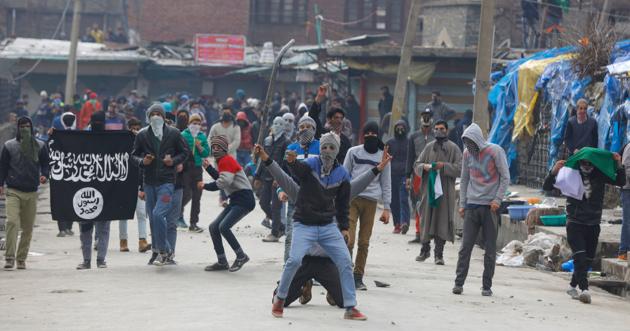
Jamal writes that anyone opposed to pro-Pakistani Jamait-e-Islami leader Syed Ali Shah Geelani, who heads the All Party Hurriyat Conference (G), was eliminated by the Pakistani ISI through jihadists, including fathers of Mirwaiz Umer Farooq and Sajjad Lone. The author actually blames Geelani for getting his political opponents killed.
Jamaal confirms the long-held view of Indian intelligence that it was the ISI that asked Valley-based militant groups to attach themselves with Hurriyat parties for a moderate political face. This means that the Hurriyat Conference is a militant front with handlers sitting across the Line of Control (LoC) in Pakistan-occupied Kashmir (PoK) and masters sitting in Rawalpindi GHQ. The third important confirmation is the ISI’s role in the creation of the Hizbul Mujahideen in the 1990s to counter the indigenous Jammu and Kashmir Liberation Front (JKLF) as the latter was a votary of the independence of Kashmir from both India and Pakistan. The Hizbul Mujahideen, according to Jamal, brutally neutralised the JKLF cadre to ensure that the Valley became the unfinished agenda of partition and ISI turning the Azaadi narrative to pro-Pakistan in the Valley.
The essence of the book is that the jihadi tap in the Valley is controlled by the ISI, which turns it off and on depending on the global focus on Kashmir. It highlights the umbilical linkage between the Pakistan agency and the Jamait-e-Islami with the latter being the proxy for ISI control in Kashmir’s political landscape.
Cut to the present, and it becomes amply clear that Jamait cadres led by Geelani are acting as the cat’s paw of their handlers across the border. Targeting of Sufi culture by Sunni jihadists fed on Salafist ideology and the growing ‘Arabisation’ of the Valley are all part of the effort to turn a majority of Kashmiris towards Pakistan with in-house ‘Kashmiriyat’ heading towards extinction. The growing Islamic radicalisation in the Valley is calibrated to using it as a political weapon against the Indian state and not join the Islamic State ideology, which is without any geographical boundaries for Islam. The Pakistani cause’s force is multiplied by its sponsored militants on the ground in Kashmir, with no less than 300 foreign fighters at present operating in the Valley.
Questions must be put up to the Indian army and security forces on why they did not stop the jihadists from infiltrating in 2015-16 after the formation of the PDP-BJP government. The presence of foreign fighters, 90 per cent of whom belong to the Lashkar-e-Taiba (LeT) group, ensures that people turn up in thousands to attend the funerals of Pakistani militants like Abu Qasim in 2015 or even those unknown Pakistanis militants killed in police encounter in Handwara on February 14. The crowds are incited by Jamait leaders, particularly Geelani, who address the gatherings through mobile phones, to take on the Indian security forces so that the circle of violence continues. Though it is nobody’s case that the agitators should be dealt with excessive force, the strength of a hundreds-strong crowd attacking a CRPF post of four constables and one head constable from Indian hinterland could be quite unnerving, forcing the latter to retaliate with whatever weapons or ammunition at hand. In these circumstances, security forces are easiest to blame.
The answer to Kashmir’s current problems does not solely lie with the security forces or the Modi government. It lies in the elected representatives from PDP, BJP, NC and Congress to re-occupy the political space in the state and reach out to agitating masses. After the killing of Hizbul Mujahideen militant Burhan Wani by security forces last year, this is easier said than done as there is practically a political vacuum in the Valley with militant diktat ruling the roost. The slogans of good governance have been subsumed by the spiraling violence with the elected government practically paralysed with fear of facing the public. Rather than treating Geelani with kid gloves and confronting the Jamaitis with her political capital, the Mehbooba Mufti government is looking askance at the Modi government to break the logjam through diplomatic initiatives. Even the window of opportunity created after the surgical strikes last year was lost by the PDP-BJP government. Fact is that while the Centre is all ready to extend any support, the number of times that BJP’s deputy chief minister Nirmal Singh has sought the support of home ministry top officials could be counted on fingertips.
With the Centre in no mood to talk to Pakistan and none whatsoever with Hurriyat, the coming months should see a spike in violence in the Valley as Rawalpindi handlers will try and force Modi government to come to table by mounting international pressure. It’s time for Mehbooba Mufti to prove her mettle and live up to her father’s political legacy.


