
 E-Paper



Two seat-belts to safely invest in small-cap stocks
Small caps have a place in a retail portfolio, but investors must have protections in place

 Prefer HTon Google


The recent Securities and Exchange Board of India (Sebi) warning of a potential bubble in several small-cap stocks had taken some gains off a market that the regulator believed was getting overheated. Retail investors who had looked at the substantial returns in some small-cap funds and stocks over the past year and had rushed in late to the party when the run-up had already taken place, took home losses when markets fell as a consequence of Sebi’s statement. So, should retail investors stay away from this risky small-cap category and remain safe with large-cap and blue chip-based investing? Or do small caps have a place in retail investor portfolios? I believe that small caps must make up a slice of the equity asset allocation pie for investors who are willing to wear seat-belts that absorb the wild volatility of this asset category.
But first, what is a small-cap stock? Sebi defines small-cap stocks as those that are the 251st stock onwards in terms of market capitalisation. Mid-caps are between 101st and 250th stock and stocks from one to 100 are called large cap. Market cap is the price of a stock multiplied by the number of stocks issued by the company and is a single number that points to the value of a company as judged by the stock market. Large-cap stocks are mature large companies that do not usually see very large swings in prices. Mid-caps typically are higher growth companies that carry the potential for a higher return, but come with a higher risk attribute than large caps. Small-cap stocks can have very high growth but carry a much higher risk of failure. The category itself moves between very good years and terrible years in terms of returns.
How high can the growth in small caps be? The average annual return on small-cap mutual funds over a 10-year period ending March 23, 2024, has been 22.16% compared to 14.17% for large-cap funds. To illustrate, ₹1 lakh would have become ₹3.8 lakh in a large-cap fund and ₹7.4 lakh in a small-cap fund — this is the performance multiplier potential of an average small-cap fund.
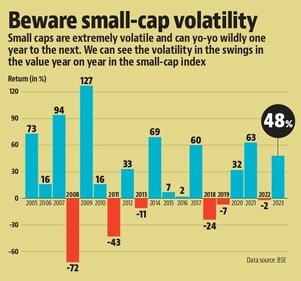
So, where is the catch to this high-return route to investing? Small caps are extremely volatile and can yo-yo wildly from one year to the next. We can see the volatility in the swings in the value year on year in the small-cap index. Good years are usually followed by bad years in an extremely volatile way as the category goes from best performing in all asset classes to the worst performing in the short period of just a few months. An investor in the S&P BSE Small Cap index with ₹1 lakh in 2006 would have seen the money almost double to ₹1.9 lakh in 2007 and then crash to ₹54,300 in 2008.
When investors see the small caps running up, as they have in the past year with some funds giving over 70% returns in a year, they tend to rush in. But then the sentiment turns and they make losses. Every few years, this cycle repeats, the old investors who burnt their hands stay away and a fresh crop enters with their money and a deep, driving desire to make quick money.
So, should retail investors stay away from this risky asset category? I believe that small-cap funds have a place in an average retail portfolio, but with some protections in place. Investors need two seat-belts to keep them strapped into safety.
The first seat-belt is using an allocation route. This means that investors must plan to always have small caps in their portfolios and not just when the markets have froth in them. The error most retail investors make is to rush in with all their equity money into small caps after they have seen the huge past returns. A more mature way to get the upside of small caps while keeping risk contained is to follow the allocation route — investors decide what part of their equity portfolio can be invested in risky small caps that have the potential for high growth. A standard equity allocation can have a 50% allocation to large caps, and a quarter each to mid- and small-caps. This can vary according to the risk appetite of each investor. Investors with a lower risk appetite can reduce the small-cap allocation.
Once the allocation is fixed, it is time for the second seat-belt. Investors must rebalance portfolios as allocations change due to a market run-up or down. For example, if there was a 25% allocation to small cap at the start of last year, by December, this allocation would have gone up to 30% or more depending on what was held in the portfolio. Without doing anything, investors saw the allocation change due to the upswing in small caps. When this happens, it is time to rebalance the portfolio to the target allocation of 25% (or whatever the desired number is). This would mean selling when the small caps are on fire. It is emotionally difficult to sell at that point, but the seatbelt’s role is to remind investors to be safe. This process must reverse when small caps go into a free fall. If the allocation falls below the desired number, investors must buy more. The cues to buying and selling come from the asset allocation and not some tipster in the market.
Following this route to sensible investing allows investors to harvest some gains that the small-cap category has to offer. Of course, new investors will do well to note that equity investing needs at least seven to 10 years of patient investing rather than a buy-and-sell approach. India has seen good equity markets for the past few years and a new crop of investors have not yet seen a bear market. They exist and investors must take care to have liquidity in fixed deposits and debt funds at all times in their portfolio.
Monika Halan is the author of the best-selling book Let’s Talk Money. The views expressed are personal


