
 E-Paper



View from the Himalayas | On eve of China visit, Chinese envoy puts Nepal PM on the spot
Nepal's political balancing act between its powerful neighbours is further complicated by the ideological allegiance of its communist leaders towards China.

 Prefer HTon Google


There’s never such a thing as a good time for diplomats to be seen as making undiplomatic comments. But the Chinese ambassador to Nepal Chen Song’s recent remarks about Nepal’s “not so beneficial” trade ties with India have come at a particularly wrong time. Nepal’s PM Pushpa Kamal Dahal, aka Prachanda, visits China on September 22. And Chen has put the Maoist prime minister in a political spot.
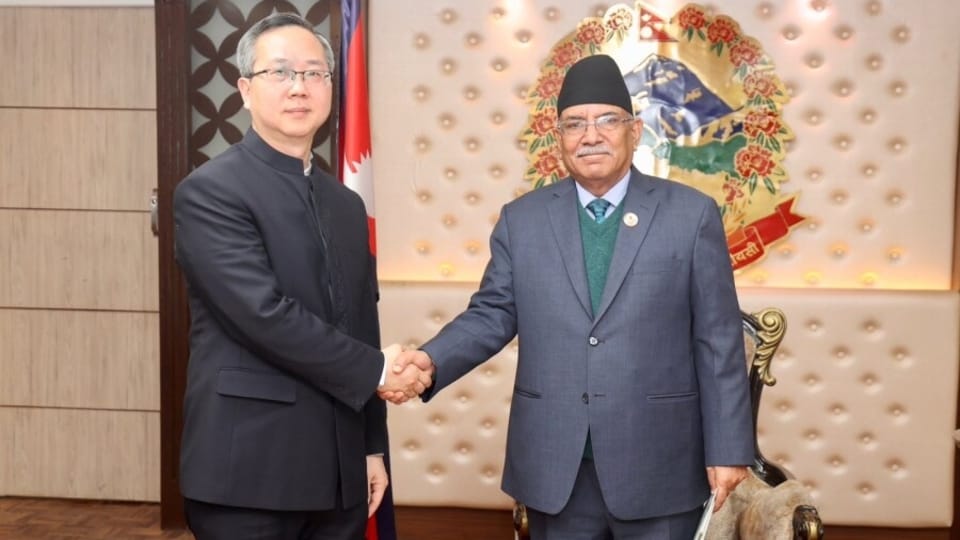
As Chen was addressing a foreign-policy forum on China’s role in the global economy, including Nepal, it is very unlikely that his remarks were off-the-cuff. He was trying to explain Nepal’s potential for power exports and the market reality. “Unfortunately, you have a neighbour like India,” he said, “but fortunately, you have a neighbour like India, because India is a huge market with huge potential you can tap into.”
He then made the most controversial statement a Chinese envoy could make about India: “But at the same time, India's policy towards Nepal and other neighbours is not so friendly and not so beneficial to Nepal.”
“Last fiscal year, you exported ₹10 billion of electricity to India. How much did you import from India? My Nepalese friends, you imported ₹19 billion of electricity from India. You had a deficit in electricity trade, one of the products you are proud of, and you think that will bring you economic independence.”
In its entirety, Chen’s remarks were not entirely unfounded, but he seemed to have forgotten – or chose to forget – that he sits in Kathmandu as Beijing’s ambassador, and Nepalis don’t want the envoy from one powerful neighbour telling them how to handle ties with another powerful neighbour. The political response in Kathmandu also underpins Nepal’s difficult balancing act, a small state’s constant nervousness as it sits between big neighbours – one, the world’s second-largest economy and the other, the fifth-largest.
Historically, Nepal’s communist leaders share a stronger ideological allegiance towards Beijing than New Delhi (and the West and Washington) and, therefore, are likely to exercise greater restraint when it comes to their political positioning vis-à-vis China. Historically, China has also been viewed in Nepal as a less interventionist power.
That perception has certainly been changing in recent years. In 2020, the then Chinese ambassador to Nepal Hou Yanqi lobbied hard with the leaders of the Nepal Communist Party, which enjoyed close to a two-thirds majority in Parliament, to remain together. The party eventually split into three parties, and in the 2022 elections, the centrist Nepali Congress emerged as the largest party in a deeply hung parliament.
Last week, when China published its new political map, it included the disputed trijunction in Nepal’s northwest, bordering China and India – the district of Pithoragarh in Uttarakhand. Though Nepal’s official response was non-committal, it again brought to public view that the new China will do what it deems fit, regardless of Nepali sentiments. Nepal government’s official response to the map was muted, unlike that of China’s other aggrieved neighbours. The Philippines, Malaysia, Vietnam and India not only rejected China's new map they also issued strong statements accusing Beijing of claiming their territory. In its public statement Kathmandu, however, stopped short of mentioning China at all, merely urging for “respect” for its own map unanimously approved by Parliament in 2020.
Chen’s remarks have been widely covered by Nepal’s media and the envoy has been on the receiving end for his “interventionist” foreign-policy approach in what is widely seen as Nepal’s own business. Earlier this week, members of the Parliament’s Foreign Relations Committee, which includes former prime minister Madhav Kumar Nepal, censured Chen. “Ambassadors, particularly from the neighbouring countries,” said MK Nepal, who also heads the Communist Party of Nepal (Unified Socialist), “should be mindful of Nepal’s geo-political sensitivity.”
In an op-ed piece in the Chinese Communist Party mouthpiece, The Global Times, Zhang Jiadong, the director of Center for South Asian Studies at Fudan University, has argued that India has “actively competed” with China over major projects in Nepal and has banned the import of electricity from Nepal that is linked to Chinese investment or involvement, be it equipment, workers, or subcontractors, “a move that restricts the development of Nepal's hydropower industry.” This, according to him, reflects India's influence in Nepal and highlights the inevitable geopolitical and economic challenges in Nepal-China trade cooperation.
In the Maoist Prime Minister ‘Prachanda,’ Beijing sees a fellow Maoist alright. But it is also well aware that he lands in China in the third week of September as the leader of a shaky coalition where his political life requires a fine balance, both among fellow coalition partners and between two powerful neighbours.
Akhilesh Upadhyay is a former editor of the Kathmandu Post, and a Senior Fellow at IIDS, a Kathmandu-based think tank. The views expressed here are personal


