
 E-Paper



Swollen Kosi river triggers panic, migration in Bihar’s Saharsa
For the past few days, Kosi has been threatening the embankment at many places, forcing engineers to man the critical points.


The rising water level in Kosi following heavy rains in the river’s catchment areas of neighbouring Nepal has prompted thousands of people in Bihar’s Saharsa district to shift to safer places.
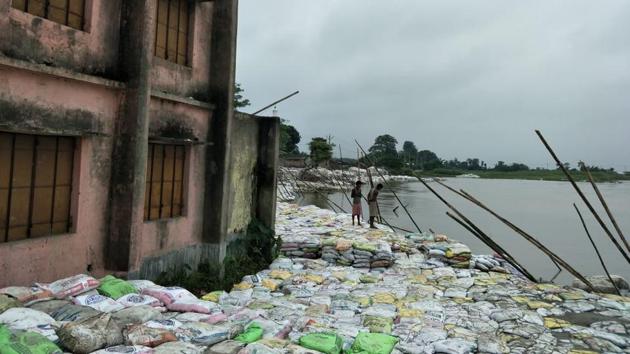
“We are helpless. The Kosi is maintaining a rising trend. Neither any officer from the district administration nor political leaders have come forward to help us,” said Mohammad Hasan, who runs a small medical store in Ghoghepur panchayat, along the rain-swollen river’s western embankment, in Saharsa district.
“With no visible government measure to tackle floods, we are planning to migrate,” he said. “The government has not learnt a lesson from the Kosi disaster of August 18, 2008, which had devastated the north Bihar plains killing over 350 people,” Hasan said.
The situation was equally alarming in Nauhatta and Mahishi blocks of the district. The spurs, built to protect the embankment near Sarauni, Mahisarho, Lakhani, Baluaha villages, are under water. On Wednesday, the water discharge was recorded at 2.50 lakh cusecs, the maximum this year.
With prediction of heavy rainfall in the river’s catchment areas, people fear a repeat of September 1984 flood that affected hundreds of people in low-lying villages of Nauhatta. In August 2008, disaster hit the area when the Kusaha embankment breached.
For the past few days, Kosi has been threatening the embankment at many places, forcing engineers to man the critical points. Boulders and sand packs continue at the vulnerable points where the river hits the embankment loosening earthwork.
Even as engineers claim “the situation is not critical”, people are packing their bags and leaving the area. Thousands of people, who live in villages between the eastern and western embankments of the Kosi, have already shifter to Mahishi and Saharsa town areas as the water rises steadily.
The Kosi embankment, built in the late 1950s, traverses over 100 km to reach Bhimnagar on the border with Nepal to the northeast and down to Salkuha in the south, guiding the Kosi to drain off into Ganga after passing through Koparia and Kursela in Katihar.
Saharsa district magistrate (DM) Shailza Sharma, who visited flood affected areas, said: “There is no need to fear as water discharge level has gone down to less than 2 lakh cusecs and the flood water level has started receding.” SDRF teams had arrived to face any eventuality, she said, while appealing to the people not to panic.

Stay updated Bihar Lok Sabha Result and with all the Breaking News and Latest News from Bengaluru. Click here for comprehensive coverage of top cities including Delhi, Mumbai, Hyderabad, and more across India . Stay informed on the latest happenings in World News.


