
 E-Paper



Photos: An Egyptian village turning a profit on used tyres
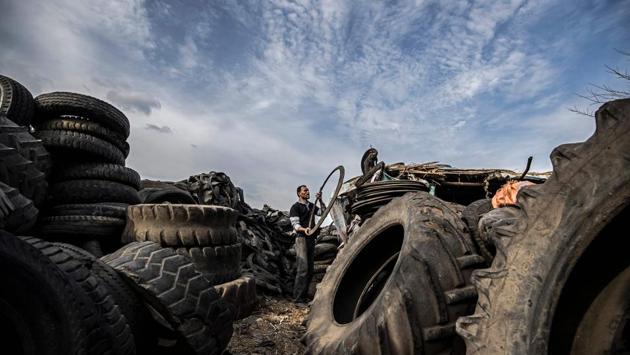
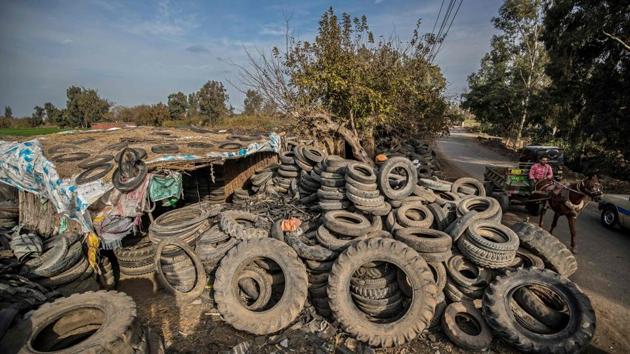
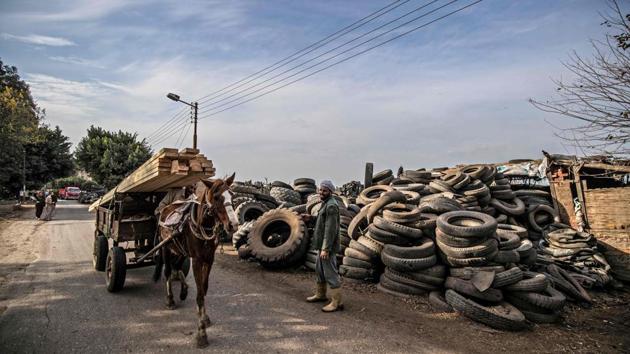
Residents of the Egyptian village of Mit al-Harun have for decades eked out a living by recycling old tyres into new rubber-based products. From early morning, workers covered in soot and dust can be seen sharpening their knives to cut the huge tyres stockpiled on the village's roadsides. With the material they extract, they make baskets, powder for landscaping and alternative fuels. The small village has become renowned as the country's rubber recycling hub.
Updated on: Jan 22, 2020 6:09 PM IST


Share via


Copy link

1/9
 View Photos in a new improved layout
Updated on Jan 22, 2020 6:09 PM
A labourer carries a deconstructed tyre piece amid stacked tyres at a rubber recycling workshop in the village of Mit al-Harun in Egypt's central Nile delta Gharbia Governorate. Residents of Mit al-Harun have for decades eked out a living by recycling old tyres into baskets, landscaping materials and alternative fuels. (Khaled Desouki / AFP)
2/9
 View Photos in a new improved layout
Updated on Jan 22, 2020 6:09 PM
From early morning, workers covered in soot and dust can be seen sharpening their knives to cut huge tyres stockpiled on the village’s roadsides. “The entire village works on recycling damaged tyres,” 35-year-old Abdelwahab Mohamed told AFP, outside of his workshop. “We inherited it from our fathers and grandfathers.” (Khaled Desouki / AFP)
3/9
 View Photos in a new improved layout
Updated on Jan 22, 2020 6:09 PM
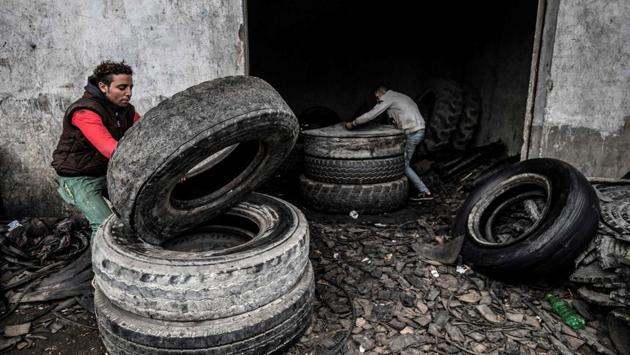
Labourers transport stacked tyres at a rubber recycling workshop. The small Nile Delta village, some 70 kilometres north of Cairo, has gained a reputation as Egypt’s top rubber recycling hub. Dealers collect used tyres from across the country, delivering them to Mit al-Harun in huge trucks. Mohamed said prices per tyre go up to around 70 Egyptian pounds ($4 USD). (Khaled Desouki / AFP)
4/9
 View Photos in a new improved layout
Updated on Jan 22, 2020 6:09 PM
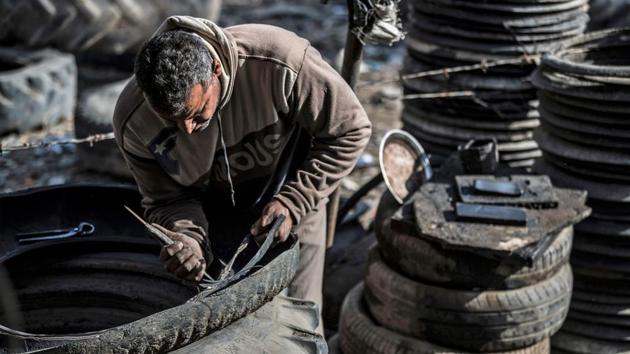
“We cut the tyres here and pull out material including wire rings, which are collected by steel and iron factories to be recycled,” he said. “Tyre rubber is often chopped into small pieces to be used by cement factories as an energy source” -- an alternative to low-grade mazut fuel oil. Other parts are recycled into mulch for playgrounds, he added. (Khaled Desouki / AFP)
5/9
 View Photos in a new improved layout
Updated on Jan 22, 2020 6:09 PM
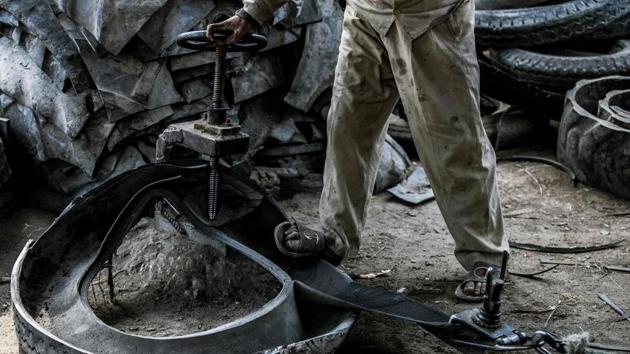
A labourer deconstructs a tyre. Mohamed said his work has grown unstable over the years, especially since the 2011 uprising that unseated long-time dictator Hosni Mubara and triggered years of political and economic turmoil. “There are days with plenty of work and others with little to none,” he said. (Khaled Desouki / AFP)
6/9
 View Photos in a new improved layout
Updated on Jan 22, 2020 6:09 PM
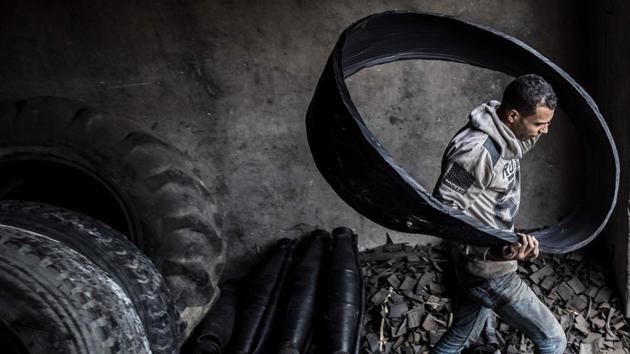
A labourer carries a ripped-out tyre liner. At another workshop, 43-year-old Mostafa Azab fashions baskets out of tyres from trucks, tractors and industrial vehicles. (Khaled Desouki / AFP)
7/9
 View Photos in a new improved layout
Updated on Jan 22, 2020 6:09 PM
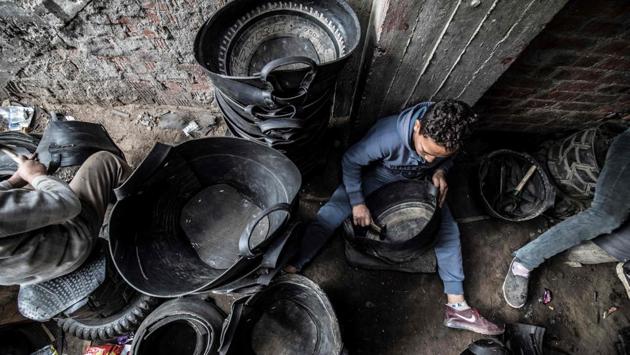
Labourers create rubber baskets from recycled tyre components. “We cut the tyre in half, then we split its inner layers using a winch, before shaping them into baskets and hammering nails around the edges to make them hold,” Azab told AFP. The heavy-duty baskets are often used by farmers, gardeners and labourers, he said. (Khaled Desouki / AFP)
8/9
 View Photos in a new improved layout
Updated on Jan 22, 2020 6:09 PM
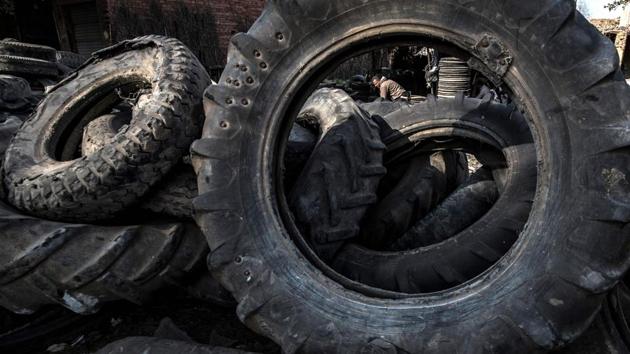
Stacked tyres at a rubber recycling workshop in the village of Mit al-Harun. Azab’s workshop, with a handful of workers, processes up to 10 tyres per day, producing between 80-120 baskets. Azab’s brother, Haitham, said the job was “exhausting”. (Khaled Desouki / AFP)
9/9
 View Photos in a new improved layout
Updated on Jan 22, 2020 6:09 PM


