
 E-Paper



Photos: Southeast Asia’s poor bear brunt as China dams the Mekong
The 4,800 km long Mekong river, is the world’s largest inland fishery and threatened by Chinese dams upstream. Fishing communities in Southeast Asia contend with growing Chinese control over the river’s flow and changes to the bio-diversity of the waters downstream.
Updated on: Jan 09, 2018 11:35 AM IST

Share via


Copy link

1/9

 View Photos in a new improved layout
Updated on Jan 09, 2018 11:35 AM
A woman unloads fish onto her boat after a fresh catch in the Mekong river in Cambodia’s Kandal province. Cambodian fishermen live at the mercy of the Mekong, a massive river that feeds tens of millions but is under threat from Chinese dams cementing Beijing’s physical -- and diplomatic -- control over its Southeast Asian neighbours. (Tang Chhin Sothy / AFP)
2/9
 View Photos in a new improved layout
Updated on Jan 09, 2018 11:35 AM
A fisherman draws in his net on the Mekong. One member of Cambodia’s Cham community which lives on rickety houseboats that bob along a river bend in Kandal province, says the size of the daily catch has been shrinking by the year, miring many of them deeper into poverty --a lament heard from many villages along the river. (Tang Chhin Sothy / AFP)
3/9
 View Photos in a new improved layout
Updated on Jan 09, 2018 11:35 AM
Nearly 4,800 km long, the Mekong is the world’s largest inland fishery and second only to the Amazon in its bio-diversity. It helps feed around 60 million people along its river basin. Yet control over its taps rests to the north with China, whose premier Li Keqiang will land in Phnom Penh on Wednesday to lead a new regional summit that could shape the river’s future. (Tang Chhin Sothy / AFP)
4/9
 View Photos in a new improved layout
Updated on Jan 09, 2018 11:35 AM
Communities in the lower Mekong report depleted fish stocks and blame Chinese dams. Beijing has already studded the upper reaches with six dams and is investing in more than half of the 11 dams down south, according to International Rivers. Experts say it is too early to draw conclusions, but agree that China has the upper hand over a resource that serves as the economic lifeblood of its southern backyard. (Tang Chhin Sothy / AFP)
5/9
 View Photos in a new improved layout
Updated on Jan 09, 2018 11:35 AM
Women fill their catch into a container on their boat. With control over the headwaters of the river -- known there as the Lancang -- Beijing can dam its section of the river while the impact is felt downstream. Dams pose a threat to fish habitats by disrupting migrations and the flow of key nutrients and sediment -- also displacing thousands of people with flooding. (Tang Chhin Sothy / AFP)
6/9
 View Photos in a new improved layout
Updated on Jan 09, 2018 11:35 AM
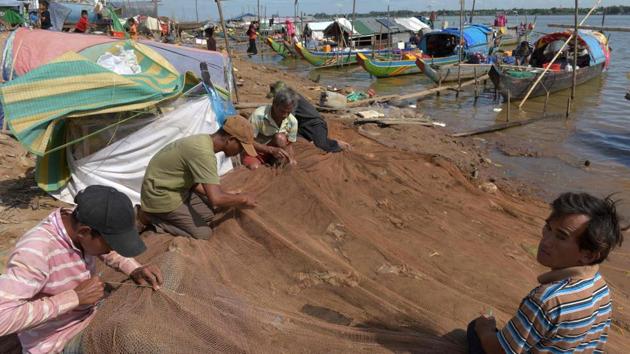
Cambodian men fix nets along the Mekong river in Phnom Penh. A powerful bargaining chip, displayed in 2016 when China opened dam gates on its soil to help Vietnam mitigate a severe drought showed that China can also modulate water levels. (Tang Chhin Sothy / AFP)
7/9
 View Photos in a new improved layout
Updated on Jan 09, 2018 11:35 AM
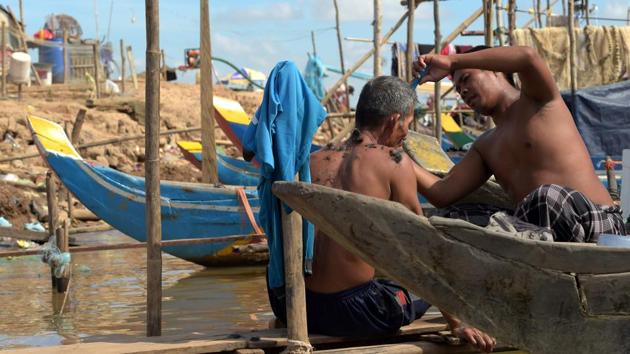
A man gets a haircut in Phnom Penh. To discuss this issue leaders from all six Mekong countries will attend the upcoming Lancang-Mekong Cooperation forum this week in Cambodia. China’s foreign ministry bills the forum, which also covers security and trade issues, as a way to foster “economic prosperity, social progress and a beautiful environment.” (Tang Chhin Sothy / AFP)
8/9
 View Photos in a new improved layout
Updated on Jan 09, 2018 11:35 AM
Chinese companies are investing billions of dollars in many of the dams but have so far failed to carry out full environmental and social impact assessments. Firms and state agencies from Thailand, Vietnam and Laos also stand to gain from their investments. (Tang Chhin Sothy / AFP)
9/9
 View Photos in a new improved layout
Updated on Jan 09, 2018 11:35 AM


