E-Paper



Backward class commission in last stage of preparing its report on Maratha reservation, will submit on Nov 15
According to justice (retired) MG Gaikwad, who is heading the commission, scrutiny of evidences and affidavits has already been done. “We are now in the final stages and will submit the report by November 15,” said Gaikwad, adding that the task of writing the report is the last stage.


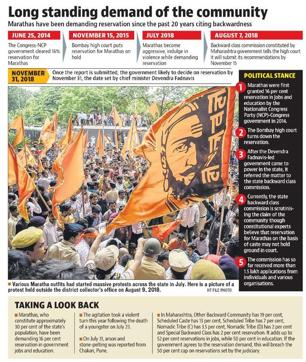
The state backward class commission, constituted by the Maharashtra government to give recommendations on reservation to Marathas, is confident that the report will be ready by November 15 as it has already started writing the report. The Bombay high court had set November 15 as the deadline for the submission of the report.

According to justice (retired) MG Gaikwad, who is heading the commission, scrutiny of evidences and affidavits has already been done. “We are now in the final stages and will submit the report by November 15,” said Gaikwad, adding that the task of writing the report is the last stage.
With the commission set to file its recommendation by November 15, the state government will have 15 days to decide on the reservation as chief minister Devendra Fadnavis had said in August that the government will ensure all constitutional obligations in connection with the granting of reservations to the Maratha community in the state is completed by November this year.
The commission has so far received more than 1.5 lakh applications from individuals and various organisations about “backwardness” of Maratha community, which has been demanding reservation. DD Deshmukh, member secretary at the commission, said most work related to the report is complete and recommendations will be filed by November 15.
The five institutes, which were given the responsibility of preparing a report about the “backwardness” of the Maratha community from various regions, had submitted the surveys to the commission in Pune in August. “We have received reports from five institutes. The commission is working on the information,” said Deshmukh.
The state government had asked the Gokhale institute, Rambhau Mhalgi Probodhini, Shivaji Academy, Sharda Academy and Gurukrupa Sanstha, to prepare a survey about the educational and economic backwardness of Maratha community from western Maharashtra, Konkan, Marathwada, Vidarbha and north Maharashtra, respectively.
Backward class commission studied the data provided by various government departments, village panchayats and educational, social and legal bodies.
The Commission also analysed data of 45,000 families belonging to the Maratha community compiled by the five institutes. The data includes information of these 45,000 families pertaining to their social, economic and educational status.
On August 7, the Bombay high court had asked government to ensure the commission files its report by November 15. The high court bench led by justice RM Savant said this while hearing a petition filed by Maratha activist Vinod Patil seeking a time-bound programme from the state government on giving quota to the Marathas.
Rise in cases of atrocities against SC, ST
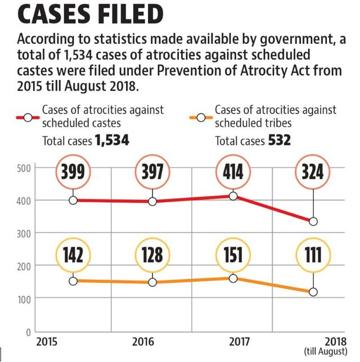
The number of cases of atrocities against scheduled castes and scheduled tribes in the state have gone up in 2016 (525) and 2017 (565) , according to the statistics made available by the home department to house panel.
A parliamentary house panel had visited Maharashtra earlier this month to analyse the number of cases of atrocities against scheduled castes and scheduled tribes.
Maratha community members have been demand dilution of the Atrocity Act through silent marches over the past two years. The community cited its alleged misuse in the Kopardi rape and murder case of a 15-year-old girl in 2016.
However, during its renewed agitation this year, the community dropped the atrocity demand and instead focused on reservation. Most of the cases registered by the police under Atrocity Act are against members of dominant communities.
According to the statistics, a total of 1,534 cases of atrocities against scheduled castes were filed under the Prevention of Atrocity Act during 2015 till August 2018. During the same period, 532 cases of cases of atrocities against scheduled tribes were filed under the same Act.