E-Paper



25 per cent pedal to work in Chandigarh
Every fourth worker in Chandigarh cycles his or her way to workplace as per the Census-2011 data released this week. This is despite the fact that two-wheelers and four-wheelers appear to swarm the city roads every day.


Every fourth worker in Chandigarh cycles his or her way to workplace as per the Census-2011 data released this week. This is despite the fact that two-wheelers and four-wheelers appear to swarm the city roads every day.
The data comprised workers other than cultivators or agricultural labourers or those engaged in household industry. In Chandigarh, there are 3.95-lakh such workers and out of them 18.7% are women.
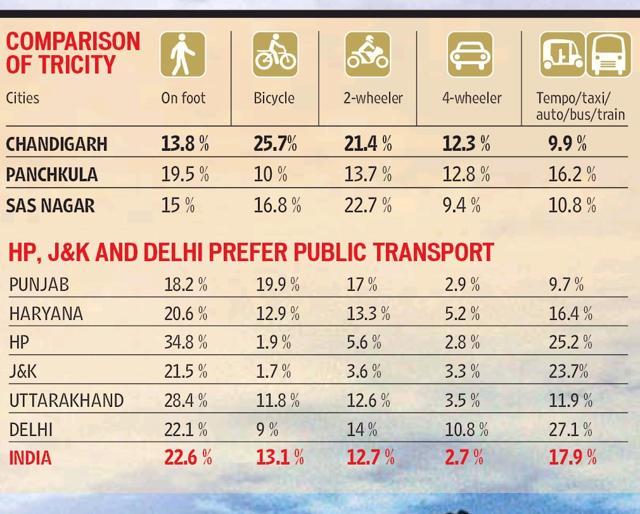
Over 25% workers in Chandigarh use bicycles, while two-wheelers and four-wheelers are being preferred by 21.4% and 12.3%, respectively. But public transport has not been popular. Buses are being preferred by only 6.7% workers and autorickshaw/taxi by close to 3%.
There are 13.7% workers who travel on foot to workplace. About 12% workers travel more than 10km from their homes to workplace.
Among women workers in Chandigarh, two-wheelers are the most preferred choice with over 19% using them, but as many travel on foot as well.
In Panchkula, over 27% are working from home, which is higher than Chandigarh and SAS Nagar.
The figure is 35% for women. Women workers travel more in four-wheelers (11.4%) than two-wheelers (9.9%).
In SAS Nagar, the use of two-wheelers as mode of transporation is highest in the tricity as 22.67% people use them.
Among women workers in SAS Nagar, over 40% are not travelling for work, which is more than Chandigarh and Panchkula, while over 15% are using two-wheelers and as many travelling by tempo/taxi/auto-rickshaw/bus. Public transport preferred in HP, J&K and Delhi.
Among north Indian states, Himachal Pradesh, Jammu and Kashmir and Delhi has high usage of public transport by workers, while Punjab has least use of four-wheelers to reach workplace.
In Himachal Pradesh, one out of every three workers are travelling on foot while over 24% are travelling by bus and is the most preferred mode of transport.
Maximum women workers are also travelling on foot (38.9 %) and 17.3% by bus.
In Jammu and Kashmir, maximum workers are taking buses (21.3%) and 21.4% go by foot. The figure for women working from home is 54.4%.
On the other hand, Uttarakhand has lesser use of public transport than HP and J&K as travelling by tempo/auto/taxi/bus/train is around 12%.
In Delhi, 27% use other modes of transportation such as buses, train, tempo, taxies and auto-rickshaw.