E-Paper



Bengaluru vs Hyderabad real estate: Growth-led stability or value-driven opportunity; where should homebuyers invest?
Real estate experts say Bengaluru shows stronger momentum, while Hyderabad offers better value and pricing flexibility for homebuyers in the market

 Prefer HTon Google


After Bengaluru Development Minister DK Shivakumar said Bengaluru is “setting a benchmark and it is not competing with Hyderabad or any other city,” the focus has shifted to a familiar question for buyers: Should you invest in Hyderabad or Bengaluru?

Real estate experts say that Bengaluru's tighter home inventory-to-sales ratio suggests stronger near-term momentum. Hyderabad's deeper inventory base provides greater selection and negotiation flexibility, with pricing positioned to attract diverse buyer segments, they said.
According to Prashant Thakur of ANAROCK Group, both cities have shown stable residential activity in the first nine months of FY26.
Bengaluru recorded 53,400 unit launches against sales of 47,200 units, indicating strong developer confidence and sustained demand. Available inventory stood at 64,900 units, reflecting relatively tighter supply conditions, Anarock data showed.
In contrast, Hyderabad saw 33,000 unit launches and higher sales of 34,800 units, suggesting that demand is actively absorbing existing stock. However, its inventory remains significantly higher at 96,100 units, giving buyers more options and pricing leverage.
“Bengaluru's launch velocity reflects developer confidence in sustained demand, while Hyderabad's sales exceeding launches indicate robust absorption, clearing existing available inventory. Both cities exhibit infrastructure-led growth patterns, with micro-market performance varying significantly based on connectivity improvements and pricing positioning across corridors.” Thakur said.
Also Read: MBA or home purchase? A 24-year-old Hyderabad professional asks if the dream house can wait
Where should you invest?
From an investment standpoint, real estate experts caution against blanket comparisons between the two markets. They say Bengaluru has fewer unsold homes and steady buying, suggesting prices are likely to remain stable and may rise, especially in areas with good infrastructure. On the other hand, Hyderabad has more homes available, giving homebuyers more choices and better chances to negotiate prices.
“Each city benefits from strong governance frameworks, infrastructure investment momentum, and demographic tailwinds. Investors need to evaluate micro market-specific fundamentals, developer track records, and regulatory environments rather than considering city-level generalisations about risk profiles,” Thakur said.
“Risk assessment depends significantly on investment horizon, target micro market, and portfolio diversification objectives. Each city benefits from strong governance frameworks, infrastructure investment momentum, and demographic tailwinds. Investors need to evaluate micro market-specific fundamentals, developer track records, and regulatory environments rather than considering city-level generalisations about risk profiles,” he said, pointing out that both markets benefit from infrastructure push, governance frameworks, and demographic demand.
Real estate experts noted that success in both residential markets depends on micro-market selection, project quality, and developer execution capabilities rather than city-level dynamics.
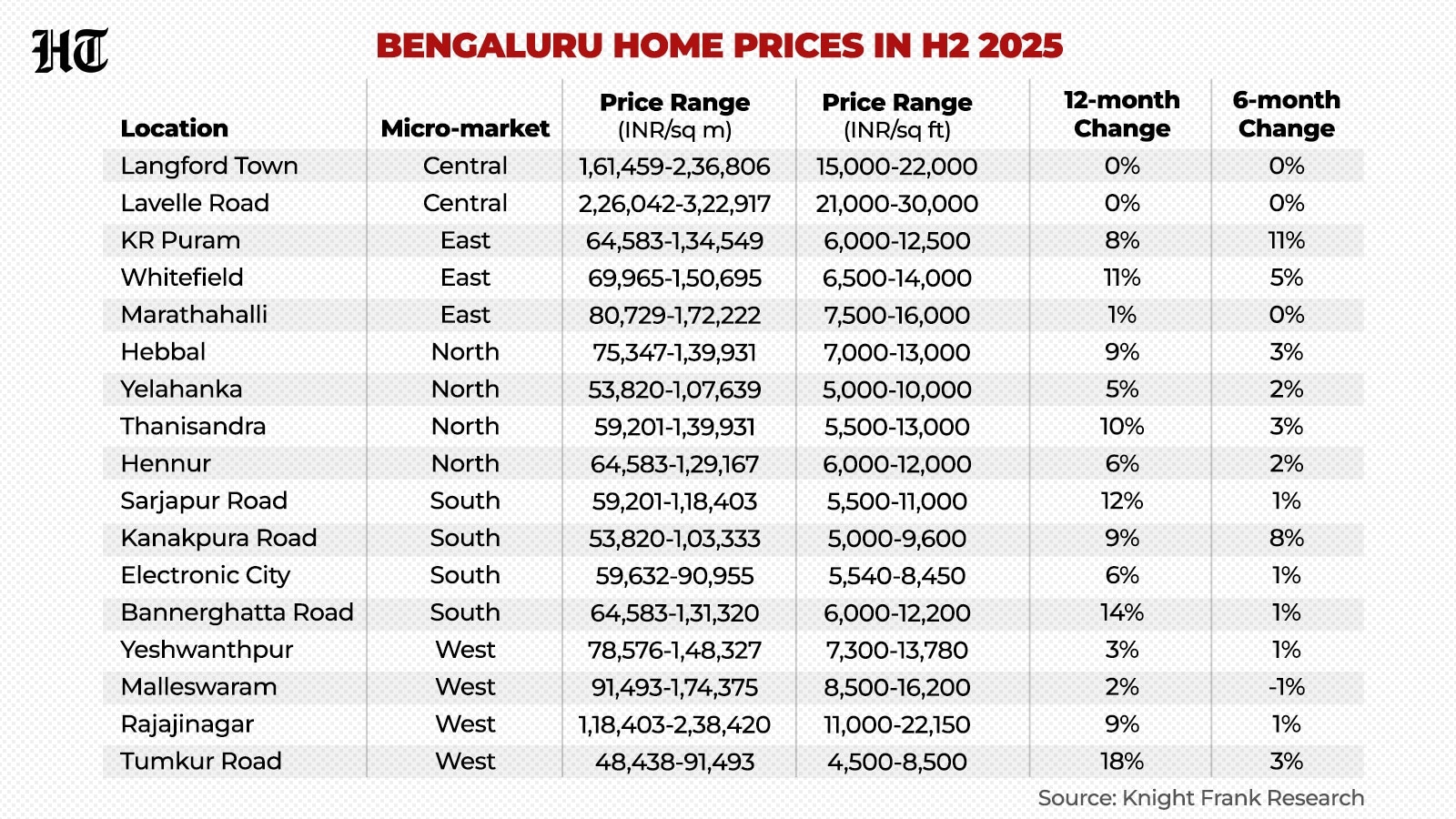
Home prices in Bengaluru
In Bengaluru’s residential market, Lavelle Road continues to command premium home prices of ₹21,000–30,000 per sq ft, with no year-on-year growth in the last six months of 2025. In contrast, the eastern IT-driven hubs like Whitefield recorded prices between ₹6,500–14,000 per sq ft, registering an 11% YoY increase, while Marathahalli, at ₹7,500–16,000 per sq ft, has seen a 1% rise, according to data from Knight Frank India.
North Bengaluru markets like Hebbal have recorded prices of ₹7,000–13,000 per sq ft with a 9 per cent YoY increase, while Yelahanka, at ₹5,000–10,000 per sq ft, has grown 5 per cent annually. Hennur follows a similar pattern, with prices at ₹6,000–12,000 per sq ft and a 6 per cent YoY uptick, the data showed.
Meanwhile, southern corridors are emerging as some of the strongest-performing markets in the city. Sarjapur Road has seen prices rise to ₹5,500–11,000 per sq ft, reflecting a 12 per cent YoY growth, while Electronic City remains relatively affordable at ₹5,540–8,450 per sq ft, posting a 6 per cent increase, it showed.
Also Read: Bengaluru vs Hyderabad: Where should techies buy their first home? Netizens weigh in
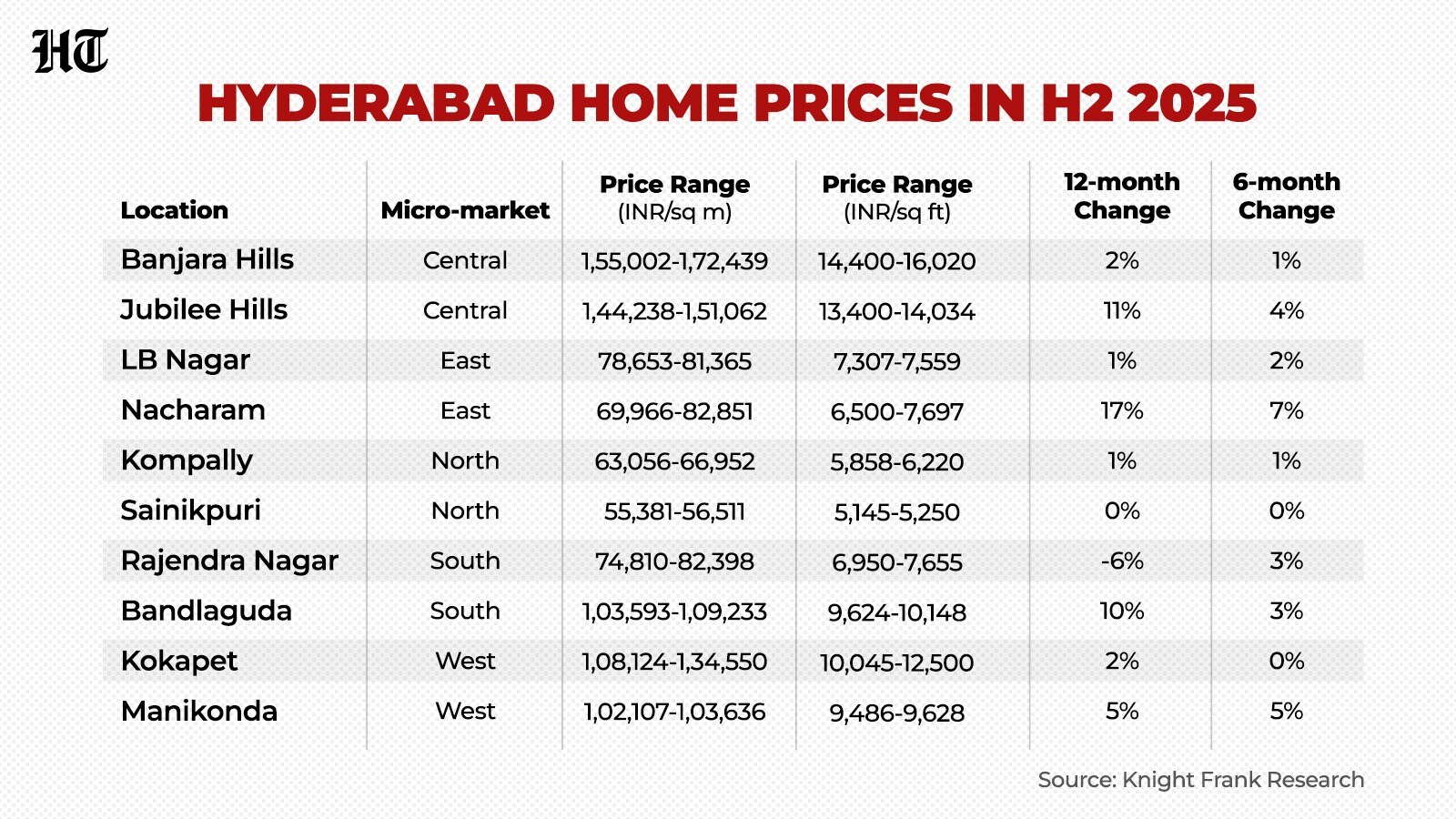
Home prices in Hyderabad
In Hyderabad’s residential market, Knight Frank data showed that Banjara Hills remains among the most expensive micro-markets, with prices ranging between ₹14,400–16,020 per sq ft, recording a 2 per cent year-on-year growth, whereas Jubilee Hills has seen stronger traction at ₹13,400–14,034 per sq ft, with an 11 per cent YoY increase. In the eastern belt, LB Nagar recorded prices of ₹7,307–7,559 per sq ft, with just a 1 per cent YoY rise, while Nacharam stands out with a sharp 17 per cent YoY growth, at prices of ₹6,500–7,697 per sq ft, making it one of the fastest-growing pockets in the city.
Northern suburbs such as Kompally ( ₹5,858–6,220 per sq ft) and Sainikpuri ( ₹5,145–5,250 per sq ft) have remained largely stable, registering 1 per cent and 0 per cent annual growth, respectively. In the south, Rajendra Nagar recorded prices of ₹6,950–7,655 per sq ft, declining by 6 per cent YoY. Western micro-markets, driven by proximity to IT hubs, continued to show stable price growth, with Kokapet commanding ₹10,045–12,500 per sq ft, up 2 per cent, while Manikonda, at ₹9,486–9,628 per sq ft, has recorded a 5 per cent YoY growth, the data showed.