
 E-Paper



REITs in India: A closer look at the evolving investment landscape
From office parks to shopping centres, listed REITs are changing how Indian investors access income-generating property - without buying a single square foot.

 Prefer HTon Google


For generations, owning real estate in India meant buying a flat, a plot or a commercial property and waiting for its value to rise. It also meant a large upfront investment, paperwork, maintenance and, often, years of waiting before the asset generated meaningful income.
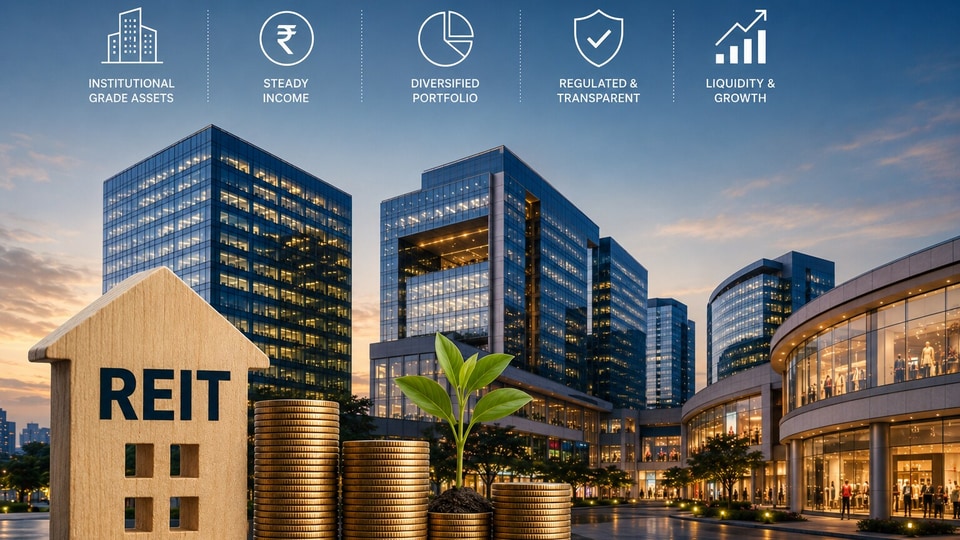
Real Estate Investment Trusts, or REITs, are changing that equation.
The concept is simple: instead of buying an entire property, investors buy units of a trust that owns and operates income-generating real estate. The portfolio can include office parks, shopping centres and other commercial assets. Investors participate in the income generated by these properties without having to become landlords themselves.
And in 2026, India's REIT market is entering a more interesting phase.
There are now six listed REITs in India—Embassy Office Parks REIT, Mindspace Business Parks REIT, Brookfield India Real Estate Trust, Nexus Select Trust, Knowledge Realty Trust and Bagmane Prime Office REIT. Together, they represent a growing listed avenue for investors seeking exposure to professionally managed commercial real estate across India's major markets.
The attraction is not merely access to property. It is the cash flow.
Under the Securities and Exchange Board of India's REIT framework, REITs are required to distribute at least 90% of their net distributable cash flows to unitholders. In effect, a substantial portion of the cash generated by the underlying properties is returned to investors, subject to the applicable distribution framework. Securities and Exchange Board of India
That creates a distinctly different proposition from buying a residential property purely for appreciation. A REIT investor is essentially buying a stake in a professionally managed portfolio of income-producing assets.
The evolution of the market is equally important. India's first listed REITs were largely built around large office portfolios. The arrival of Nexus Select broadened the proposition into organised retail, while subsequent entrants have expanded the range of assets available to public-market investors.
This matters because India's real-estate economy itself is changing.
Office demand is increasingly linked to the country's services economy, global capability centres and technology businesses. Retail assets, meanwhile, offer exposure to consumption and the formalisation of shopping. The result is an asset class that sits somewhere between traditional real estate and listed securities.
For investors, that diversification can be meaningful. Instead of committing a large amount of capital to a single property, investors can gain exposure to a portfolio of assets through a listed security. Professional managers oversee leasing, operations, asset management and capital allocation, while investors can buy or sell units through the market.
But REITs are not fixed deposits in disguise.
Distributions can vary, property values can move, interest rates can affect financing costs and unit prices can fluctuate on the stock exchange. Investors also need to examine occupancy, tenant concentration, lease expiries, debt levels and the quality of the underlying assets before investing.
The tax treatment of distributions can also vary depending on the nature of the income and the investor's circumstances, making it important to look beyond the headline payout.
Still, the bigger shift is unmistakable.
Real estate is becoming less about owning a building outright and more about owning a slice of the cash flows generated by one.
For India's retail investor, that may be the most important REIT story of 2026: you no longer need to own the property to participate in its economics.
Note to the reader: This article has been produced on behalf of the brand by HT Brand Studio and does not have journalistic/editorial involvement of Hindustan Times.


