E-Paper



In 1991, eight people entered Arizona’s Biosphere 2; 16 months later, oxygen fell from 21% to a dangerous 14%
A sealed glass world lost about a third of its oxygen in 16 months. Scientists traced it to soil microbes and concrete.

 Prefer HTon Google


Eight people entered the facility called Biosphere 2 on September 26, 1991, after sealing up the 3.15-acre glass-enclosed facility in southern Arizona from the outside world. The facility had been built to study entire ecosystems and investigate how life support could be provided in space. But then the air changed inside Biosphere 2, and solving the mystery required a closer investigation.
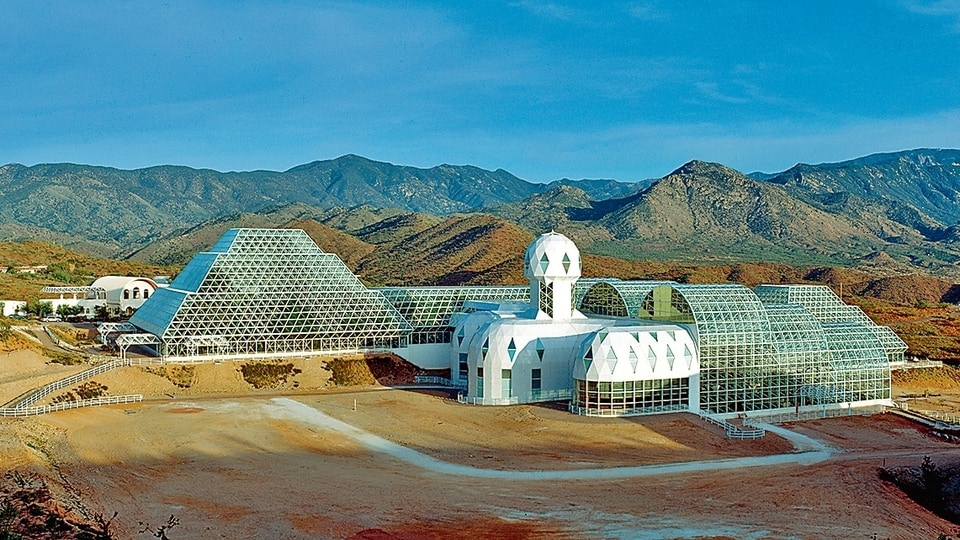
The clearest account came out in a 1994 paper titled Oxygen Loss in Biosphere 2, published in EOS, Transactions American Geophysical Union by Jeffrey P. Severinghaus, Wallace S. Broecker, William F. Dempster, Taber MacCallum and Martin Wahlen. The study reported that oxygen in Biosphere 2 had fallen from the ambient 21% to 14% during the first 16 months of closure, enough to cause health problems for the human occupants.
Soil seemed like an obvious cause at first. The soil mixture included 70% clay loam, 15% compost, and 15% peat, providing organic material for microbes to process while consuming oxygen and releasing carbon dioxide. Oxygen might have been restored by plants through photosynthesis, but only about 45% of the sunlight outside the facility reached the interior. Even then, something did not seem right. Microbial respiration produces roughly one molecule of carbon dioxide for every molecule of oxygen consumed, so the two gases should have changed by roughly corresponding amounts. Yet the carbon dioxide level in the air increased by less than 0.5%. A chemical scrubber had also removed carbon dioxide, equivalent to about another 1.5% of atmospheric concentration, bringing the total apparent increase to about 2%. That was still much smaller than the roughly 8% oxygen decrease discussed in the source material, so respiration alone could not explain the numbers.
Where did the carbon dioxide go?
Focus shifted onto the building itself. Calcium carbonate forms when carbon dioxide reacts with calcium hydroxide in concrete, a chemical process known as carbonation. To see whether this was happening, researchers took 12 concrete samples from inside the building and four from exterior walls poured at the same time as the interior walls. The carbonation depth inside was about 10 times greater than outside, consistent with the much higher carbon dioxide concentration inside.
Based on these core samples, the authors estimated that the concrete had absorbed around 750 kilomoles of carbon dioxide, plus or minus 250. A kilomole is a unit used in chemistry to measure an amount of a substance. The estimate had a wide margin of uncertainty, but even its lower end was enough to account for a substantial portion of the carbon dioxide expected from the oxygen loss. There were other indications, too. Isotope analysis of recently grown plant material suggested an additional carbon sink, while the isotopic makeup of carbon in the concrete was consistent with the same source. Oxygen also decreased more quickly during winter, when carbon dioxide levels were higher. Taken together, the evidence supported the conclusion that respiration was outpacing photosynthesis by about two to one, while carbonation of the concrete helped remove the resulting carbon dioxide from the air.
Why a good seal was needed
Another paper written by Dempster in 2008, in the journal Advances in Space Research, helps explain why the tight seal around Biosphere 2 was so important. Outside air can obscure small changes in the atmosphere of a system that is leaking. The air renewal rate of Biosphere 2 was less than 10% per year, while oxygen declined by an average of about 140 parts per million per day during the first 16 months. Computer simulations showed that a leak rate of just 1% per day could have hidden the oxygen decline.
Achieving that required careful engineering. Laminated glass panes sat above a welded stainless steel liner below ground, while two expansion chambers nicknamed "lungs" helped keep the pressure difference between the inside and outside within a narrow range. Two separate leak tests were used: one measured how quickly the lungs deflated, while the other tracked how quickly trace gases became diluted. Both methods confirmed that atmospheric leakage was less than 10% per year. Dempster's work also showed why such a tightly closed system was valuable: it allowed slow changes in oxygen and carbon dioxide to accumulate rather than being quickly masked by outside air.
The oxygen had been consumed by microbial respiration in the soil, while much of the resulting carbon dioxide was taken up by the concrete through carbonation. That helped explain why the oxygen decline was much larger than the apparent rise in atmospheric carbon dioxide. In a sealed ecosystem, even the building itself could become part of the experiment.