E-Paper



In 2003, a Spanish vineyard began using ground cover; 20 years later, its soil had more than twice the organic matter of tilled land
A 20-year comparison in central Spain found that soil under wild ground cover held more than twice the organic matter of nearby tilled vineyard soil.

 Prefer HTon Google


An unusual way of managing a vineyard has been used in a semi-arid region of Spain for more than 20 years, and the soil differences are now visible. The findings of this study, published in Frontiers in Soil Science in March 2026, compared two neighboring vineyards near Mota del Cuervo in Castilla-La Mancha, Spain. Led by Juan Emilio Herranz-Luque, the study examined differences in soil organic matter, vegetation cover, and other soil properties between the vineyards. Soil under spontaneous vegetation cover had more than twice as much organic matter as soil under tillage.
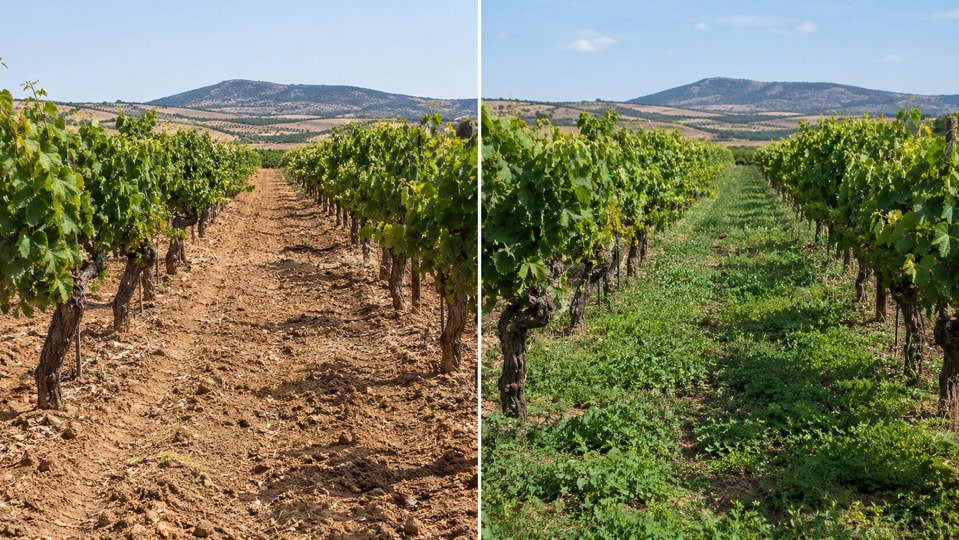
Both vineyards are planted with Airén vines that are about 70 to 80 years old. The farmer reported that the first vineyard had not been irrigated or treated with pesticides, including fungicides and herbicides, for more than 20 years. Weeds were allowed to grow in the spaces between the vines. The study describes the cover-cropped vineyard as having minimal soil disturbance, although the farmer may plow the entire vineyard during prolonged or severe drought to conserve water and reduce stress on the vines.
Greater soil organic matter at both depths
The difference was present at both depths. In the upper 10 centimeters, organic matter content was 1.74% under ground cover and 0.83% under tillage, a 109% higher value. At 10 to 30 centimeters, it was 1.35% and 0.69%, respectively, which was 96% higher. The authors noted that the large increase in the deeper layer was surprising because previous research has generally found greater soil enrichment closer to the surface.
Also Read | Heat is on as German winegrowers struggle to protect vines
A 2023 meta-analysis by Rachel Wooliver and Sindhu Jagadamma, published in Agriculture, Ecosystems & Environment, examined 49 studies of cover cropping and soil organic carbon. It found that cover crops increased particulate organic carbon by about 15% and mineral-associated organic carbon by about 6% on average. The increase in particulate organic carbon was greater in the upper 10 centimeters than at 10 to 30 centimeters, while the researchers noted that more research was needed to understand carbon responses at greater depths.
Vegetation between the vines averaged 4.71 metric tons of biomass per hectare, compared with 0.29 metric tons in the tilled plot, and covered about 54% of the ground surface versus roughly 1%. In a statistical model, root and above-ground growth, together with ground cover, explained about two-thirds of the variation in soil organic matter. Underground, microbial activity also differed between the plots. β-glucosidase activity, an enzyme involved in breaking down plant material, nearly doubled in the topsoil, while dehydrogenase activity, a general indicator of microbial activity, was also significantly higher. Even so, β-glucosidase activity in both vineyard plots was below the range typically reported for Mediterranean arable soils, which the study cites as 5 to 35 mU/g in topsoil. The researchers interpreted the lower activity in both treatments as evidence of a lasting effect of agricultural land use on soil biological functioning, despite the differences associated with ground cover.
The deeper soil layer also showed differences. Between 10 and 30 centimeters, porosity was 51.2% under ground cover and 44.0% under tillage. Available water was 29.6% under ground cover compared with 25.1% under tillage, an increase of about 18%, although the difference was not statistically significant. The researchers considered the higher water availability potentially important for vineyards in a drought-prone region.
What the study can and cannot prove
Available phosphorus also tended to be higher under ground cover, at 19.13 milligrams per kilogram compared with 14.13 milligrams per kilogram under tillage, although the difference was not statistically significant. The researchers described the vineyard soils as calcareous and strongly basic, with a mean pH of 8.6. Under these conditions, phosphorus availability can be limited because it can precipitate with calcium and become sorbed onto calcium- and iron-rich mineral surfaces, making it less available for plant uptake. Higher soil organic matter was associated with greater phosphorus availability, but the data did not confirm the specific mechanism behind this relationship. The results for nitrogen were less clear.
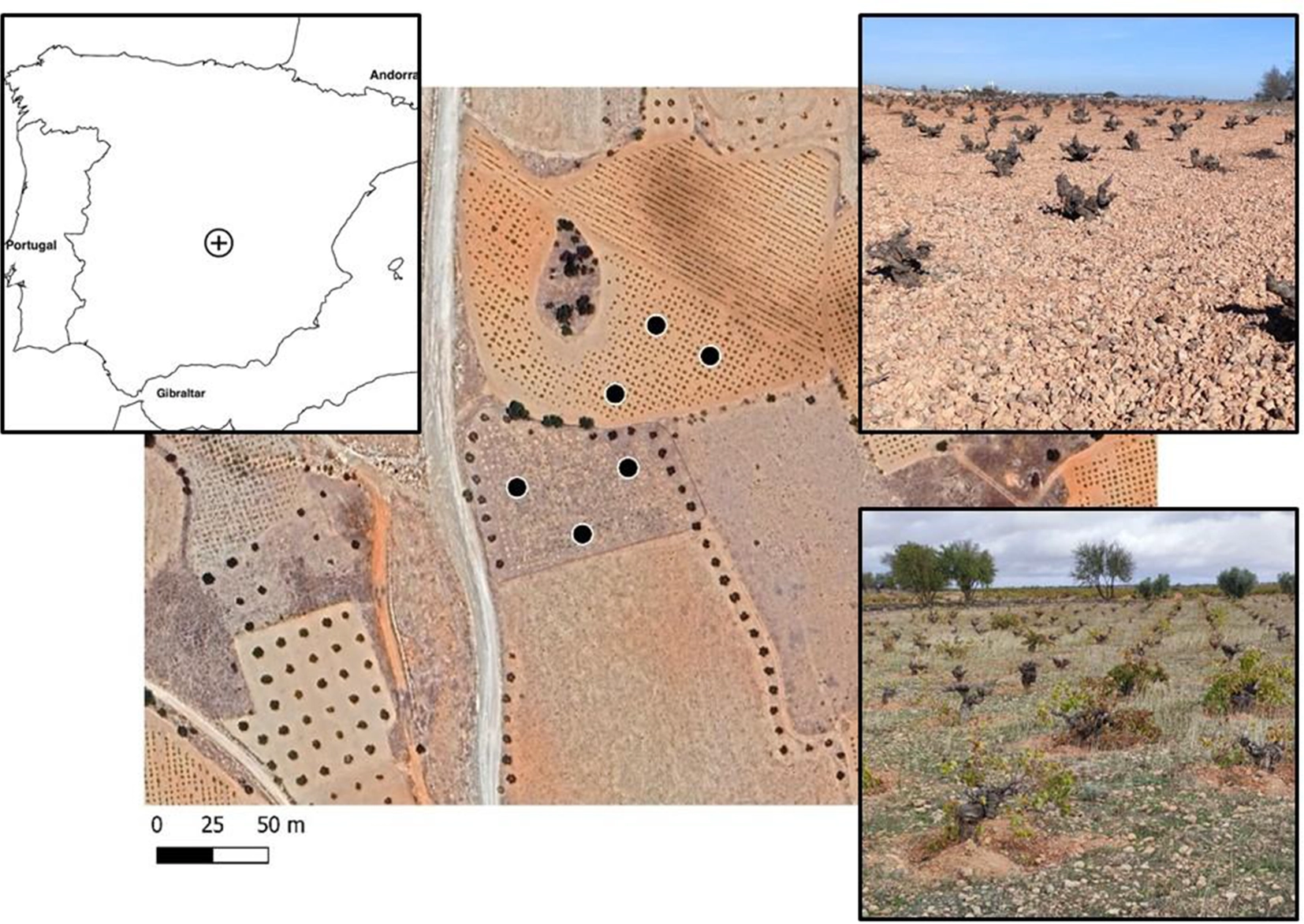
The study design also has limitations. The team randomly collected three soil samples from each of two adjacent vineyards, sampling the 0 to 10 centimeter and 10 to 30 centimeter soil layers. Because the researchers compared existing vineyard management practices rather than assigning treatments experimentally, the study cannot establish that ground cover alone caused the observed differences in soil properties. The cover-cropped plot was not completely free of tillage: the farmer may plow the entire vineyard during prolonged or severe drought to conserve water and reduce stress on the vines. The study also did not report grape yields, so it could not assess whether the differences in soil properties were accompanied by changes in vine productivity.
Many winegrowers in semi-arid areas are concerned that vegetation growing between the vines could compete with the vines for water, particularly in young vineyards. The researchers also noted that a lack of knowledge and experience in managing cover crops has hindered their adoption in rain-fed vineyards. The authors argue that vineyard management should retain some flexibility because extreme weather conditions, such as drought and heat waves, can require adjustments to reduce water stress on vines.