
 E-Paper



The blinders are on: No break for Sujeet Kalkal as he targets Worlds title
Training in Sonipat, the new star of Indian wrestling says he doesn't want to get distracted

 Prefer HTon Google


Sujeet Kalkal emerged as one of the faces of India’s Asian Games campaign with his gold medal-winning effort in the 65kg weight class. The 23-year-old wrestler showcased his attacking skills and fighting spirit as he overturned a seven-point deficit to beat Tajikistan’s Abdulmazhid Kudiev in a dramatic final.
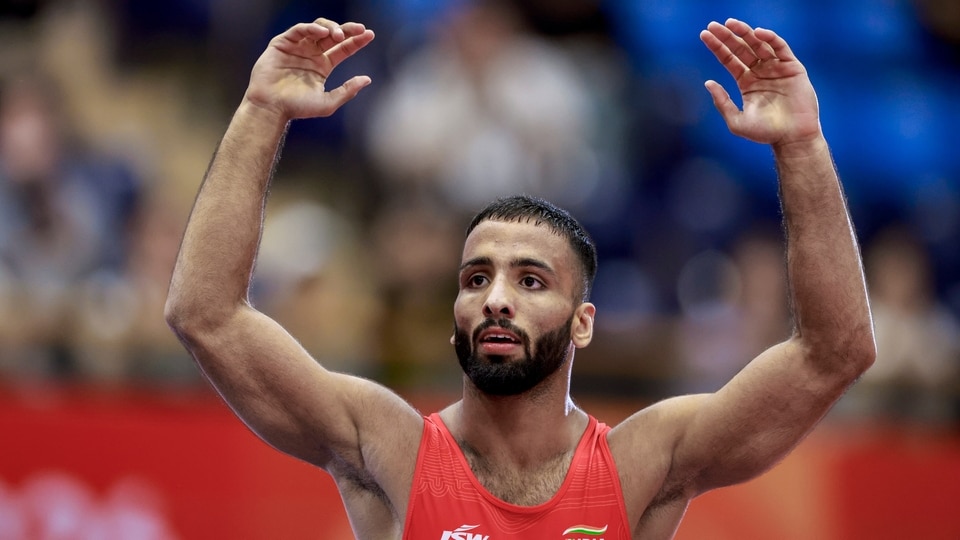
But there is no break for Sujeet as the World Championships begin in Astana on October 24. He does not want to get distracted. Sujeet has not been to his home in Charkhi Dadri. Instead, he is preparing for the Worlds at his base in Sonipat, where he trains under coach Kuldeep Singh.
“My next target is the World Championships, and I want to win gold there. It is going to be a tough competition. Whether it’s the Asian Games or the Olympics, the World Championships are still tough. Of course, the final aim is to win at the Olympics. It’s the dream of every player,” said Sujeet.
“After coming to the Games, there is a little distraction as I am attending a programme today. But I will still try not to be distracted and keep my focus on the preparation,” said Sujeet from Sonipat during an interaction facilitated by SAI.
Going by Sujeet’s display in Aichi-Nagoya, he will be among the favourites for the title. Having beaten the likes of Paris Olympics champion Kiyooka Kiyoto of Japan, Iran’s Abbas Ebrahimzadehsavadkouhi and Kudiev in the final, Sujeet will be one of the biggest threats in his weight class. Reigning world champion Rahman Amouzadkhali of Iran was absent in Japan, but Sujeet had pushed him hard at the previous Worlds before losing a close bout.
In Japan, Sujeet’s attacking intent was striking. Coach Shako Bentinidis had urged Sujeet to attack more, and the change paid dividends.
“Shako coach told me that I should attack more. We had a competition in Russia a few days ago where I came first but coach was not happy. He said that I don’t attack as much as I can. I worked on it. So in the Asian Games I was attacking and scoring in every bout.”
“In the final bout against Kudiev, I could not control myself in the first period. I could not warm up properly. When the second period started, I was able to control my pace. I was scoring a lot. All my attacks were successful and this motivated me. By the end, I was able to cover all the points.
“I just wanted to fight till my last breath.”
Sujeet now wants to improve his attacks from the ground.
His father, Dayanand Kalkal, a former international Greco-Roman wrestler and coach, laid the foundation for his career. “I used to play various sports to build my base. Speed, agility and flexibility are the basics of wrestling. My father made me work on these things since childhood. I used to play football and gymnastics. It helped me in wrestling.”
“My father also told me that if I am educated, my brain will work better. Studies are very important. These are general life skills that will make you better in every sphere. Even today he comes up and teaches me something good every day,” says Sujeet, who at one point was also preparing for engineering entrance exams.
Training and competitions in Russia and Armenia also proved valuable. “There are medalists of the World Championship and Olympic Games. We trained with them and got to learn a lot. The competition in Russia was a very good experience. The help from TOPS and our federation (WFI) in giving exposure tours at the right time has contributed to the success.”
One technique that stood out was the shoulder throw (or Dhobi Pachad), which Sujeet had worked on with Shako.
"I was interested in using it. But I could never do it in matches. Shako Coach corrected me a little bit and made me practise. So I was able to use it. It takes time to learn a technique and keep training before you can use it in competition.”
For the moment, Sujeet is relishing the homemade food sent by his mother, though he is still away from home.
“My mother keeps sending me churma and kheer and I love it. That’s what I missed the most in Japan. I miss it here too, because I am still away from my mother.”


