
 E-Paper



The Mika Haikkinen interview: 'Biggest challenge in F1 is that you have to beat your teammate'
In a free-wheeling chat at the HT office in Mumbai, the two-time champ held court on all things F1.

 Prefer HTon Google


The current Formula 1 season is six races from its conclusion, and Kimi Antonelli looks poised to win his first World Championship.
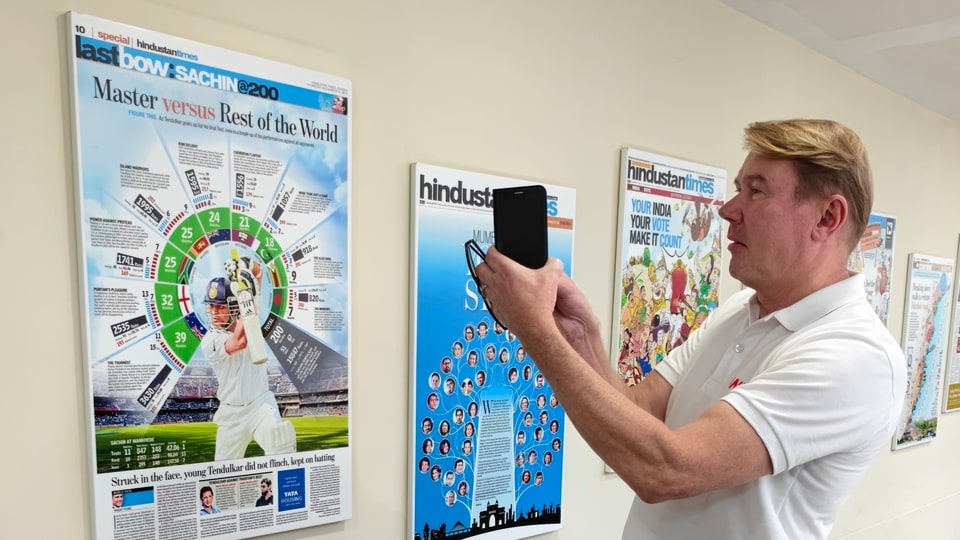
Mika Hakkinen knows what it takes to win the coveted title in the most popular motorsport competition in the world. The two-time F1 champion, who was in Mumbai with Fancode, the official broadcasters of F1 in India, met with Hindustan Times on Saturday.
In a free-wheeling chat, he recounted his early days in the sport, relived one of F1’s most iconic rivalries with Michael Schumacher, and backed India’s return as a Grand Prix host.
Excerpts from the interaction:
It has been 25 years since you retired. Is the sport in a better, safer space now?
It has improved massively in all areas and safety is a very important factor. I had experienced quite a serious accident in 1995 when I lost control and I cracked my skull. I was in a coma for a couple of months in the hospital and came back to racing. Safety wasn't as good then, but Formula 1 learned along the way.
Your crash in 1995 happened just a year after Ayrton Senna’s fatal accident. What effect did it have on the F1 fraternity?
It was horrible. Many lives were lost in Formula 1 because the cars weren't safe enough, the tracks weren't safe enough. If something goes wrong, it's not always the driver making some kind of mistake. It can be some kind of technical issue that causes you to go off the track. If you go back in history, for many years the cars didn't even have seatbelts.
At the time when I had my accident, it was really hard to even think about it coming back. It took me a couple months. One day I was standing on my balcony in Monaco and thinking about it. “What, Mika, is this it? Are you gonna just sit in your sofa in Monaco and start watching Coronation Street every day?”
I thought, no way I'm gonna do that. I started when I was six-years-old, and I'd gone a really long way. I was 25 when the accident happened. I felt like I was at the peak of my physical performance. What I had learned from Formula 1, I thought there was no way I could stop now. So I went back.
Then actually the McLaren team gave me a call and asked if I was ready to drive a test car. I said absolutely.
The engine sounds were absolutely amazing. Going out of the pits, going through the pit lane, and listening to the sound of the engine was absolutely beautiful.
But in high-speed corners, I did think I could go off in that corner, and it’s going to hurt. But then I just thought, “Mika, you cannot think about that, you just have to switch off, you have to focus on what you do.”
And then suddenly the lap times started getting better and better. It was quite tough but I tried to turn that into something positive. And did it make me a better racing driver? I think so.
When you came back, you started winning, which earned you fans but also some animosity because you were challenging Michael Schumacher. How did that rivalry shape the two of you?
Michael was an incredible racing driver. Very hardworking and an incredible team player. But sometimes he was a bit of a naughty boy. When we were racing together, he was challenging me very often in quite a hard way – which I didn’t always agree with. But it was his way of racing.
We're all different characters and we all operate differently. In one sense I accepted his way of working, but we had some tough challenges and very good races together. And we had a huge respect for each other.
Talking about the current generation, there is this young driver, Kimi Antonelli, who is topping the charts. What do you make of his racing style?
He's doing a brilliant job. Absolutely fantastic performance. He's a great personality, very positive character and everybody likes him. He’s a very fast, talented young driver.
I think he's in the right place at the right time. There's a huge amount of great talent out there below Formula 1 and in Formula 1, but if you are not early enough to be able to find the way to end up in the right place, it can destroy your career.
Kimi is an absolutely beautiful talent. I'm happy also for Italians, because in my childhood, I saw so many great Italian young drivers, but they never did make it. So I'm very happy for Italy.
Occasionally, he does have a few lapses of concentration, and some believe this is not something that would happen with the greats of the past. Is it just his speed or youth? What do you put it down to?
This is normal. He's leading the World Championship in a very comfortable way. The pressure is there, you cannot start thinking the job is done. But you start getting tired, and this is something that, when you don't have all the experience yet, it's difficult to balance how much energy you use in different things. You can start losing energy and make little mistakes. But this is normal.
He is developing, becoming a better racing driver, but there aren't many more races left. So it's interesting to see how he continues to keep his focus.
Lewis Hamilton’s move to Ferrari has been one of F1’s biggest storylines. At this stage of his career, how challenging do you think it has been for him to adapt to a new team and car?
I started my Formula 1 career with Team Lotus, where I spent two years, before moving to McLaren for the rest of my career. At McLaren, everything was tailor-made for me, right down to the size and shape of the steering wheel and the placement of every button. When you move to a new team, you have to familiarise yourself with completely different systems and designs. At 300 kmph, you cannot afford to look down and figure out which button to press.
I think Lewis has done a brilliant job, particularly in maintaining his motivation and inspiring the team. He thoroughly deserves his world championships, and I am confident he will continue to deliver strong results.
Your rivalry with Schumacher was well documented. But how does it work with teammates?
The biggest challenge in Formula 1 is that you first have to beat your teammate. If your teammate is faster than you, it is game over. So, in a way, your teammate is your biggest rival, even though you are both driving for the same team.
David Coulthard and I were teammates at McLaren for seven years, and in the beginning, it was quite challenging. I remember when we travelled from Monaco to England for team meetings. I would take my limousine to the airport, David would take his. He would fly in his plane, I would fly in mine. We would land, take separate cars to the factory and eventually sit across from each other in the same meeting. We barely spoke. Neither of us wanted to reveal our strengths or weaknesses.
But then McLaren’s management realised this was not good. The team was starting to split, with one side supporting David and the other supporting me. So they told us that we had to start working together. They said, ‘When you put your helmet on, that is when you can fight. But in meetings and in front of the media, you have to communicate and work together.’ And it worked. Today, David and I are very good friends.
Looking back, we were two young drivers with big egos, both determined to succeed. That competitiveness was always there, but we eventually learned how to manage it.
Formula 1 cars have evolved significantly since your racing days. Do you think driving in your era demanded more raw skill compared to today?
I think the drivers in my time were much better (Laughs). No, of course, today’s drivers are better. It is a natural part of human development. They have access to far more knowledge and can start learning about Formula 1 from a very young age.
Young drivers can ask questions about how a suspension system works and study almost every aspect of racing. In my time, we didn’t have those opportunities. You had to walk to a library and hope you could find a book about motorsport.


