
 E-Paper



Aryna Sabalenka lost more than the US Open final to Elena Rybakina: The 72-hour nightmare that changed everything
Sabalenka’s 72-hour nightmare ended with a defiant message as Rybakina took her No. 1 ranking and US Open crown.

 Prefer HTon Google


On Wednesday evening, Aryna Sabalenka watched from the practice arena as Elena Rybakina ended her 99-week reign as the WTA world No. 1. Rybakina sealed the top ranking by beating the resurgent Qinwen Zheng to reach her first US Open semi-final.
Sabalenka, already through to the last four, paused during her training and looked over towards the proceedings at Arthur Ashe Stadium, perhaps on a television. Her disappointed expression lasted a moment before she turned back to her practice.
The threat to the world No. 1 ranking had been looming for some time. Rybakina’s ascent had been building since last season, when she ended 2025 by beating Sabalenka in the WTA Finals Riyadh championship match. Weeks later, she came back from 3-0 down in the deciding set to beat Sabalenka again and win the Australian Open.
Deep Dive

Heading to New York, the 27-year-old reached the Montreal final, putting herself back in contention for the top ranking. But a left ankle and heel tendon injury in Cincinnati then cast doubt over her US Open participation. She withdrew from the quarter-finals in Ohio after aggravating what she described as a “chronic foot injury”.
Rybakina did not confirm her US Open participation until the last minute. But once she arrived in New York, there was no looking back.
She did not drop a set in the opening week, and her crushing win over Naomi Osaka in the round of 16 turned heads. Rybakina fired seven aces and won 87% of the points behind her first serve.
Sabalenka was watching it all.
When the media asked her about the ranking scenario amid Rybakina’s surge, Sabalenka insisted she had distanced herself from those thoughts.
“I completely separate myself from that, because it’s just guessing. It’s like if, if, if, if. I’m just trying to bring my best tennis every time I’m competing out there and basically fight for it,” she said after reaching the quarter-finals.
When Rybakina officially took the top spot, Sabalenka offered a more defiant response.
“I don’t care!”
She added that she would rather take home the US Open crown than the world No. 1 ranking.
Rybakina’s surge continued. Former US Open champion Coco Gauff was no match for the reigning Australian Open winner in the semi-finals, losing in three sets after taking the opening set.
Then it was Sabalenka’s turn.
The Belarusian was the favourite in the final. She had not lost at Arthur Ashe Stadium in two years and had the chance to become only the third woman in history to win the US Open three consecutive times.
Yet the night belonged to Rybakina.
Her 6-4, 5-7, 6-2 victory in 2 hours and 21 minutes on Arthur Ashe Stadium came despite Sabalenka pushing her to three sets. Playing in her first US Open final, Rybakina broke to move ahead 3-2 in the opening set despite landing only 27% of her first serves, making up for it with her powerful groundstrokes.
Her first-serve percentage improved to 61% in the second set, but she could not convert either of her two break points. She then saved two set points to hold for 5-5, only for Sabalenka to break two games later and level the match.
Rybakina regained control in the decider, breaking for 2-1 and then again at 5-2 with a volley winner. A few points later, she sealed the title with her 12th ace, mirroring the way she had converted match point at the Australian Open eight months earlier.
Rybakina surged to the pinnacle of women’s tennis after producing her best Grand Slam season yet. She became the first woman to beat the world No. 1 in a Grand Slam final twice in the same year since Steffi Graf in 1995, when Graf defeated Arantxa Sánchez-Vicario in the French Open final and Monica Seles in the US Open final.
When the WTA releases its updated rankings on Monday, Rybakina will officially become the 30th woman to reach the world No. 1 ranking in the Open Era.
As for Sabalenka, in the space of 72 hours, she lost it all.
First, the world No. 1 ranking. Then the US Open title.
She was left without a Grand Slam title in 2026 — the first time since 2022 that she has failed to win a major in a calendar year.
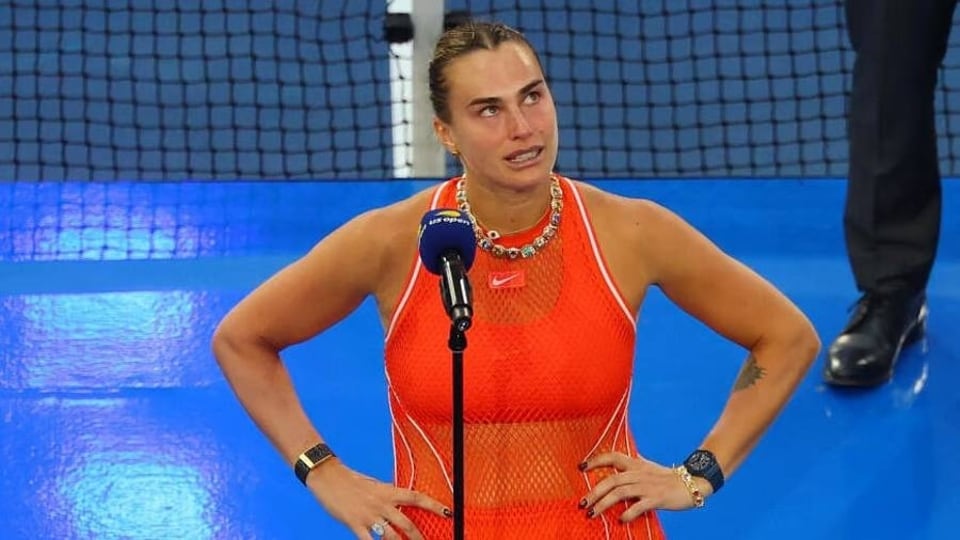
Despite the meltdown on the court after the loss, Sabalenka left New York on a more defiant note, already setting her sights on reclaiming the world No. 1 ranking.
"I don't even know how many weeks I was able to be there, but it was amazing. Let's see if Elena can beat me in that. If she continues playing like that, I'm in trouble"


